Les Bastions de la Nation
| Capitale | Le Pic |
|---|---|
| Government | Oligarchie |
| Souverain | Arbitre du Conseil de Fer, Torlan Morinnanon |
| Population | 700,000 |
| Races | 65% Nains 12% Humains 10% Orcs 08% Gnomes 05% Autres |
| Religions | Légion Souveraine Le Narquois Dragon d'En-dessous |
| Exportation | Banque, Métaux précieux et non précieux |
| Reconnue pour | Ha11marks: Banking, Nains, metalwork, mining (precious and non-precious metals) |
| Fondateur | Wroann, cinquième descendant du roi Jarot |
| Devise nationale | “On gagne ce que l'on donne” |
| Climat | Tempéré au nord, tropical au sud |
L'or est le don des montagnes, mais le fer vient du sang et des os.Proverbe Morinn
Ça prends une enclume pour forger une hacheAutre proverbe Morinn
Tol kollan! Certains disent que nos ancêtres sont venus d'un endroit de glace, mais nous savons tous que c'est des conneries. Nos ancêtres ce sont les montagnes elles-mêmes. Les dragons étaient jaloux de leur stature puissante, alors ils ont lancé un sort qui les ont tous endormis, et c'est de là que viennent les montagnes. Et nous les nains? Nous sommes la sueur de leur front.
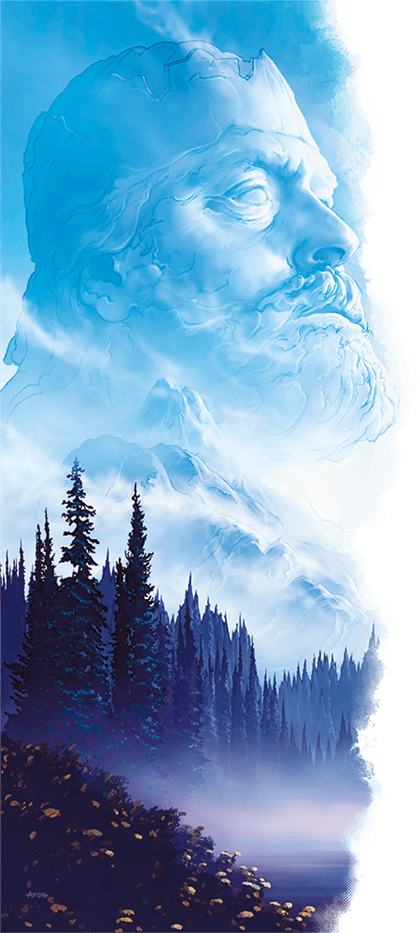
Vous ne me croyez pas? Allez jeter un œil à la Face de Morinn! Personne ne pourrait sculpter quelque chose comme ça, mon ami, c'est le visage originel de la montagne. Quant aux autres, eh bien, ils se sont juste endormis face contre terre. C'est l'histoire que j'ai eue de mon père, êtes vous en train de le traiter de menteur?!
Les Bastions de la Nation sont reconnus comme la patrie des Nains. Non seulement les Bastions sont l'une des rares terres naines de Khorvaire, mais on estime que pas moins de 455 000 Nains y vivent ; beaucoup plus que tout autre endroit connu. Cependant, les Nains ne sont pas les seuls habitants de cette région montagneuse.
Géographie
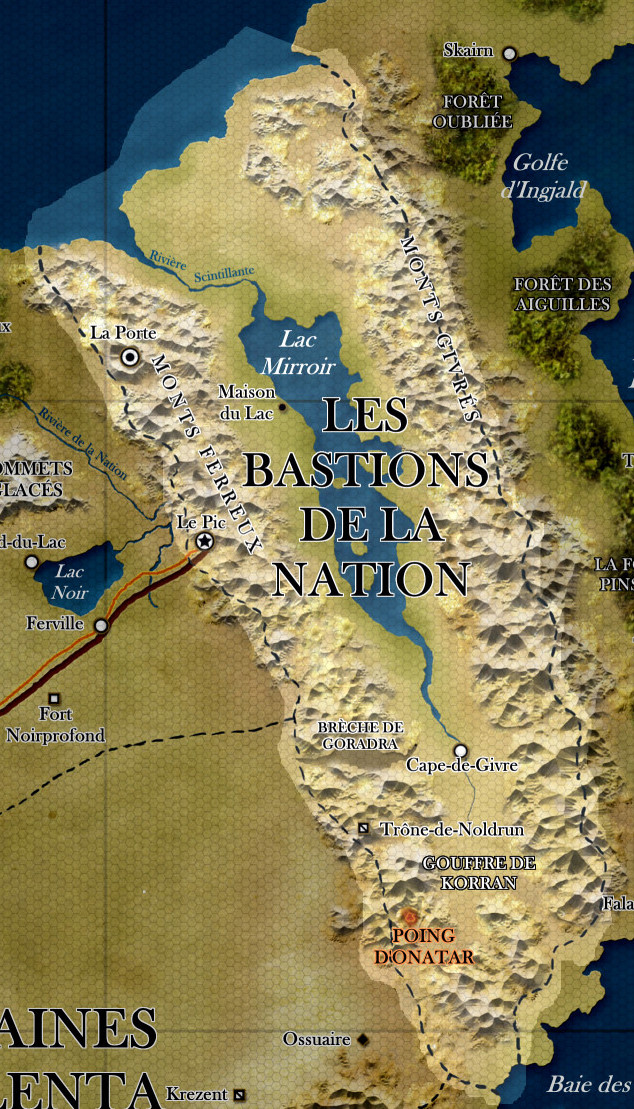
Entourés par les Monts Ferreux et les Monts Givrés des deux côtés et par la Mer Amère au nord-ouest, la plupart des établissements des Bastions de la Nation sont situé sous terre. À l'est se trouvent les Principautés de Lhazaar tandis que les Plaines de Talenta et Karrnath partagent sa frontière ouest.
Société
La population des Bastions de la Nation se compose principalement des douze clans Nain formés à partir des chefs exilés originalement.
Le clan Noldrun a depuis été détruit. Depuis 106 AR, le Clan Kundarak est la Maison Kundarak et comme toutes les Maisons Marquées Du Dragon, reste neutre et participe au Conseil de Fer des Clans uniquement en tant qu'observateurs, bien qu'ils gouvernent toujours leurs domaines ancestraux de Kundarakhold.
Groupes Influents
Histoire
Coeur et Histoire
Les Bastions de la Nation sont fondés sur le fer et l'or. Les Monts Ferreux détiennent de vastes gisements de métaux précieux et de minerais rares, et les Lords [Nain]]s ont utilisé ces ressources pour créer un empire marchand qui s'étend à travers tout Khorvaire. Mais sous les bijoux et les parures d'un Nain des bastions il y a de l'acier, le cœur d'un guerrier dont les ancêtres se sont livrés à une bataille constante pendant près de sept mille ans.
Une grande partie de l'histoire ancienne des Nains des Bastions est basée sur des fragments transmis par tradition orale et dispersés à travers les clans. Il est généralement admis que les Nains sont apparus pour la première fois sur Khorvaire il y a environ douze mille ans, mais avant cela, les histoires diffèrent. Certains contes disent que les Nains sont venus d'une terre de glace et de neige, que la plupart des érudits modernes considèrent comme le Givre-féroce. Cependant, les quelques âmes courageuses qui ont exploré cette terre glaciale n'ont trouvé aucune preuve d'une civilisation naine. D'autres prétendent que les Nains sont sortis de la terre elle-même, que Kol Korran et Onatar les ont forgés à partir de la pierre des montagnes ou encore qu'Eberron les a créés pour combattre les aberrations du Khyber. Chaque clan et chaque nain a sa propre opinion, et la plupart sont prêts à se battre avec quiconque n'est pad d'accord.
Quelle que soit leur origine, il est clair que les Nains étaient une forte puissance bien avant nos jours. Les chants des Dhakaanis parlent de batailles avec les «hommes de pierre des montagnes», et les Dhakaani ont été repoussés des Monts Ferreux par une nation naine unifiée et disciplinée. Même aujourd'hui, les érudits observent que les tactiques de combat Morinn sont parfaitement adaptées pour contrer les techniques traditionnelles utilisées par les Dhakaani et leurs descendants du Darguul.
Les Nains eux-mêmes ont de nombreux récits de cet âge de gloire, bien qu'il soit difficile de séparer les faits des mythes. Ces contes parlent de Rois de Pierres et de Gardien du dragon, de maîtres des runes forgeant de puissantes lames dans les profondeurs. Cet âge prit fin sous le règne du Lord Kordran Morinn. Un certain nombre de guerriers et de héros avaient suscité des troubles dans Le Royaume d'en Dessous, et Morinn a banni douze des chefs et leurs partisans à la surface des montagnes. Les profondeurs ont été scellées avec des protections magiques et un clan de gardiens fut envoyé à la surface afin de s'assurer que les sceaux restent scélés jusqu'à ce que les autres « se révèlent dignes du royaume d'en bas ».
Les Lords Nain ont pris de nombreuses mesures pour prouver leur valeur. On dit que le grand visage de pierre du Seigneur Morinn a été produit à cette époque, bien que ce soit en soi un grand débat. Les sages de Korranberg affirment que les Nains n'avaient tout simplement pas les compétences nécessaires pour produire un tel artefact. Pour preuve, ils pointent à des références obscures au «visage d'Eberron» et suggèrent que le «Gardien du Dragon» peut avoir fait référence à un monument draconique remontant à la nuit des temps.
Quoi qu'il en soit, quand aucun de leurs efforts n'a produit de résultats, les Nains bannis se sont battus entre eux. Leur culture s'est lentement erodée, et ils ont embrassé la sinistre joie de la guerre. Pendant des milliers d'années, les clans se sont battus, chacun cherchant à prouver sa supériorité et à gagner les clés du royaume de pierre.
Lorsque les Humains sont arrivés sur Khorvaire, ils ont ignoré les clans ennemis des Monts Ferreux. Les Nains étaient trop occupés à se battre les uns contre les autres pour s'intéresser au monde au-delà des montagnes, et les batailles se poursuivirent sans relâche jusqu'à ce que Karrn s'intéresse à la région. Le jeune prince devinait les richesses qui pouvaient être cachées dans ces montagnes, et il voulait sa part. Avec la permission de son père, il dirigea une armée pour subjuguer les « barbares des montagnes ». Bien qu'ils (ou peut-être parce qu'ils) se battaient depuis des millénaires, les Nains étaient mal préparés à affronter un ennemi inconnu. Ensemble, les clans auraient facilement pu expulser l'envahisseur, mais Karrn a joué sur leurs querelles pour diviser et conquérir les clans. En une décennie, les Lords des clans avaient plié le genou devant le prince de Karrnath.
Après avoir libéré les Gobelins lors de sa conquête des Cinq Nations, le roi Galifar n'allait pas tolérer l'esclavage des nains. Karrn a été chargé d'apporter la paix du roi à cette terre sauvage. Les Nains ont été contraints d'arrêter leurs guerres et encouragés à se développer une nouvelle nation basée sur le modèle de Galifar, payant tribu à Karrnath et à l'ancien royaume. Les Karrn ont explorés les montagnes, mais ils ne pouvèrent percer les anciennes protections.
Des décennies passèrent. De nombreux Nains ont abandonné leurs anciennes habitudes et se sont répandus dans tout Khorvaire. Ceux qui sont restés dans les montagnes se plaignièrent du poids des impôts et des tributs, et lentement leur mécontentement les a rapprochés.
Puis vint la convocation. Les Nains de Kundarak étaient les gardiens des sceaux, et ils appelent les Lords des douzes clans dans leur bastion. Dans les manoirs de La Porte, les Lords des clans se réunissèrent en paix, discutant de leurs projets pour leur nation et s'inquiétaient de leur avenir dans le Royaume de Galifar. Après quelques jours de conversation, le patriarche de Kundarak a conduit les dirigeants sous la citadelle jusqu'à l'une des anciennes protections. “Enfin, vous avez mis de côté vos différences”, a-t-il déclaré. “Avancez et ouvrez la porte du royaume d'en dessous.” Lorsque douze Nains ont touché le sceau, il s'est évanoui et le chemin vers le passé a été révélé.
Ce qui se trouvait en dessous fut un choc pour tous. Alors que les Lords des clans se battaient à la surface de la montagne, les descendants Morinns avaient combattu les Daelkyrs dans les profondeurs, et Perdu. Il n'y avait pas de royaume glorieux de nobles Nains en attente de leur retour, seulement des ruines et des ombres abritant de terribles monstres tapi dans l'obscurité. D'anciens trésors restaient dans ces forteresses dévastée, et les mines ruisselaient encore de toutes sortes de minerais. Lentement, les Nains ont réclamés ces anciennes forteresses et les fortunes cachées en dessous.
Maintenant que leur ancien devoir était rempli, le clan Kundarak, qui possédait depuis longtemps la Marque de la Protection, fut attiré dans la plus grande communauté des maisons Marqué Du Dragon. Avec l'aide des gnomes de Zilargo, les Nains de la Maison Kundarak se sont imposés comme les principaux banquiers de Khorvaire. De nombreux autres clans ont travaillés avec les Kundarak, vendant leurs minerais et leurs bijoux à la banque ou servant de gardes.
À travers tout cela, les Nain sont restés des citoyens de Galifar. Les Nain étaient patients, et la plupart accordaient une grande importance à leur parole et à l'honneur de leurs ancêtres. Les Lords des clans du passé avaient prêté serment à Galifar, et ce n'était pas à leurs enfants de rompre ce serment. Même si Karrnath a augmenté les impôts, la richesse de La Mine Profonde dépassait de loin ce tribut. De nombreux Lords Nain ont appelé à la rébellion, mais les clans ne sont jamais parvenus à un accord et aucun clan ne voulait agir seul.
Puis vint La Dernière Guerre. Les Nains avaient prêté serment à Galifar, mais ce royaume n'existait plus. Jamais plus les Nains ne se soumettraient au règne d'un seul roi, pas même d'un Nain. Ils déclarèrent la naissance d'une nouvelle nation, alliance formelle des clans qui rivaliserait un jour avec le royaume d'antan : les Bastions de la Nation.
Empire Dhakaani
Bien que l'on sache peu de choses sur cette période, il y a plusieurs références dans les chants Dhakaani aux « guerriers de pierre du Nord ». La simple présence des Nains dans leurs forteresses montagneuses avant que les Humains arrivent en Khorvaire prouvent que les villes des Nains existent depuis un certain temps.
L'Exil des Douzes
Sous le règne du Lord Kordran Morin, un certain nombre de guerriers se soulevèrent dans les profonds domaines des Nains. Bien que l'on ne sache pas exactement les causes de se soulèvement, ils étaient suffisamment graves pour que Lord Morin exile les douze dirigeants responsables vers les montagnes de la surface. Lors de leur bannissement, des sceaux et des protections magiques furent mis en place pour empêcher les bannis de retourner dans les domaines profonds et un clan de gardiens fut envoyé pour garantir que les protections magiques resteraient en place jusqu'à ce que les Nains bannis aient prouvé qu'ils étaient dignes de revenir dans le royaume d'en bas. Les Douzes exilés deviendront Les Douzes clanlords.
Les chefs de clan ont passé de nombreuses années à essayer de prouver leur valeur individuelle. On dit que c'est à cette époque que fut construit le puissant visage du Lord Morin. Finalement, la compétition pour prouver quel clan était le plus digne du domaine profond a conduit à des luttes intestines entre les clans qui se sont transformées en querelles de longue date.
Assaut de Karrn
Lorsque les Humains se sont répandus pour la première fois dans les confins du Khorvaire, ils n'ont prêté que peu d'attention aux conflictuels clans Nain dans leurs montagnes. Cependant, au fil du temps, Karrn du Wynarn fils du Roi Galifar I considéra les montagnes et leurs richesses comme une bénédiction possible pour l'empire. Avec la permission de son père, il entreprit d'attaquer les forteresses naines. Affaiblis par leurs propres querelles, les Nains tombèrent aux mains des forces de Karrn et furent bientôt soumis au Royaume de Galifar et leurs terres furent ajoutées aux territoires de Karrnath. Cependant, cela se révélera être une bénédiction la population de Nain, qui furent désormais obligée de travailler ensemble sous la paix du roi.
Sous Galifar
Finalement, après avoir mis de côté leurs petites querelle, les nains Kundarak, les gardiens des protections magiques protégeant le royaume d'en bas, brisèrent les sceaux magiques et autorisèrent le passage vers le royaume d'en bas. Malheureusement, tout n’allait pas bien dans les profondeurs. Au fil des siècles, ses habitants y avaient mené une longue guerre contre les Daelkyrs et avaient perdu. Alors qu'une grande partie des anciennes cités sont désormais revendiquées par les Daelkyrs, les Lords des clans Nain s'apprêtent à les reconquérir pour l'ancienne gloire de leur peuple.
Les clans Nain étaient toujours fidèles au Royaume de Galifar, refusant de revenir sur la parole de leurs ancêtres qui avaient juré fidélité au royaume.
La Dernière Guerre
C'est en fait La Dernière Guerre qui délivra les Nains des Bastions de la Nation de leur serment envers Galifar. Puisque Galifar, le royaume, n'existait plus, les Lords du clan Nain furent libérés de leur engagement et en 914 AR lors de la première réunion du Conseil de Fer les Lords Nain déclarèrent leur indépendance. Cette nation indépendante fut ensuite reconnue par le Traité du Fort-du-trône.
La Dernière Guerre
It was actually La Dernière Guerre that released the Nains of the Bastions de la Nation from their duty to Galifar. Since Galifar, the kingdom, no longer existed the Nain clanlords were released from their pledge and in 914 AR at the first meeting of the Conseil de Fer the Nain lords declared their independence. This independent nation was later recognized with the Treaty of Fort-du-trône.
Villes et agglomérations
cities_morin_holds Cities of the Morin Holds Frostmantle · Krona Peak · Korunda Gate · Lake Home · Nuldonthrone
Autres Sites Notables
Cuisine
Les nains de la Nation ont des constitutions exceptionnelles et sont résistants au poison, et grâce à ces traits, ils apprécient une cuisine que d'autres devraient éviter. Ces nains vivant dans de hautes montagnes et dans des colonies souterraines utilisent une grande variété de champignons, de mousse et autres ingrédients exotiques. Par exemple leur pouding rouge est une forme de pouding (ou slime) paisible élevé comme du bétail et utilisé dans une variété de plats. Le ragoût du peuple peut rendre malade toute créatures à l'estomac plus délicat, mais il est totalement inoffensif pour ceux résistant aux poison, et de nombreux hobbits robustes des Plaines de Talenta apprécient la cuisine du peuple.
L'alcool est aussi une forme de poison, et les spiritueux du peuples doivent être exceptionnellement forts pour que les nains puissent profiter de leurs propriétés psychotropes. Les brasseurs du peuple utilisent souvent des champignons pour produire leurs alcools et produisent également des boissons à base de champignons avec de légers effets hallucinogènes. Les boissons des Cinq Nations sont extrêmement faibles selon les normes de la nation, et les nains considèrent la capacité de préparer leurs propres boissons personnelles comme un outil de survie essentiel pour les voyages à l'étranger. Et lorsque des étrangers visitent les Nations, leurs hôtes prennent soin d'empêcher que ces voyageurs achète des produits qui pourraient les tuer.
Religion
Les conteurs Morinns soutiennent que les nains sont le peuple choisi originalement par les souverains, en particulier par Kol Korran et Onatar. C'est effectivement une curieuse coïncidence que Kol soit le mot nain pour « commerce », tandis que dol signifie « guerre », et ces conteurs disent que le Voyageur a volé les noms des souverains aux nains pendant l'Exil. Les prêtres du Pic disent que Kol Korran est venu voir le héros Morinnanon et a promis aux nains d'énormes richesse s'ils se souvenaient de son nom et suivaient son chemin, tandis que les conteurs du bastion de Doldarun jurent que le héros Doldarun était le fils de Dol Dorn et Dol Arrah.
Les archives de la Bibliothèque de Korranberg montrent que les missionnaires Zils étaient actifs dans les Monts Ferreux au cours des siècles avant Bal Dulor, et certains sages affirment que ces récits pourraient avoir été l'œuvre d'astucieux missionnaires. Quelle que soit la vérité, les Morinns possédaient déjà des sanctuaires pour les Souverains lorsque le jeune Karrn mena ses forces à la conquête des bastions.
Alors que les Morin reconnaissent largement tous les Souverains, Kol Korran et Onatar sont les plus aimés, suivit de Boldrei et Olladra. Les clans Doldarun, Morinnanon et Soranath sont particulièrement pieux, tandis que Droranath, Clan Soldorak et Toldorath sont les plus pragmatiques. Le Sang Divin et les Sombres Six ont quelques adeptes dans Narathun.
National Character
Les Nains des Bastions sont un peuple passionné. Ils sont motivés par la fierté, la loyauté au clan et un amour féroce de la vie : nourriture, boisson, bataille et toutes les myriades d'expériences que le monde a à offrir. Parmi les étrangers, un Nain Morinn cache souvent ses véritables pensées et sentiments derrière un masque sévère. Mais en compagnie d'amis, les Nains embrassent la vie avec un zeste sans précédent.
Les Nains des Bastions sont de féroces négociateurs, privilégiant l'intimidation à une diplomatie plus subtile. La plupart tiennent l'honneur en haute estime, et au dit que le serment d'un Lord Morinn est aussi solide que de l'adamantine.
Les Nains des Bastions sont des marchands depuis des siècles, mais ils sont guerriers depuis des millénaires. Même lorsque Karrn a imposé la paix de Galifar, les Nains ont continué à former leurs enfants à l'art de la guerre. Alors que les Bastions de la Nation furent en grande partie isolés de La Dernière Guerre, les pilleurs Orcs Jhorash'tar restent une menace constante, et les rochers et les gouffres abritent des ogres, des trolls et bien pire. Les plus grands héros des bastions chassent dans les profondeurs du Khyber, traquant les dolgaunts, Mastodonte des ombres et autres aberrations à l'ombres sous les montagnes. Certains supposent que parce que les Nains des bastions sont riches, ils sont doux, alors qu'en fait ils sont plus durs que la pierre et plus tranchants que l'acier. L'or est une nouvelle arme pour les Nains des Bastions mais ils n'ont jamais oublié le chemin de la hache.
Alors que les Nains des Bastions sont fiers de leur jeune nation et du pouvoir qu'ils exercent, les vieilles querelles et rivalités persistent, et les Nains sont extrêmement compétitifs. Généralement, ces conflits sont ouverts ; deux routiers se feront la course pour atteindre une destination, deux marchands se se feront une guerre de prix, deux nobles soutiendront différents faucons dans une chasse. Les membres de L'Aurum sont connus pour mener des vendettas secrètes aux conséquences plus sombres et plus meurtrières. Certains disent que L'Aurum est un clan à part entière, que son pouvoir est plus grand que n'importe laquelle des familles d'antan. La plupart des honorables Lords estiment que L'Aurum représente une corruption des vertus claniques. Ils disent que les vrais nains sont fait de fer et d'or, mais ceux qui servent L'Aurum ne serait que fait d'or, influent mais mou et peu fiable.
Morin Fashion
Les humains voient souvent les Nains des Bastions comme cupides et vaniteux. La vérité est plus compliquée. La plupart des Nains des Bastions apprécient le travail de qualité d'une manière que peu d'autres peuvent comprendre. Ils vont littéralement tomber amoureux de leurs objets. En regardant un beau gobelet, un Nain voit le toast qu'il partagera avec sa femme (quand il la trouvera). Un Nain des nations peut raconter des histoires sur chaque objet de valeur qu'il possède, en regardant le passé qu'il a partagé avec son trésor ou l'avenir qu'il espère avoir.
Au-delà, le peuple voient dans l'apparence personnelle bien plus qu'une simple vanité. Les vêtements d'un Nain reflètent sa richesse et donc son pouvoir, mais ils indiquent également son appréciation de la beauté, son jugement et son intelligence. Un marchand mal habillé a du mal en affaires. S'il ne peut pas juger de la valeur de ses propres vêtements, qui se fiera à sa marchandise ? En conséquence, un Nain des nations peut dépenser plus pour ses vêtements, son armure, ses bijoux et ses armes que pour sa maison. Les nains de la nation sont stoïques et sont satisfait d'endurer de l'inconfort physique et des épreuves. Dormir sur de la pierre est préférable à porter des vêtements ternes.
À cause de cela, une troupe de soldats du peuple est un véritable spectacle. Les armures naines sont généralement recouvertes d'émail ou de gravure complexe. Les armes sont tout aussi frappantes, en plus des manches colorés et des lames dorées, beaucoup sont fabriqués dans des designs inhabituels personnalisés pour chaque guerrier. Les bijoux sont très importants pour les nains de la nation et ont souvent une signification particulière, indiquant leur rang au sein d'un clan, un honneur militaire ou une fonction civique.
Au contraire, l'architecture des Nations est austère et fonctionnelle. Possédant une vision dans le noir, les Nains ont peu besoin de fenêtres, bien que la plupart des bâtiments soient éclairés par respect pour les immigrants gnomes et humains. Les Nains des Bastions apprécient la bonne compagnie, la bonne chère, les boissons fortes et l'activité physique. Ils s'embarrassent rarement de coussins moelleux ou de conforts similaires. Un riche marchand est plus susceptible de dépenser ses bénéfices en beaux vêtements ou en armes finement ciselées qu'en tapis luxuriants et édredons en plumes.
Les vêtements racontent une histoire et les nains adorent les utiliser pour parler de leur clan, leur famille, leur foi et leur personnalité. Comme pour la plupart des biens des Bastions, la qualité des vêtements passe avant tout. Pour cette raison, les nains des familles plus pauvres peuvent n'avoir qu'un seul ensemble de vêtements, mais ceux-ci sont durables et bien faits. Bien que leurs tenues de base soient peu nombreuses, ils placent un grand stock d'accessoires, et une tenue Morin comporte généralement des éléments qui peuvent être inversés, déplacés ou supprimés. Les broches ont une signification culturelle importante et peuvent représenter des armoiries familiales, le sceau du clan au pouvoir, le symbole d'un souverain dont on recherche la faveur, ou même des humeurs ; certaines broches signifient « laissez-moi tranquille » ou « cherchez de la compagnie ». D'autres formes de bijoux—bagues, chaînes, bracelets—sont couramment portées par les nains des deux sexes; c'est l'occasion de montrer la richesse, mais les ornements décoratifs en fer sont également portés par les gens du commun. Le dultar – lame de sang – est un poignard porté à la fois comme outil utilitaire et comme déclaration d'allégeance ; chacun des clans au pouvoir a un style distinct de dultar. Tout nain Morin peut immédiatement identifier le clan d'un autre nain à partir de son dultar ; pour qu'un étranger en reconnaisse un, cela nécessite un test d'Intelligence (Histoire) DD 13 réussi.
Though their basic outfits may be few, Morin place great stock in accessories, and a Morin outfit typically has elements that can be reversed, shifted, or removed. Brooches have important cultural significance, and can depict family crests, the seal of the ruling clan, the symbol of a Sovereign whose favor is sought, or even moods; some brooches mean “leave me alone” or “looking for company.” Other forms of jewelry—rings, chains, bracelets—are commonly worn by dwarves of both genders; this is an opportunity to show wealth, but decorative ornaments of iron are also worn by common folk. The dultar—blood blade—is a dagger worn both as a utilitarian tool and as a statement of allegiance; each of the ruling clans has a distinct style of dultar. Any Morin dwarf can immediately identify another dwarf’s clan from their dultar; for an outsider to recognize one, it requires a successful DC 13 Intelligence (History) check.
De nombreux clans des Bastions privilégient un look martial, notamment dans le sillage de Dol Udar. Cependant, tout le monde ne veut pas porter de l'acier lourd toute la journée, et les Morin utilisent généralement des alliages légers et de fines couches de métal pour fabriquer leur armure. De nombreux Morin portent une armure décorative qui utilise les statistiques d'une armure légère, mais évoque la saveur générale d'un plastron plus lourd, bien que toute personne compétente en armure moyenne ou lourde en reconnaisse immédiatement la nature décorative. La pilosité faciale est courante chez les Morin, mais les styles varient selon le clan et la famille. Certaines familles préfèrent les barbes bien taillées. De nombreux clans tissent des perles dans la barbe, le motif de la perle invoquant la faveur d'un souverain ou honorant un clan. La teinture pour les cheveux est souvent utilisée comme une forme d'expression personnelle. Les clans qui ont adopté l'utilisation de symbiotes, notamment Soldorak, Toranath et Narathun, ont développé de nombreuses modes exotiques au cours du siècle dernier. Pour de tels nains, porter des vêtements ou des accessoires symbiotes est un signe de courage et de puissance, tout comme un chasseur pourrait porter les peaux d'animaux qu'ils ont vaincus. Les vêtements vivants ont généralement une texture similaire à celle du cuir, bien qu'un placage de chitine ou des saillies en forme de corne soient possibles. Les motifs ou les couleurs peuvent changer pour refléter l'humeur du porteur, et une cape vivante peut onduler ou gonfler de son propre gré. Les vêtements vivants se nettoient et se raccommodent eux-mêmes et se nourrissent des excrétions (principalement de la sueur) de l'hôte. Narathun compte actuellement les meilleurs artisans-éleveurs travaillant avec des vêtements vivants, et les styles évoluent constamment.
Many Morin clans favor a martial aspect to their attire, especially in the wake of Dol Udar. However, not everyone wants to wear heavy steel all day, and the Morin generally use light alloys and thin layers of metal to craft their armor. Many Morin wear decorative armor that uses the statistics of light armor, but evokes the general flavor of a heavier breastplate—though anyone proficient in medium or heavy armor immediately recognizes the decorative nature of it. Facial hair is common among the Morin, but styles vary by clan and family. Some families prefer neatly trimmed beards. Many clans weave beads into beards, with the design of the bead invoking the favor of a Sovereign or honoring a clan. Hair dye is often used as a form of personal expression. Clans that have embraced the use of symbionts—notably Soldorak, Toranath, and Narathun—have developed many exotic fashions over the last century. For such dwarves, wearing symbiont clothing or accessories is a sign of courage and power, much as a hunter might wear the hides of animals they’ve defeated. Living clothing typically has a texture similar to leather, though chitin plating or hornlike protrusions are possible. Patterns or colors may shift to reflect the mood of the wearer, and a living cloak may ripple or billow of its own accord. Living clothing is self-cleaning and mending, and feeds on the excretions (primarily sweat) of the host. Narathun currently has the finest artisan-breeders working with living clothing, and styles are constantly evolving.
The Nains des Bastions in Battle
When Prince Karrn led his forces into the Monts Ferreux, he found a culture engaged in constant warfare. The Nains placed more value on weapons and armor than home and hearth, and the Morin villages were pale Ombres of the cities of Galifar. This was but one of the factors that led Karrn to call the Nains “barbarians.” While the Morin find joy in battle, they are not raging berserkers. Most Morin soldiers have warrior levels, and there are many fighters among the Bastions de la Nation. Other combat classes are unCommun, though Clan Droranath is noteworthy for having true barbarians.
Most Morin soldiers prefer heavy armor and close combat, and typically focus on Power Attack and its related feats. Morin warriors traditionally name weapons and shields. When a Nain tells a story about one of his many battles, he will refer to his axe as if it were another warrior standing at his side. Battlecries are an important part of Morin culture. A Nain may develop his own, or he may adopt the battle call of an honored ancestor. Nains wish to be remembered on the battlefield, and their colorful armor and mighty cries reflect this fact.
Elite Morin troops generally follow the path of the fighter. Because honor and military skill are both held in high regard by the Nains, kensai and knight protectors can also be found in the service of the clan lords. Nain defenders guard the vaults of Maison Kundarak, and there are a few frenzied berserkers in Clan Droranath. The Nain fighter substitution level presented in Races of Stone is appropriate for Morin characters.
While Morin smiths constantly improve their skills, they do not possess the uncanny skills of their ancestors. If you use Races of Stone, Nains des Bastions do not have the ability to produce Naincraft items or Nain armor, and they cannot create magic forges. Such items might be found as relics of the Premier Âge, however, and a DM could choose to introduce a smith who has mastered these ancient techniques and learned to produce improved armor or weaponry.
Magie parmi les Nains des Bastions
Alors que les prêtres de Kol Korran et d'Onatar ont toujours eu une place dans les montagnes, avant la conquête de Karrn, il n'y avait aucune tradition de magie arcanique chez les Nains des Monts Ferreux. Il est clair que les Nains du premier royaume possédaient des mage-forgerons et des artificiers d'une compétence considérable, mais cette connaissance a été perdue lorsque les clans ont été exilés des profondeurs. Au cours des derniers siècles, les Nains des Bastions ont beaucoup appris en travaillant avec les immigrants gnomes. Certains clans commencent à réclamer les secrets du Premier Âge. Les magiciens ne sont toujours pas communs, mais une poignée d'artificiers travaillent dans les profondeurs, et la plupart des forteresses contiennent des forgerons mage-artisan et d'autres simples lanceurs de sorts.
Les gnomes des Bastions Les Nains Morin et les Gnomes Zil Alors que l'humanité a largement ignoré les Bastions jusqu'après la fondation de Galifar, les explorateurs Zil sont venus dans les montagnes bien avant Bal Dulor. Les caractères des Zil et du peuple se complètent bien. Les Zils sont fascinés par les connaissances abstraites et aiment tenir des registres et la comptabilité, tandis que les Nains des Bastions préfèrent l'histoire et l'émotion aux faits ennuyeux. En conséquence, les scribes de Zil sont rapidement devenus une caractéristique standard dans les tribunaux des clans.
Au fur et à mesure que le peuple embrassait les banques et les affaires internationales, ce partenariat s'est développé. Les Bastions de la Nation et Zilargo sont de puissants alliés, et l'alliance entre la Maison Kundarak et la Maison Siri est la plus forte des Douze.
De nombreux étrangers ont du mal avec l'image de banquiers Nains, ils voient les nains comme des guerriers, pas comme des comptables. En fait, les Nain s'intéressent peu à la comptabilité, mais ils ont l'or. Ils sont fiers de leur capacité à protéger leurs coffres. Ils savent comment négocier dur. Mais la paperasse ? C'est là qu'interviennent les gnomes.
When Karrn brought order to the Monts Ferreux, he paved the way for a massive gnomish immigration. The gnomes of Zilargo were détective, diplomatic, and skilled miners in their own right. Karrn initially brought gnomes to the mountains to serve as translators, mediators, and advisors. The Nains were more comfortable dealing with gnomes than with Humains, because clan lords disliked looking up at the invaders. For their part, the gnomes saw a tremendous amount of potential in the mountains, and many of the gnomish families sent envoys east. These immigrants played a major role in shaping the mercantile culture of the emerging nation. Most clans have a close relationship with one or more of the gnomish clans. Maison Siri and Maison Kundarak have very strong ties. Siri gnomes uncovered the full potential of the Marque de la Protection and helped Clan Kundarak find its place among the Marque Du Dragon houses, and Siri notaries and stonesenders play a crucial role in the Kundarak Guilde Bancaire. Most gnomes in the Bastions de la Nation maintain ties with their families in Zilargo, but a few have broken ties with the homeland and fully embraced Morin culture.
Lorsque Karrn a mis de l'ordre dans les Monts Ferreux, il a ouvert la voie à une immigration massive de gnomes. Les gnomes de Zilargo étaient des détectives, des diplomates et des mineurs qualifiés à part entière. Karrn a d'abord amené des gnomes dans les montagnes pour servir de traducteurs, de médiateurs et de conseillers. Les Nains étaient plus à l'aise avec les gnomes qu'avec les Humains, car les Lords de clan n'aimaient pas regarder les envahisseurs. Pour leur part, les gnomes ont vu un énorme potentiel dans les montagnes, et de nombreuses familles gnomes ont envoyé des émissaires vers l'est. Ces immigrants ont joué un rôle majeur dans la formation de la culture mercantile de la nation émergente. La plupart des clans ont une relation étroite avec un ou plusieurs clans gnomes. La Maison Siri et la Maison Kundarak ont des liens très forts. Les gnomes Siri ont découvert tout le potentiel de la Marque de la Protection et aidé le Clan Kundarak à trouver sa place parmi les maisons de la Marque Du Dragon, et les notaires et marchands de pierres Siri jouent un rôle crucial dans la Kundarak Guilde Bancaire. La plupart des gnomes des Bastions de la Nation entretiennent des liens avec leurs familles à Zilargo, mais quelques-uns ont rompu les liens avec la patrie et ont pleinement embrassé la culture morin.
Parce que les Nains accordent une grande importance à l'apparence personnelle, le nombre de tailleurs et d'esthéticiennes gnomes dans les Bastions de la Nation augmente. Des experts gnome en prestidigitation excellent à garder les couleurs fraîches, et les riches du peuples paie de bon montants pour les derniers designs gnome de vêtement glamour.
The Clans
Morin exiled twelve heroes from the deep kingdom and set the line of Kundarak to watch them. The great clans are the direct descendants of these heroes, and the holds bear their names. Each hero was accompanied by a host of loyal followers and servants. As a result, there are dozens of different family lines in the Bastions de la Nation.
The great clans are Morinanon, Doldarun, Droranath, Kolkarun, Kundarak, Laranak, Londurak, Narathun, Noldrun, Soldorak, Soranath, Toldorath, and Tordannon. Kundarak, however, has never been a part of the council of clans, and Clan Noldrun was completely destroyed (see page 193 of the EberronCampaign Setting for more information).
The Ruling Clans The Morin Holds are divided into twelve holds, each bearing the name of the ruling clan that exercises authority within that region. These twelve clans are the foundation of Morin culture, and every citizen owes allegiance to one of these clans. This section provides an overview of the twelve ruling clans, including their most remarkable mineral resources, their established feuds, and the virtues they assign to their mythic founder—and thus, the virtues they strive to embody. It’s worth noting that almost all Morin value many of these virtues, but in their stories, one founder is acknowledged as the best at that thing. Clan Doldarun certainly values strength, but in the story, Doldarun’s defining feature is his courage and integrity, while Droranath is known for his untamable strength. Likewise, while each clan includes suggestions for possible character classes, any character could come from any clan; in particular, talespinner bards and entertainers are found in every clan. While all Morin are bound to one of the ruling clans, there are many lesser clans, and below those, tenant families.
Among the Morin, the dwarven subraces largely reflect their culture and personal aptitude, not bloodlines, and a Morin dwarf can take any subrace. For example, mountain dwarves have expanded martial training, likely due to militia service in Dol Udar, while dwarves with the Mark of Warding have a blood tie to House Kundarak in their family tree.
RISING :
When Humainity first came to Khorvaire, they found the Nain clans of the Bastions de la Nation locked in endless feuds. This division kept the clans from uniting against the new arrivals, and the Nains were forced to swear fealty to Karrnath and Galifar. Over the centuries, they turned their energies to harnessing the astonishing natural resources of their mountain home. The Nains were then reborn as merchant lords. In the early days of the La Dernière Guerre, Morin miners made an astonishing discovery: the ruins of an ancient dwar ven empire, vast halls deep within the Ironroot Moun tains. Explorers uncovered mines still brimming with jewels and precious ores and vaults filled with riches and powerful artifacts. The Morin restored these ancient fortresses and worked to reclaim the secrets of their ancestors. Seeing the untapped potential of the Realm Below and the broken Royaume de Galifar, the clan lords joined together to form the Conseil de Fer and to declare the independence and sovereignty of the Bastions de la Nation. One question remained: What had become of the an cient Nains? The answer soon became apparent. As the Morin delved deeper into the Royaume d'En Dessous, they woke an ancient evil: Dyrrn le Corrupteur, a daelkyr lord of madness. Hordes of aberrations and derro rose from the depths to challenge the explorers. For decades, the Morin lords have been fighting a battle in the depths, strug gling to drive the darkness from their ancestral halls. Many Nains revile anything to do with the daelkyr. Others believe that the daelkyr can grant the Morin Nains the power to overcome any enemy. Some clans have taken up Symbiotes and living weapons recovered from the depths, and cabals of warlocks draw on the power of the Plane of Xoriat (see chapter 4). The Bastions de la Nation consist of a loose confederation. Twelve noble clans each govern a hold and have a representative on the Conseil de Fer, which resolves dis putes and issues affecting the entire nation. Each hold includes a number of lesser clans, who owe fealty to the noble line. Those who occupy land above have the right to claim the halls that lie below if they can. The Légion Souveraine is the dominant faith of the Morin Holds. Kol Korran is the most beloved of the Sover eigns, but the Nains also revere Boldrei, Doi Dorn, Olladra, and Onatar.
CITI E S AND SITES The Bastions de la Nation spread across the Monts Ferreux. Most Morin communities are at least partially subterranean, extending down into the mountains. The Realm Below is deep beneath the surface, and not every town has a passage to it.
Le Pic Located in the Nain realm of Morinanonhold, Krona Peak serves as the seat of the Conseil de Fer and thus is the Bastions de la Nation' equivalent of a capital. This center of commerce provides a major connection to the western nations. Kol Korran's Throne, Khorvaire's largest temple to the Sovereign Lord of World and Wealth, dominates the cityscape.
SOLANGAP The holdfast of Clan Soldorak, Solangap boasts vast gold mines and the largest mint and treasury in Khorvaire. Clan Soldorak has recovered many daelkyr tools and weapons from the Royaume d'En Dessous. Solan lords proudly wear Symbiotes and make no effort to hide their warlock pacts.
NOLDRUNHOLD Four hundred years ago, the Nains of Clan Noldrun vanished. All expeditions that delved into Noldrunhold ended in disaster, and the region was declared to be cursed and shunned. At the time, the Nains believed that the Jhorash'tar ores were responsible, but now it seems more likely that the Noldrun opened a path to the Royaume d'En Dessous. What malevolent powers have claimed the halls of Noldrunhold?
THE Royaume d'En Dessous No one knows the extent or depth of the ancient Nain empire deep beneath the Monts Ferreux. Great wealth and arcane secrets remain hidden in these halls, along with endless hordes of aberrations. As a Morin adventurer, you could help your family reclaim lands from the Royaume d'En Dessous, or you could lead your allies into the deep in search of wealth and glory.
AFTERMATH OF THE LA8! WA� The Bastions de la Nation declared independence during the Last War. Many nations depend on the resource of the Holds, and the Treaty of Fort-du-trône affirmed its sovereignty. To the casual observer, the Nains des Bastions' star appears to be rising. Their mines seem to offer limitless resources. Morin Artificiers make amazing strides as they study the relics of their ancestors. The Nains are proud of their ancient past and optimistic about the future. Most Morin are generous and courageous, eager to show off their wealth and accomplishments. Those who dig deeper realize that this prosperity is built on an unstable foundation. La Dernière Guerre may be over, but the war against the daelkyr has barely begun. The clan lords hold their reclaimed halls in the Realm Below, but no one knows the full extent of the power of the daelkyr. A renewed assault could come at any time, whether it's a force of monsters boiling up from below or a creeping madness that infects the weak-willed. The Nains are also divided by their attitude toward the aberrations. Some of the clans-notably Soldorakembrace Symbiotes and other daelkyr gifts; some even experiment with flesh-warping techniques and create their own monsters. Others-notably Clan Morinanonavoid contact with the aberrations. Such Nains treasure the relics of their ancestors but despise those who use Symbiotes or form pacts with the darkness. Long ago, the Nains engaged in vicious feuds that kept them from uniting as a nation. This new divide could reignite those rivalries, leading to a civil war on the surface even as evil gains strength in the depths.
Malgré leur longue vie, les nains des bastions sont étonnamment peu soucieux d'enregistrer le passé. Ils se soucient profondément de leur famille. Ils s'accrochent à la propriété, qu'il s'agisse de terres ou de biens plus portables. Ils sont féroces pour protéger les choses qui leur tiennent à cœur. Mais comme l'a dit le barde Kessler, “Les Nains se soucient profondément de leurs histoires, mais les faits ne font que les gêner.” Les contes de Morin ont une quantité infinie d'histoires sur les exploits puissants des héros du clan, mais lorsqu'il s'agit de dates spécifiques ou de faits vérifiables, les choses deviennent souvent boueuses. Les registres des dettes, des mariages, des adoptions – ces choses sont écrites par les scribes de Sivis. Mais l'histoire générale est largement confiée aux récits transmis par les filateurs, et ils rendent l'histoire intéressante. Une histoire particulière pourrait être placée dans trois siècles différents par trois clans différents, et le méchant d'une histoire pourrait être le héros de la forteresse voisine.
Despite their long lives, the Morin dwarves are surprisingly unconcerned with recording the past. They care deeply about family. They cling to property, whether it’s land or more portable possessions. They’re fierce in protecting the things that they care about. But as the bard Kessler said, “The Morin care deeply about their stories, but facts just get in the way.” Morin talespinners have an endless supply of stories about the mighty deeds of clan heroes, but when it comes to specific dates or verifiable facts, things often get muddy. Records of debts, marriages, adoptions—these things are written down by Sivis scribes. But general history is largely trusted to the passed-down tales of the spinners, and they make history interesting. A particular story could be placed in three different centuries by three different clans, and the villain of one tale could be the hero in the neighboring holdfast.
Histoire de Morin Les nains ne sont pas originaires de Khorvaire, mais personne ne sait exactement comment ni quand ils sont arrivés. La plupart des conteurs s'accordent à dire que les nains viennent d'une terre de glace et de givre, bien que tous ne soit pas d'accord.
Bien que cela suffise aux nains, d'autres érudits continuent de débattre de leur origine et de la façon dont ils se sont rendus sur Khorvaire. La théorie la plus populaire est que les premiers nains soient venus du Givre-féroce, voyageant par un passage en demi-plan à travers Khyber. Les partisans de cette idée pensent qu'il pourrait y avoir une civilisation naine non découverte - ou des ruines de celle-ci - attendant d'être trouvée dans Frostfell. Une deuxième théorie populaire est que les nains sont originaires de la toundra Tashana de Sarlona, naviguant vers Khorvaire et atterrissant dans les principautés de Lhazaar des millénaires avant les colons humains. Cependant, les nains Akiak modernes ont peu de chevauchement culturel avec les Morin, et il n'y a aucune preuve qu'ils aient jamais construit des navires. L'histoire la plus exotique est que les nains de Sarlona et de Khorvaire sont tous deux originaires de Risia, et qu'il existe peut-être encore une grande civilisation cachée au plus profond de la glace de Risian. Alors que les histoires d'origine varient d'un clan à l'autre, les conteurs s'accordent tous sur les grandes époques de l'histoire de Morin qui ont suivi.
While that’s enough for the Morin, other scholars continue to debate where they might have originated and how they traveled to Khorvaire. The most popular theory is that the first dwarves came from the Frostfell, traveling by way of a demiplane passage through Khyber. Proponents of this idea believe that there may be an undiscovered dwarven civilization—or ruins of it—waiting to be found in the Frostfell. A second popular theory is that the dwarves originated in the Tashana Tundra of Sarlona, sailing to Khorvaire and landing in the Lhazaar Principalities millennia before human settlers. However, the modern Akiak dwarves have little cultural overlap with the Morin, and there’s no evidence that they ever built ships. The most exotic story is that the dwarves of Sarlona and Khorvaire both came from Risia, and that there may still be a grand hidden civilization deep in the Risian ice. While origin stories vary from clan to clan, the talespinners all agree on the broad eras of Morin history that followed.
Morin History Sol Udar: Le Royaume d'En Dessous Wherever the dwarves came from, they sunk their roots into the soil of Khorvaire. Dhakaani dirge singers sing of battles between dwarf and dar that took place in vast halls below the earth. Dhakaani records—which are more accurate than those of the dwarves—show that the Dhakaani encountered dwarves late in the golden age of the Dhakaani Empire and drove them east, eventually reaching a stalemate. The ancient dwarves lacked the numbers or resources to threaten Dhakaan, but they established a line below the Ironroot Mountains and held it against countless onslaughts. The dar had no need of the territory, and in time, decided the effort of conquest wasn’t worth the rewards. This was the origin of what the dwarves call Sol Udar, the Royaume d'En Dessous. Mallanok: The Exile The next major era in Morin history was Mallanok, the Exile. At some point—whether years or centuries later is unclear—a group of dwarven warriors were exiled from the Royaume d'En Dessous, and found a new home in the mountains above, along with their families and followers. The reason for the Exile depends on who you ask. Morinanon talespinners say King Morin of Sol Udar couldn’t decide which of his thirteen heirs should inherit his throne, so he pushed these heroes out onto the mountain to prove themselves worthy of his kingdom. The Soldorak say that King Morin was a weak tyrant, and he exiled the thirteen heroes because he feared an uprising. Professor Melian Mit Davandi of Korranberg has advanced the theory that the ancient dwarves may have exiled criminals to the surface world instead of maintaining prisons, and the founders of the Morin Holds were a broad assortment of criminals and undesirables. The truth is buried beneath the weight of thousands of years and may never be known.
Sol Udar : Le Royaume d'En Dessous D'où que venaient les nains, ils enfonçaient leurs racines dans le sol du Khorvaire. Les chanteurs de chant funèbre Dhakaani chantent les batailles entre les nains et les dar qui ont eu lieu dans de vastes salles sous terre. Les archives de Dhakaani - qui sont plus précises que celles des nains - montrent que les Dhakaani ont rencontré des nains à la fin de l'âge d'or de l'empire Dhakaani et les ont chassés vers l'est, atteignant finalement une impasse. Les anciens nains n'avaient ni le nombre ni les ressources nécessaires pour menacer Dhakaan, mais ils ont établi une ligne sous les montagnes Ironroot et l'ont tenue contre d'innombrables assauts. Le dar n'avait pas besoin du territoire et, avec le temps, a décidé que l'effort de conquête ne valait pas les récompenses. Ce fut l'origine de ce que les nains appellent Sol Udar, le Royaume d'En Dessous. Mallanok : L'Exilé La prochaine grande ère de l'histoire de Morin fut Mallanok, l'exilé. À un moment donné, on ne sait pas si des années ou des siècles plus tard, un groupe de guerriers nains a été exilé du Royaume d'En Dessous et a trouvé un nouveau foyer dans les montagnes au-dessus, avec leurs familles et leurs partisans. La raison de l'exil dépend de qui vous demandez. Les contes de Morinanon disent que le roi Morin de Sol Udar n'a pas pu décider lequel de ses treize héritiers devrait hériter de son trône, alors il a poussé ces héros sur la montagne pour se montrer dignes de son royaume. Les Soldorak disent que le roi Morin était un tyran faible, et il a exilé les treize héros parce qu'il craignait un soulèvement. Le professeur Melian Mit Davandi de Korranberg a avancé la théorie selon laquelle les anciens nains auraient pu exiler des criminels à la surface au lieu de maintenir des prisons, et les fondateurs des forteresses de Morin étaient un large assortiment de criminels et d'indésirables. La vérité est enfouie sous le poids de milliers d'années et ne sera peut-être jamais connue.
Dul Krok: Bloody Stones The Exile was followed by Dul Krok, Bloody Stones. When humanity came to Khorvaire, the Ironroot Mountains were divided between thirteen powerful clans of dwarves. These mountain dwarves were proud and warlike, but they were mired in feuds—and these ancient conflicts kept them from substantially advancing their culture or their influence in the world. Even as humans spread across the land, the dwarves continued to devote their energy and resources to their own ongoing vendettas. While they were unquestionably fierce warriors and made fine weapons, their deep division prevented any progress. The Ironroot dwarves weren’t the only dwarves on Khorvaire; some had spread east into what’s now the Lhazaar Principalities. It was largely these Lhazaar dwarves who integrated with humanity, spreading west with them, though there were also a few Morin who left their feuds behind to help build the foundations of the new kingdoms.
Bal Dulor: The Great Sorrow As the Five Nations took form, humanity largely shunned the Ironroot Mountains and left the dwarves to their feuding. Following the rise of the united kingdom of Galifar, Prince Karrn finally made a concerted effort to pacify the mountain dwarves. This time is known as Bal Dulor, the Great Sorrow. The soldiers of Galifar were disciplined and took advantage of the existing feuds, isolating the clans or pitting them against one another. The central fortresses of the holds were impregnable, but Galifar held the surrounding lands; the compromise that followed left the dwarves as lords of their territories, but as subjects of Galifar, forced to pay tribute and taxes.
Korran Hal: Korran’s Bless ing While the Great Sorrow was a source of deep shame to the dwarves, it brought a forced end to their violent feuds and forced them to raise the funds to pay their tribute. Warriors became miners, and the Ironroot Mountains proved to be an astonishingly rich source of mineral wealth. Morin talespinners say that the Sovereign Onatar had his forge in the mountains, and that Kol Korran kept his hoard beneath it; other scholars have speculated that there could be a more unsavory supernatural force at work, an overlord tied to greed bound beneath the peaks. Whatever the truth, this led to the period known as Korran Hal, Korran’s Blessing. Even with the taxes owed to Galifar, the Morin prospered and built a thriving society. While the ancient feuds were never forgotten, violence was no longer their first answer. The bearers of the Dragonmark of Warding, Clan Kundarak, were drawn into the Twelve and became House Kundarak. Working closely with House Sivis, Kundarak parleyed its wealth and the power of its dragonmark to establish the Banking Guild, and the influence of Kundarak helped to drive a further wave of cultural advancement.
Ironroot or Hoarfrost? The Morin Holds occupy the mountainous region that separates Karrnath from the Lhazaar Principalities. The Morin dwarves occupy this entire region, and they call it tra Morineln, the Iron Roots. When humans first came to Khorvaire and settled the Lhazaar Principalities, they called the foreboding range to the west the Hoarfrost Mountains. Today, the Morin and most others refer to the entire region as the Ironroot Mountains. However, the people of the Lhazaar Principalities still call them the Hoarfrost, and some people use this term to refer to the mountains east of Mirror Lake.
Dul Krok : Pierres sanglantes L'exil a été suivi par Dul Krok, Bloody Stones. Lorsque l'humanité est arrivée à Khorvaire, les montagnes Ironroot étaient divisées entre treize puissants clans de nains. Ces nains des montagnes étaient fiers et belliqueux, mais ils étaient embourbés dans des querelles – et ces conflits anciens les empêchaient de faire progresser considérablement leur culture ou leur influence dans le monde. Même si les humains se sont répandus à travers le pays, les nains ont continué à consacrer leur énergie et leurs ressources à leurs propres vendettas en cours. Alors qu'ils étaient incontestablement de féroces guerriers et fabriquaient de belles armes, leur profonde division empêchait tout progrès. Les nains Ironroot n'étaient pas les seuls nains sur Khorvaire; certains s'étaient étendus à l'est dans ce qui est maintenant les principautés de Lhazaar. Ce sont en grande partie ces nains de Lhazaar qui se sont intégrés à l'humanité, se propageant vers l'ouest avec eux, bien qu'il y ait également eu quelques Morin qui ont laissé leurs querelles derrière eux pour aider à construire les fondations des nouveaux royaumes.
Bal Dulor : Le grand chagrin Au fur et à mesure que les Cinq Nations prenaient forme, l'humanité évitait largement les Montagnes Ironroot et laissait les nains à leurs querelles. Suite à la montée du royaume uni de Galifar, le prince Karrn a finalement fait un effort concerté pour pacifier les nains des montagnes. Ce temps est connu sous le nom de Bal Dulor, le grand chagrin. Les soldats de Galifar étaient disciplinés et profitaient des querelles existantes, isolant les clans ou les opposant les uns aux autres. Les forteresses centrales des cales étaient imprenables, mais Galifar tenait les terres environnantes ; le compromis qui suivit laissa les nains Lords de leurs territoires, mais sujets de Galifar, contraints de payer tribut et impôts.
Korran Hal : la bénédiction de Korran Alors que le Grand Chagrin était une source de honte profonde pour les nains, il a mis fin à leurs violentes querelles et les a forcés à lever des fonds pour payer leur tribut. Les guerriers sont devenus des mineurs, et les montagnes Ironroot se sont avérées être une source étonnamment riche de richesses minérales. Les conteurs de Morin disent que le Souverain Onatar avait sa forge dans les montagnes, et que Kol Korran gardait son trésor en dessous ; d'autres chercheurs ont émis l'hypothèse qu'il pourrait y avoir une force surnaturelle plus désagréable à l'œuvre, un suzerain lié à la cupidité lié sous les sommets. Quelle que soit la vérité, cela a conduit à la période connue sous le nom de Korran Hal, la bénédiction de Korran. Même avec les impôts dus à Galifar, les Morin prospèrent et bâtissent une société prospère. Alors que les anciennes querelles n'ont jamais été oubliées, la violence n'était plus leur première réponse. Les porteurs de la Marque de Dragon de Garde, le Clan Kundarak, furent entraînés dans les Douze et devinrent la Maison Kundarak. Travaillant en étroite collaboration avec la Maison Sivis, Kundarak a discuté de sa richesse et du pouvoir de son dracogramme pour établir la Guilde bancaire, et l'influence de Kundarak a contribué à entraîner une nouvelle vague de progrès culturel.
Racine de fer ou givre ? Les Forts de Morin occupent la région montagneuse qui sépare Karrnath des Principautés de Lhazaar. Les nains de Morin occupent toute cette région, et ils l'appellent tra Morineln, les racines de fer. Lorsque les humains sont arrivés à Khorvaire pour la première fois et ont colonisé les principautés de Lhazaar, ils ont appelé la chaîne inquiétante à l'ouest les montagnes de givre. Aujourd'hui, les Morin et la plupart des autres appellent toute la région les montagnes Ironroot. Cependant, les habitants des principautés de Lhazaar les appellent toujours le givre, et certaines personnes utilisent ce terme pour désigner les montagnes à l'est du lac Mirror.
Tra Halor: th e Revelation As the dwarves expanded their mines and fortress holds, they’d occasionally find tunnels and outposts that seemed to be tied to Sol Udar—outposts that appeared to have been abandoned many thousands of years ago. The dwarves continued to dig deeper toward the Royaume d'En Dessous, and this led to a wave of breakthroughs in the early tenth century, an event broadly known as tra Halor, the Revelation. Miners and masons found evidence of a vast, wondrous subterranean empire, with enormous city-halls below all of the modern holds. Early explorers found finely crafted treasures, along with evidence of even deeper mines and fortresses. It was clear that these cities had been built by dwarves, and it speaks to Morin character that rather than pondering the fate of the builders of this abandoned realm, the dwarves simply embraced this as a miraculous stroke of fortune and proof of their collective destiny. Morin Solu: The Realms of Iron By this time, the Last War was underway. For the last decade, Karrnath had been steadily raising taxes and demanding troop levies. But the dwarves were conquered long ago by Galifar, whereas Karrnath was just a piece of that broken kingdom. Inspired by Sol Udar and recognizing how far their people had come since the Great Sorrow, the lords of the holds convened in Morin Aulan, the Iron Council. The lords of the Iron Council affirmed their union and declared the sovereignty of Morin Solu—the Realms of Iron—a name which even the Morin themselves usually translate into Common as the Morin Holds. It’s worth noting that in calling themselves the Morin, dwarves aren’t professing fealty to Clan Morinanon or the ancient king of Sol Udar; rather, they’re simply calling themselves “the Ironfolk.”
Dol Udar: The War Below The time that followed was initially known as Aul Aur, the Age of Gold. While Karrnath engaged in retaliatory actions during the Last War, it was struggling with famine and against its neighbors, and lacked the power to stop the rebellion.
The dwarves expanded and explored Sol Udar, reclaiming wondrous relics and facilities. But soon they learned what had become of the ancient dwarves of the Royaume d'En Dessous, and why the kingdom had never reached up to the exiles. The ancient dwarves had been wiped out thousands of years ago by the daelkyr, for Sol Udar abutted on the demiplane prison of Dyrrn the Corruptor, one of the mightiest of the daelkyr. The first explorers found curious tools formed from flesh and bone—and then they discovered the creatures that made them. Dolgrim hordes rose from the depths. Entire colonies were lost and consumed by illithid corruption. While the Five Nations fought the Last War, the Morin fell into Dol Udar, the War Below, discussed in more detail later in “The Royaume d'En Dessous” section.
Today, the Morin Holds are in a stalemate against the aberrations below, and remain balanced between the Age of Gold and the War Below. Even with their current holdings, the dwarves continue to draw vast wealth from their mines. Clans take pride in the treasures reclaimed from the depths, and Morin artificers continue to learn from studying ancient artifacts. Though the dwarves are few in number, their economic power and strong fortifications have deterred any Karrnathi retribution, and no one challenged their recognition under the Treaty of Thronehold. The dwarves are proud and prosperous—and yet, old feuds linger. The Royaume d'En Dessous remains both a glorious lure and a deadly threat. And tensions are further exacerbated by the other treasures recovered from the depths—tools made not by dwarves, but by the daelkyr.
What Defines the Morin? Dwarves aren’t human. In creating a Morin character, it can help to reflect on the ways dwarves differ from humans. Clan plays a significant role in Morin culture; especially in the wake of rediscovering the Royaume d'En Dessous, a Morinanon dwarf is quite different from a Soldorak dwarf. But there are a few common things that can be borne in mind for any Morin character.
Biology While the dwarves of the Royaume d'En Dessous may have spent their entire lives below the surface, the Morin dwarves were born on the surface of the Ironroot Mountains. Morin dwarves appreciate sunlight and color, and their buildings typically have windows, but dwarves don’t need light. Absolute darkness impairs their darkvision, but this is merely inconvenient, not unbearable, and many mine tunnels and stretches of the Royaume d'En Dessous have no light sources. Resulting from this, the circadian rhythms of dwarves are more flexible than those of humans. While it’s important to maintain a regular schedule, day and night have little meaning for the Morin. Morin communities are active at all hours, and major Morin businesses are continuously open. “Nightlife” isn’t a concept in Morin society, and entertainment can likewise be found at all hours, so traveling Morin are often frustrated by the limited opportunities in human communities.
The War Below Characters from the Five Nations are shaped by the Last War, and similarly, Morin are shaped by Dol Udar, the War Below. Currently, this conflict is simmering, but there has been no victory and the threat remains. When the war was at its height, all Morin lived in daily fear of aberrant attacks and society’s resources were devoted to the war effort. The Morin Holds are smaller than the Five Nations, and the impact of the conflict was intense. All civilians engaged in combat drills in preparation for dolgrim assault, and everyone was expected to contribute to the war effort—repairing or producing arms and armor, maintaining fortifications, or fighting. For the Morin, this is the source of the Weapon Training and Tool Proficiency racial features. For example, if you are proficient in brewer’s tools, you may have been involved in creating supplies for the soldiers. In creating a Morin character or NPC, consider how the war affected you and how this is reflected by your class and proficiencies. A few questions to consider . . . • Did you fight on the front lines, battling aberrations in the depths? If so, what’s the most terrifying thing you saw in the conflict? Are you scarred by your experiences, or does nothing scare you anymore? • If you didn’t fight in the Royaume d'En Dessous, did you serve on any civilian support brigades? Did you spend your childhood sharpening axes and repairing armor? Were you kept out of the conflict by family connections, or did you refuse to serve? • Who or what did you lose to the conflict? Did you have a stake in a colony or mine that had to be abandoned? Do you have a sibling or lover lost in the depths—and if so, are you sure that they’re dead, or could they be prisoners of Dyrrn? • Do you dream of delving deeper into the depths, or would you rather see the Royaume d'En Dessous sealed away forever? Family First The Morin Holds are a feudal society, comprised of holds, spires, and families. There are twelve active holds, each governed by a ruling clan, which gives its name to the hold—so Droranathhold is ruled by Clan Droranath. Each hold is then broken up into smaller territories known as spires, each ruled by a clan; there are ancient ties of kinship and marriage between clans and the ruling clan. Within a spire, families maintain tenant relationships with the local clan. Land is held by a clan or family, and most businesses are family businesses. Families are long established, and the creation of a new family is an extremely rare event. The Morin engage with their history through stories, and clans and families are the characters in those stories. Typically, a Morin tale refers to heroes and villains solely by their family names. So in Morinanon and the Troll King, it doesn’t matter exactly when the story took place or which specific Morinanon it was; it’s a story about Morinanon. In one tale, he is a heroic youth, and in another, she is a battle-scarred veteran, and yet they’re depicted as the same Morinanon. And in both cases, all Morinanon dwarves should strive to live up to that example. Where the Tairnadal elves seek to emulate specific ancestors, Morin dwarves view their family as a greater whole. Your family is a direct extension of your identity; it’s only natural that you’d help a family member in need, and betraying a family member is like stabbing yourself in the hand. This drives feuds and alliances; if you’re wronged by a Hronnath dwarf, the blame lies with Clan Hronnath, not simply the individual. To draw another comparison to the elves, the Aereni preserve their ancestors as deathless undead. In contrast, the Morin don’t feel that need to preserve individuals; you preserve your family by living up to its character and by adding to its story. The Morin also aren’t as particular about precisely following the traditions of ancestors, as shown by the clans that are embracing symbionts; what you do is less important than how you do it, the values you stand for, and the lines you refuse to cross. This doesn’t mean that Morin don’t take personal responsibility for their actions or feel pride in their personal deeds. The deeds of living dwarves are generally acknowledged by name, but when they take their place in history, their names are unlikely to be remembered. Instead, every dwarf hopes that their grand deeds will be added to the trove of stories told of their family—and that they won’t shame their family with the memories of their misdeeds. In creating a Morin character or NPC, consider your family. Are you part of a clan or ruling clan? If so, are you close enough to power to take the noble background, or are you a lesser heir? Are you from a tenant family, and if so, what is your family’s business? Even more crucial, what is your family’s character? When people tell stories about your family, what are the virtues they highlight? Are there any particular things your family is known for, any celebrated deeds you might emulate, or anything a member of your family should never do? Some families have specific taboos; a Tronnan must never break their word, while a Holladon never turns away a guest. Does your family have any such traditions? Also consider how your family was affected by the Dol Udar. Did they invest deeply in the depths, only to suffer grievous losses when the horrors rose? Did they fight on the front lines, or largely remain above? Do they have a family treasure recovered from the Royaume d'En Dessous—a legendary item or artifact you might someday have the honor to wield? Are they willing to embrace symbionts, or are they disgusted by the tools of the daelkyr? Finally, what is your standing with your family? If it’s good, consider why you left the Morin Holds; chapter 1 of Eberron: Rising from the Last War includes a table with suggestions for this. If your standing is bad, what happened? Is it a situation you hope to fix, or have you turned your back on your family? As a player, talk to your DM about the role your family might play in a campaign; do you want to have cousins showing up in need of assistance or to be drawn into new feuds, or would you rather your family remain in your backstory? Long Life and Treasured Stories The Morin attitude toward family is one example of how they deal with their long lives. A dwarf can live to be up to 350 years old; intellectually, they mature at about the same rate as humans, but they generally aren’t considered to be full adults until around 50 years of age. This ties to the fact that dwarves have a low fertility rate and their reproductive peak is between 50 and 120. While under 50, a Morin dwarf is usually learning the family trade and working directly for their parents, uncles, or aunts; at 50 and above, a dwarf starts thinking about starting their own branch of the family tree and the family trade. In stark contrast to the elves of Aerenal, the Morin dwarves deal with their long lives by largely ignoring the passage of time: they intentionally don’t record every detail or remember every person, instead simply holding on to the best moments and ideas. To them, the story matters more than the concrete facts. Individuals come and go, but the family remains, and the story continues. And the Morin deeply love stories. Like the dar, they prefer stories to be based on fact as opposed to being absolute fiction—but to the Morin, a story should always be entertaining, and as long as the spirit is true, it’s fine to exaggerate the details. So while the talespinner bard serves as a keeper of history, their role as entertainers is as important—if not more so—than their role as sage. Morin dwarves can be seen as boastful by outsiders, quick to share tales of their exploits. However, they don’t seek to dominate every conversation with their tales, but expect others to share their stories as well—and if others don’t, Morin are quick to boast about the deeds of their companions. Anyone who spends much time around Morin quickly grows used to the phrase Tol kollan—or the Common translation, “That reminds me of a story.” Morin hate quick meetings; any gathering should have time for tales. In playing a Morin character, you might come up with a few stories you love, as well as taking joy in dramatically retelling the story of your adventures—the deeds of both you and your fellow adventurers—celebrating and highlighting your finest moments.
Morin Families and Dragonmarked Houses Most Morin businesses are family businesses passed down over generations. However, families can and do adapt to deal with changing circumstances. In particular, the arrival of the dragonmarked houses forced many families to change their paths or to find a way to work with the houses. The Jolnar family of Toldrathhold had been healers for generations, but they couldn’t match the healing capabilities of House Brunet. Over time, the Jolnar shifted their focus to cultivating medicinal herbs and other supplies needed by Brunet. They are still devoted to the health of others, but they’ve found a way to work with Brunet instead of directly challenging it. In short, Morin families are more flexible than the Tairnadal or Aereni. They are willing to change their specific traditions or techniques to adapt to changing times; what matters is remaining true to the core values of the family.
Grand Gifts and Storied Treasures The Morin are known for their love of objects—their love of treasure. In part, this ties to a deep appreciation of quality work. The dwarves appreciate beautiful things, but durability and functionality are far more important—as shown by the willingness of many dwarves to embrace grotesque symbionts. However, the dwarves are not greedy hoarders; while there are certain families known for their thrift, generosity is an important virtue to the Morin. As much as they value their treasures, there’s joy in giving the perfect gift—showing that you can afford to give away a treasure, and that you recognize someone who will appreciate it and make good use of it. A common tradition at a grand feast is for each of the greatest heroes present—typically, the scions of ruling clans—to offer a gift to the host along with a tale of how they came by the gift; the one who gives the finest gift is served first at the feast. While you may not have many feasts, consider this tradition when you have time and opportunity. Is there a chance to give a comrade a perfect gift? Is there a treasure you possess that might be better suited to one of your companions? The Morin are deeply interested in objects with stories of their own. Every family has their own family treasures. Sometimes these are the most powerful magic items the dwarves have acquired, notably the case with artifacts and legendary items that have been recovered from the Royaume d'En Dessous over the last century; part of the pride of the ruling clans is derived from the treasures they can boast of. But a family treasure can also be a mundane item that has been a part of many epic stories. As noted earlier, no one cares which specific Morinanon heir was the hero of Morinanon and the Troll King. But if the house still has the bracer that hero made from the troll king’s nose ring, carrying this relic is a tremendous source of pride. As a Morin adventurer, when you find treasures, you want to know the stories they already carrying—who forged this flame tongue shortsword and what battles has it seen? Also consider the items you possess that you feel a strong attachment to—how are their stories evolving along with yours?
The Royaume d'En Dessous Each clan holds dominion over a spire, with the ruling clans laying claim to all remaining land within a hold. Critically, a clan holds domain both over its territory and all that lies below it. Early in the tenth century, miners in multiple holds broke through to the Royaume d'En Dessous. Wide tunnels shaped by elemental magic led to grand halls and subterranean cities crafted with techniques far beyond those of the modern Morin earthmovers. Avenues were lit by continual flame, and environmental enchantments ensured purity of air and comfortable climate. One might think the dwarves would have been more curious about the fate of the builders, but the ancient halls were entirely empty, with no signs of blood or bone. To those who discovered them, these empty halls were not foreboding, but a gift from the Sovereigns—a wondrous realm waiting for residents. Clan leaders proceeded with caution, but were lured in as greater wonders were discovered. Ancient forges held the promise of forgotten techniques that could yet be reclaimed. Explorers returned with ornaments of gold and silver, found simply lying around the avenues for the taking. And there were mines—mines far safer and grander than those above, yet still containing riches. In time, explorers would realize that some of the richest mines were not entirely natural—that some shafts connect to demiplanes where the rules of reality don’t always apply, like mines where emeralds grow like moss. This, too, could have been a warning, but the clan rulers were dazzled by wonder and opportunity. Expeditions moved into these upper levels, establishing colonies in the Royaume d'En Dessous. Miners began working the ancient veins, and smiths brought some of the forgotten foundries back online. The War Below For a time, it seemed like a golden age. No one knows exactly what brought it to an end. It may be the fault of adventurers and explorers who pressed too deep, ever searching for greater treasures. Or it could be that Dyrrn and its minions were watching the Morin expansion all along, waiting for the civilian population in the subterranean colonies to reach a critical level. At first, scouts brought back reports of newly exposed tunnels and chambers, of passages coated with unnatural fluids and strange things growing among mushroom gardens. Then the scouts stopped returning and the first wave of attacks began. Squads of dolgrims. Chokers lurking in the shadows. Soldorakhold faced howling mobs of derro—possibly the twisted survivors of Noldrunhold, the Lost Clan (described later in this chapter). Strange plagues and implacable oozes spread through the sunken colonies of Londurak. It was a time of terror, but also determination: whatever this unknown threat was, it must be held in the depths at any cost. Armies were rallied, clans sending their finest soldiers into the depths, while every citizen trained with axe and hammer in preparation for dolgrim raids or a more dramatic surface assault. While some clans considered withdrawal, pride and a hunger for the wealth and wonders still hidden kept the dwarves fighting. They believed if they didn’t hold them below, the aberrations would merely follow them to the surface. The years that followed were a time of endless terror and uncertainty. As the horrors were driven back in one hold, they would strike with redoubled force in another. New threats appeared with alarming regularity; dolgrims and derro were common foes, but there was no telling when a previously unknown danger would rise. Two major discoveries shaped the second decade of the war. The first was the revelation of the enemy the Morin faced: the daelkyr known as Dyrrn the Corruptor. In 943 YK, the illithid Dyrrashar seized the colony below Loran’s Gate in Soldorakhold, and broadcast a psychic message known as Dyrrn’s Promise. This telepathic message didn’t take the form of words, and attempts to transcribe it have produced widely varied translations. But the thrust was this: “You have drawn the gaze of the Overmind. You walk the Foul Labyrinth. Everything will change.” Clan Soldorak eventually retook Loran’s Gate and forced Dyrrashar to retreat, but the illithid general has risen elsewhere and remains at large today. None who experienced Dyrrn’s Promise can ever forget it. Even as Dyrrn’s Promise spread fear, a second discovery brought hope. Following grave losses, Clan Londurak withdrew its forces to the surface. The Londurak prepared their defenses for a surface attack . . . but it never came. This pattern was repeated in other spires and holds; though the reasons are unclear, Dyrrn’s forces won’t pursue their enemies beyond Sol Udar. Stalemate in the Depths Nobody’s sure why the aberrations avoid attacking the surface in force. Sages theorize it’s tied to the wards that bind Dyrrn within its demiplane, and the aberrations only venture so far from the realm of their master. Or perhaps it’s just a tactical choice. Regardless of the reason, the war has been in a stalemate over the last few years. But many sages believe that complacency is foolish, and until they know with absolute certainty what keeps Dyrrn’s forces from rising to the surface, they can’t know their protection will last. And even if the dolgrim hordes won’t leave the tunnels and there’s no threat of a large-scale assault, the Slithering Lord could be unfolding more subtle schemes. Londurakhold and Tordannonhold have both pulled back from the war, fortifying all passages to the Royaume d'En Dessous and forbidding any traffic with the depths; they ignore the Royaume d'En Dessous, believing that if they don’t poke the stirge’s nest, the aberrations won’t threaten them. Most of the other major clans maintain lines in the depths, defending claimed mines and colonies with steel and blood. These territories are secured by heavy fortifications, strong enough to repel attack, though serving on the line is a dangerous job. But the dwarves aren’t trying to press beyond their current lines, for if they venture across it, their fate is unknown. The future of the war remains unclear. Many of the clan lords yearn to press deeper. But there have been all too many casualties over the past few decades, and there is still considerable fear that the current lull is a trick—that Dyrrn is building forces for a renewed assault. And no one knows if there is a way to win the war once and for all, or if it’s just a matter of advancing the line another hundred feet. Ultimately, it’s up to the DM to decide whether the war remains as a lurking threat, or if it heats up and dominates the story. Ripples on the Surface While the aberrations have yet to come to the surface in force, the war is ongoing, and it can be felt on the surface. Individual aberrations occasionally come to the surface; a lone choker might carry out a spree of killings, or an illithid could rise to work with a dwarf cult. Psychic attacks, unnatural diseases, and other threats can emanate from the depths. In the past three decades, the touch of Dyrrn has become seen even in the children born to the Morin dwarves. Very rarely, an infant born to ordinary parents is different. Known as ruinbound dwarves, these unusual infants are born with a personal symbiont bound to them, along with other unnerving mutations—and unexpected powers. Chapter 6 contains more information about ruinbound dwarves (and their reception amongst the Morin), along with a playable subrace. The Influence of Dyrrn table gives examples of threats that could arise either in a subterranean colony or on the surface itself. These things aren’t common, and clan soldiers are ever wary to repel threats, but these ideas could drive a story set in a Morin community. It’s important to recognize the scope of the conflict in the depths. No one knows the full size of the Royaume d'En Dessous, though it appears to stretch across the Ironroot Mountains, and connects to multiple demiplanes in Khyber. There’s a good chance it exists below every major Morin city, but not every spire has broken through and made a connection to Sol Udar. When creating adventures in a Morin city, decide if there is an established passage to the Royaume d'En Dessous; if so, is it a simple passage, or is there a subterranean fortress or colony? In a spire with no known connection, a cult could be secretly digging to try to reach their aberrant masters. Or a clan could have opened a passage beneath its keep but lacked the courage to explore it—a job for adventurers.
Venturing Below To an outsider, the idea of pressing into the Realms Below may seem like madness, but several factors drive the ongoing Morin presence in the depths. The first is a hunger for the wonders that lie below. The ancient dwarves possessed the ability to craft legendary objects and artifacts. They understood Khyber’s systems of demiplanes in a way even the Dhakaani haven’t mastered; many clan lords dream of bottomless mines or resources that can’t be found in the natural world. Beyond the innate desire for these things, for the Morin, it’s a matter of pride. Sol Udar is the work of their ancestors. The knowledge that it holds, the untold wealth, this is their birthright. It’s a burning reminder that they could be more than they are now—they could be greater than the Five Nations or the Aereni. Additionally, many dwarves are driven by their desire to know the story—to understand who their ancestors were and what became of them. If a player character is a Morin noble, the Royaume d'En Dessous can be a tempting opportunity for advancement. The clans hold all lands below their territory. If a noble with a stalwart band of allies can secure an outpost in Sol Udar and fortify against the forces of Dyrrn, they can claim it as their personal estate. This could be a remarkable keep for a party of adventurers—if they are powerful enough to maintain it! The Royaume d'En Dessous Story Hooks table contains some more ideas for why adventurers might delve into the Realm Below. The lines between regions secured by the Morin and those held by Dyrrn’s forces are clearly marked. As the aberrations generally don’t come to the surface, there are places where the uppermost passage has simply been sealed with magic and steel. In other places where the dwarves have established colonies, the edge of the colony is heavily fortified and patrolled by soldiers, ever alert for some new attack. In most cases, soldiers won’t prevent someone from proceeding into the depths—but anyone returning goes through careful scrutiny to ensure they haven’t been infected by unnatural influences. And if an explorer has returned with treasures, it’s considered polite to offer a gift to the guardians. Into the Silent Halls
The Royaume d'En Dessous blends the civilization of Sol Udar with the alien touch of the daelkyr. The dwarves of Sol Udar were an advanced civilization employing arcane science beyond that currently possessed by the Five Nations. The halls were shaped by elemental magic—an improved form of the move earth spell—and reinforced to be stronger than any natural stone. Barring any alien influence, the air is renewed by magic and remarkably fresh; a permanent prestidigitation effect keeps these halls clean after thousands of years and untold conflicts. Ultimately, venturing into this environment can be somewhat eerie: though there may have been a brutal battle there just months ago, the halls are silent and pristine. Widespread magic was a part of daily life in Sol Udar. Explorers might find a chamber where illusory music begins to play as soon as someone enters, or discover a theater still performing ancient entertainment. Many doors are sealed by arcane locks, and high-security areas may have self-restoring glyphs of warding or more sophisticated security. The people of Sol Udar weren’t warlike by nature. Their halls contain great forges and foundries, but many of their wonders are utilitarian. An Udar kitchen has tools that replicate the heating, chilling, and flavoring effects of prestidigitation, and might have a built-in alchemy jug to dispense whatever liquids are needed. Of course, not all enchantments are automatically noticeable, and many effects require some form of command word or gesture to activate; modern colonists who have settled in the upper levels of Sol Udar are still struggling to understand the full capabilities of their new home. The dwarves of Sol Udar also took advantage of the many demiplanes that lie within Khyber, identifying passages to them and building around them, just as the people of the surface build around manifest zones. A typical demiplane portal is clearly marked and heavily secured, of great potential value—and danger—as they can break the laws of the natural world. Demiplanes are entirely unpredictable in size, some no larger than a town, with others the size of Khorvaire itself. Within a demiplane, time might run differently. Gemstones could grow on trees. A demiplane can have its own sun, and provide vegetation and other resources that couldn’t be found in any natural cave. But a demiplane could also hold strange curses, unnatural diseases, or deadly creatures—or in the case of Dyrrn’s prison-realm, all three. The Royaume d'En Dessous isn’t one single contiguous community. It was an entire nation, one that stretched at least the length of the Ironroot Mountains. There are major cities, small outposts, and long passages connecting them. The Royaume d'En Dessous likely had some form of rapid transit: Teleportation circles? Something similar to the lightning rail? A system tied to demiplanes? Whatever this was, it has yet to be discovered, and may lie on the lower levels held by Dyrrn’s minions. In creating a section of the Royaume d'En Dessous for an adventure, the DM should think about the purpose of this particular area. Was it an industrial center? A residential community? A hospital? A prison? If it contains a passage to a demiplane, the nature of the demiplane should relate to the function of the community; if it’s a hospital, perhaps the local demiplane has alien vegetation that has remarkable medicinal properties. But what unknown threats could dwell in the demiplane—threats the ancient dwarves knew to avoid?
Denizens of the Deep Dyrrn’s minions have spread throughout the lower reaches of Sol Udar. Areas inhabited by aberrations are generally easy to spot. Often, organic matter covers the surfaces of the buildings. Explorers have encountered fleshlike coating, with tendrils of muscle spread out like spiderwebs; organic fluids that move along the walls, a harmless form of living ooze; floating, bioluminescent globes that could be neurons in a vast brain; and other, stranger things. There are strange smells and sounds. People often experience telepathic static, hearing thoughts of people around them or having flashes of alien imagery. Areas infested by the daelkyr may use any of the traps found in the Dungeon Master’s Guide, but in this realm, hazards are generally alive. A falling net is a web-like membrane secreted by the ceiling. Poison darts are chitinous stingers grown by the walls. These traps can still be evaded by the standard methods, though at the DM’s discretion, unusual skills could also apply; perhaps an organic poison needle trap could be disarmed with a Dexterity (Medicine) check instead of using thieves’ tools. Dyrrn’s specialty is corruption, both mental and physical. Thus it has created creatures like the dolgrims and dolgaunts—goblinoids physically transformed into monsters, the most prolific denizens of the dark—as well as the derro, who still bear some resemblance to the dwarves they once were, but whose minds have been altered. Dolgaunts often command units of dolgrims, but dolgaunts can also be found acting alone or maintaining strange shrines. The statistics presented in Eberron: Rising from the Last War represent the typical creature, but unique dols can have greater abilities. Dols are capable of acting with surprising discipline and precision, but their strategies are often unorthodox and enigmatic. Derro aren’t aberrations, but are believed to be dwarves twisted by Dyrrn’s power. There may be derro whose roots go back to the ancient dwarves who built Sol Udar; however, the common assumption is that the derro are the descendants of the lost dwarves of Noldrunhold. Other derro could be more recent victims, created from Morin settlers captured in the Dol Udar. The derro are nomadic scavengers who remain in constant motion, roaming the deep tunnels of the Royaume d'En Dessous. They completely ignore Dyrrn’s aberrations, and seem to be ignored in turn; one scout reported seeing a derro band walk through a dolgrim camp, without acknowledgment from either side. Some scholars believe that the derro can’t perceive the aberrations, and that some believe themselves to be in a reality in which Sol Udar is still in its time of glory, and the derro are its lords. They don’t appear to serve Dyrrn directly, but they definitely see all outsiders from above as enemies. A derro warlord calling himself Lord Morin has repeatedly attacked Morin colonies; however, it’s unclear if this is a single powerful derro with followers across the realm, or if several derro savants use this title. The daelkyr often hold the most important areas of an Udar site; as such, these dungeons contain both treasures created by the dwarves and the organic tools of the daelkyr. However, the purpose of areas claimed by Dyrrn’s forces varies widely. In some cases, there’s a clear logic to what these creatures are doing: dolgrims could have seized an ancient foundry and begun forging weapons. Explorers could find some sort of spawning pit where new aberrations are being produced. But the behavior of aberrations is often alien and inexplicable; a chamber could contain a giant, beating heart that serves no apparent purpose, or a pool of liquid that reflects another location. The inhabitants of the depths are unpredictable, and aberrations may not have the same biological needs as natural humanoids; for example, dolgrims don’t need to work subterranean farms for food. Some aberrations are permanently settled in a region, but others may spill out of portals to Dyrrn’s domain, and others may be grown on the spot by the organic matter spread throughout infested regions, or created from the corpses of foolish explorers. A gibbering mouther may whisper with the voices of the dwarves who ventured into the depths last week. While mind flayers can be found serving any daelkyr, Dyrrn the Corruptor is their creator. Sol Udar is thus a logical place to encounter mind flayers or any creatures associated with them: intellect devourers, ulitharids, neothelids, and the like. Bear in mind that these creatures may serve a very different role in Eberron than in other settings, as they are the creations of Dyrrn; a neothelid may be an intentional creation, as opposed to an accidental abomination. Elder brains are tools used as telepathic anchors, linking local mind flayers, while the elder brains are linked to Dyrrn itself. In general, mind flayers serve as Dyrrn’s emissaries and lieutenants—directing lesser aberrations or humanoid cults, or engaged in inscrutable research. The most infamous mind flayer is Dyrrashar, the ulitharid who delivered Dyrrn’s Promise. It has appeared multiple times since then, often leading subtle attacks against Udar colonies. Most other threats are encountered in isolation, and almost any sort of aberration could be found in the darkness; you can also use unusual variations of aberrations or monstrosities, shifting the creature to fit your story. For example, beholders primarily serve Belashyrra, the Lord of Eyes, but Dyrrn could have beholder servitors with beaks surrounded with tentacles, as opposed to toothy maws.
The Spoils of War A tool’s a tool. I don’t care if my axe is made of steel or bone; I care about its edge. Our people found gold and iron beneath the mountains. We seized that opportunity and we prospered. Now we’ve dug deeper, and found something new. You may see monsters and be broken by your terror— I see only opportunity, and I intend to take it. —Lord Halarak of Soldorakhold
The first Morin dwarves to explore Sol Udar were amazed at the treasures they found. While there was no sign of the original inhabitants, their possessions remained. Early explorers found remarkable jewelry, intriguing artwork, and caskets of coins—but magic items were often the most valuable. Many of these are like those found in the Five Nations, with a focus on practicality—items such as the alchemy jug, bag of holding, or decanter of endless water. While similar items are produced in the Five Nations, the arcane techniques used are intriguing, and some items displayed superior qualities; one team of scouts found an alchemy keg that’s bulkier than the standard jug, but can produce twice the amount of liquid each day—and the alcohol it produces is far more potent than that of a standard alchemy jug. The Sol Udar Trinkets table presents some interesting items, both magical and mundane, that might be found adventuring in the Royaume d'En Dessous.
Beyond the minor curiosities scattered throughout Sol Udar, there were far greater treasures—legendary magic items and artifacts, things that can’t be created in the present day. Only a few of these wonders have been found, and these have become a source of immense pride for the clans that possess them. It’s common for a clan to declare such items to be the work of their ancestors, though this is typically a talespinner’s fancy. Little concrete scholarship has been done on most of these treasures, and despite the commonly accepted myth of the dwarven exile, there’s no reason to think that the ancestors of the modern Morin were all distributed evenly around the mountains, their descendants just happening to have remained exactly above their ancestral homes. Nonetheless, these relics are seen as proof of the power and potential of a clan, and most clan leaders don’t look kindly on outsiders questioning their stories. Surely even more powerful and precious artifacts remain to be found in the deeper layers of the Royaume d'En Dessous, but the Dol Udar has kept the Morin from claiming these wonders.
While battling aberrations and making expeditions into infested layers, the dwarves recovered another unusual treasure—symbionts, living tools crafted by the daelkyr. Chapter 7 presents eight new symbionts that might be found in the Royaume d'En Dessous. Many clans want nothing to do with these foul things; Doldarun dwarves always burn symbionts with the corpses of the creatures that carry them. But not all dwarves share this distaste. Some clans see symbionts as just another form of treasure from the depths. The Toldorath and Droranath dwarves have no fear of symbionts, and a warrior may carry a hungry axe (as described in chapter 7) without protest from their clan; but these clans haven’t embraced symbionts beyond keeping the trophies taken from fallen enemies. Both Soldorak and Narathun have gone further; in addition to using salvaged symbionts, these clans have spent decades studying the science behind these items and creating their own symbionts. In some cases, they are replicating existing items, but Soldorak fleshcrafters have also created unique symbionts, integrating the principles of daelkyr magic with their own arcane traditions. Those clans that favor such tools call fleshcrafted items dolaur—spoils of war. On the other hand, those that despise them often call symbionts and those who use them dularash—foul blood—a term often used to refer to spoiled meat or corrupted bloodlines. Many existing magic items can be reflavored as symbionts. A Soldorak artificer might create a cloak of elvenkind, but formed of leathery, living flesh that shifts in hue like a chameleon. A Narathun rope of climbing isn’t rope at all, but a coiled tentacle that follows the commands of the creature holding it. The Soldorak have created lighting bugs—identical in function to everbright lanterns, but able to cling or detach to a surface on command. These bugs need to be fed a few drops of blood each day, and in communities that use these, the former lamplighters now walk the streets to feed the bugs from their own body. Outsiders may be horrified by these living tools, but the motives of dwarves that use them are rational to many of their people. To many Morin, these items are trophies, concrete proof of Morin victories over the daelkyr: “If you took a magic axe from a fallen foe, you’d be a fool to throw it away. So what if it moans when it kills? It’s a powerful weapon, and it’s mine by right of conquest!” Many Morin also see carrying these tools as a sign of their courage, proudly demonstrating they aren’t afraid to put on living armor. They may bask in the fear that their treasures instill in their enemies. In addition, both Soldorak and Narathun are ambitious clans, and leaders hope that by unlocking the secrets of fleshcrafting, they can increase the power of their clans. Those clans that revile symbionts say that fleshcrafting is an abomination and an affront to Aureon and Onatar. The Narathun counter that Onatar is the master artisan and can work with any material; it is the doubters who insult Onatar by thinking his servants can’t master this new medium. This argument has found supporters in Clan Soranath; while the Soranath dwarves don’t fully embrace symbionts as the Soldorak and Narathun do, they are interested in the science of fleshcrafting and have been studying these techniques. The clans that embrace these techniques say that there is no danger, that this is just another form of science, while Doldarun dwarves insist that there can be no traffic with the daelkyr without corruption. The DM will have to decide the truth— can Soldorak benefit from their exploration of fleshcrafting, or are their warlocks and artificers being corrupted by Dyrrn? Whatever the truth of it, tensions between those clans who embrace these tools and those who revile them continue to rise. A character exploring the fleshcrafting techniques could be an artificer, describing their spellcasting as being tied to organic tools. Other arcane scholars who explore the techniques of the daelkyr become warlocks, typically using the Great Old One as their patron. In creating a Morin warlock, consider whether you’re bargaining with Dyrrn itself—are you a cultist of the Dragon Below, willing to serve the daelkyr to gain power? Or have you gained your powers from studying the daelkyr and their methods, but instead of serving them, you’re essentially stealing their techniques and hacking their systems? If you follow the latter path, you might not have a literal patron at all, or your “patron” could be a cabal of other dwarves studying the same techniques, and their requests help all of you learn more about fleshcrafting. Or if your DM is willing, perhaps you can even tap into the telepathic network of Dyrrn and the elder brains to steal their secrets; rather than receiving requests from your “patron,” you gain flashes of insight or information about them—attacks that are going to happen, plans you might stop—that could drive your actions.