Thrane
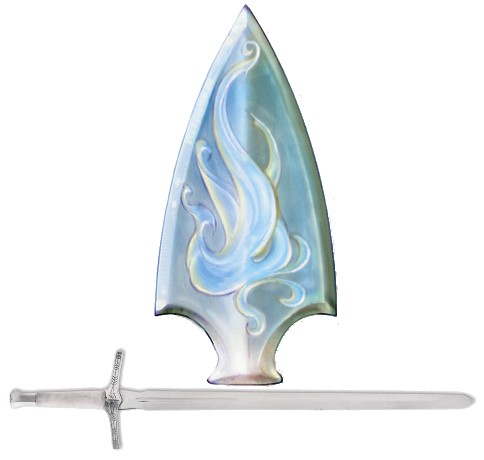
| Capitale | Fort-de-la-Flamme |
|---|---|
| Gouvernement | Théocratie / Monarchie |
| Souverain | Gardien de la Flamme Jaela Daran / Reine Diani du Wynarn |
| Population | 2.3 million |
| Gentilé | Thranais, Thranaise |
| Races | 70% Humains 10% Demi-Elfes 09% Nains 04% Elfe 04% Hobbits 03% Autres |
| Religions | La Flamme d'Argent, Légion Souveraine |
| Exportation | Art et Artisanat, laine, textiles, missionnaires, fruits, bétail |
| Reconnue pour | Magie divine, Flamme d'argent |
| Fondateur | Thalin, deuxième descendant du roi Jarot |
| Devise nationale | “Gloire à la Flamme d'Argent” |
| Climat | Tempéré |
Postwar Thrane Imagine being surrounded on all sides by angry, resent- ful neighbors, and you can begin to understand how
Highest Point: Trumpet Mountain in the Starpeak Range, elevation 10,965
Thrane is one of the original Cinq Nations that formed the Royaume de Galifar before La Dernière Guerre. It is the only nation out of the Cinq Nations that has replaced its monarchy with a theocracy. Unlike the other nations which largely worship the Légion Souveraine religion, Thrane's state religion is the Église de la Flamme d'Argent.
Geography
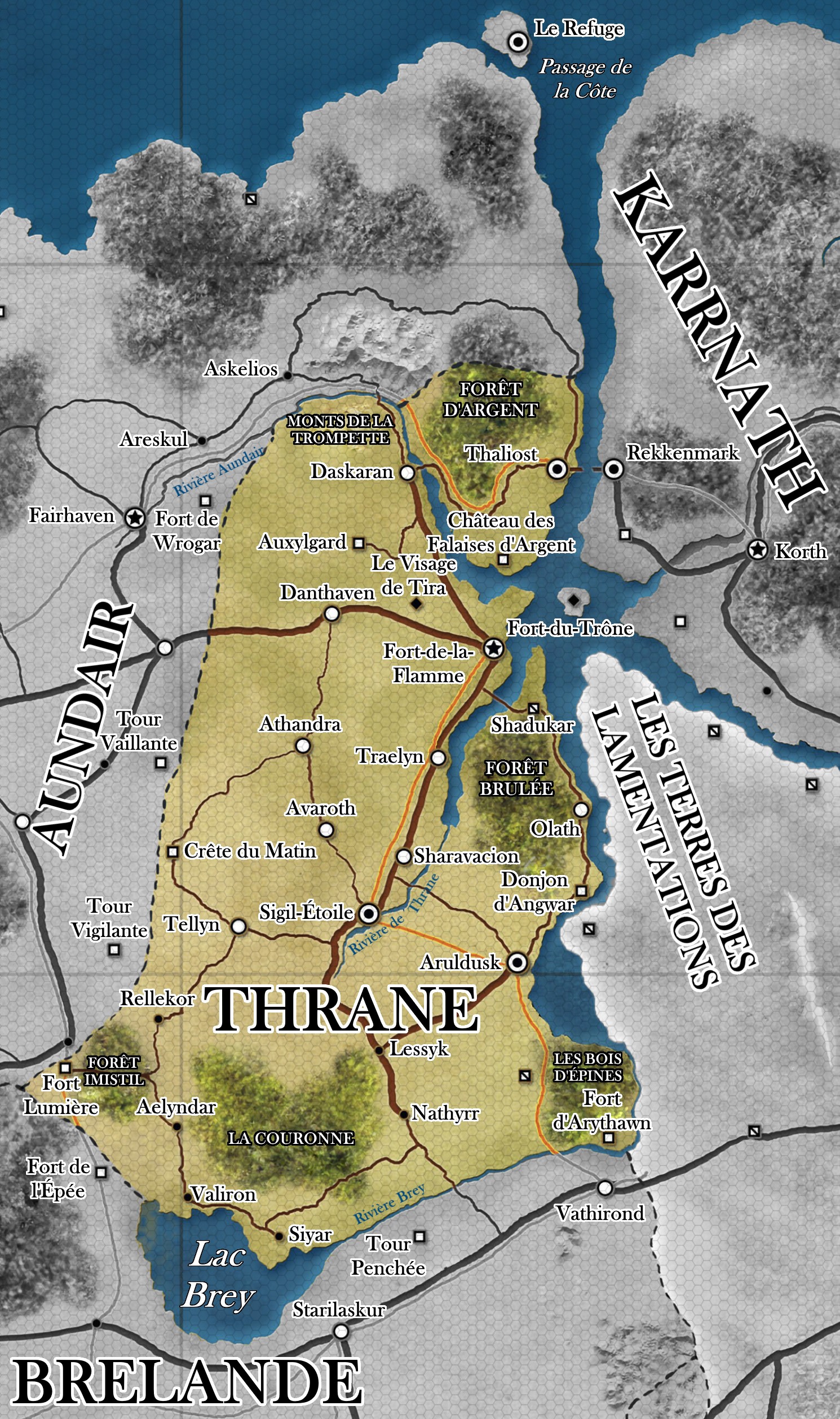
Thrane is located in central Khorvaire, sharing its western border with Aundair and its southern one by Brelande. It also shares a small land border with Les Terres des Lamentations in the south-east though is largely separated by Passage de la côte. Thrane occupies a rich territory of fertile farmland and large forests. With natural waterways demarcating most of its boundaries, Thrane was the only nation not to lose territory due to the Traité de Fort-du-Throne. Thrane also shares the closest proximity to Fort-du-Trône.
Society & Culture
The Thranish people are overwhelmingly honest and passionate about their state religion The Église de la Flamme d'Argent. Thranish culture is conservative in that the Thranish are devoted to religion, family, work and puritanical ideals. Thranes are known to be hard working, once accepting a task they devote themselves to its completion. The Thranish tend to lead abstinent lives, gambling, carousing and similar hedonistic activities are frowned upon.
Religion
Despite Commun belief, the majority of Thranes are not zealots and tolerate other belief systems because most are aware that Tira Miron hersElfee started as a paladin of Dol Arrah. The Thranish understand that The Flamme d'Argent demands its followers only destroy evil incarnate in the forms of the Mort-vivant, fiends and other abominations. If a paladin sensed the evil within a person they would council them back to the light and as a rule would not attempt to execute them. However on some extreme occasions this has been too hard a set of ideals to follow.
Art
Thranish art embraces and expresses the tenets of the Flamme d'Argent. The most popular style of art in Thrane is Kree-Flammic, a stylized form of rendering that uses cubes and triangles to create all shapes and images. A counterculture has emerged within Thrane's art world known as Style Pré-Royaume and though still small it is growing.
Cuisine
Most foreigners tend to think that the theocracy stifles secular life in Thrane however, Thranish cuisine is surprisingly good. During a diplomatic visit Princess Wroya of Brelandeonce said “It is like a breath of fire in the cold of a dark winter's night” after partaking in the Feast of the Flamme d'Argent.
Thranish cuisine utilizes thrakel spices cooked in thick sauces. Thrane cuisine tends to be heavy, filling and spicy. Renowned Thranish dishes are thrakel-seared beef in red sauce, three-thrakel fish stew and silvered vegetable skewers. Desserts are also popular and are used to counteract the spicy nature of the main meal. The desserts are often sweet and served cold the most famous of which is silverfruit pie topped with beesh-berry sorbet.
Groupes Influents
- The Galifar Loyalists
Hymne National
O Flamme d'Argent, éclaire le chemin
Au travers de la guerre, des ténèbres et du désespoir ;
O Flamme d'Argent, nous ne nous égarerons pas !
Esprit de Thrane, entends notre prière.
Aucun ennemi ne peut atténuer ta lueur argentée
Aucun enfant ne peut vivre au-delà de ta lumière
Avec l'épée à la main,
Vos soldats se tiennent debout,
Ô Flamme d'Argent, brûle toujours fort ! L'hymne national Thranais Éclairez le chemin
Politics
Politically Thrane is very distinct to that of the other Cinq Nations. The most notable deviation is that it is no longer a monarchy but the first and only theocracy of Khorvaire. After the death of King Thalin many were concerned about the weakness of the next in line, Prince Daslin. Since the country was at war it was relatively easy to convince the people to want to replace the prince. In 914AR reigning Prince Daslin acceded the throne to the Flamme d'Argent church without opposition. Being a theocracy of a foreign religion to that of its neighbors, Thrane often feels isolated and had the most difficulty during La Dernière Guerre making alliances.
Who should rule the country is probably the biggest political debate within Thrane. The majority are content with the status quo however, many believe that the monarchy should be restored. To this day the scions of the Thranish monarchy are simply figureheads without any temporal power. Ruling Queen Diani du Wynarn supports the return of the monarchy and many Thranes, especially nobles support her return. A third proposition to this problem exists within Thranish politics, one held by Captain Otherro of the Knights of Thrane is that the monarchy should be restored to rule alongside the church rather than replace them.
Supporting the side of restoring the monarchy however, are a group of extremists known as The Galifar Loyalists or Porteurs du Trône colloquially. This group criticizes the events in which the church seized control of the nation casting doubt on its legitimacy.
Thrane is still rebuilding from the results of La Dernière Guerre and its treasury is low on coins. It is in debt to many Maisons Marquées Du Dragon, particularly Maison Kundarak and in return its citizens are overtaxed. Unable to afford large scale repairs many cities show signs of destruction wrought by invaders.
The Maisons Marquées Du Dragon find it very difficult to operate within Thrane due to the church's strict legislation.
Histoire
Under Galifar
La Dernière Guerre
Cities and settlements
Aelyndar Fin-du-Crépuscule Athandra Danthaven Daskaran Fort-de-la-Flamme Lessyk Nathyrr Olath Sharavacion Étoile-polaire Siyar Thaliost Valiron
Villes de Thrane
Aelyndar · Donjon d'Angwar · Arolangard · Fin-du-Crépuscule · Donjon d'Arythawn · Athandra · Auxylgard · Avaroth · Château de Rhonewatch · Danthaven · Daskaran · Fort-de-la-Flamme · Fort Lumière · Harrowgard · Lessyk · Crête-du-Matin · Nathyrr · Olath · Rellekor · Fort Sentinelle · Shadukar · Sharavacion · Étoile-polaire · Château de la Falaise d'Argent · Siyar · Tellyn · Thaliost · Traclyn · Valiron
Autres Sites Notables
*
- The Visage de Tira
- Shadukar
- [[Thrane River|Thrane River
The modern Église de la Flamme d'Argent was founded in Thrane, and most of the people of the nation follow this faith. During La Dernière Guerre, the people of Thrane chose to set aside the rule of the monarchy and to embrace the leadership of the church. For the last seventy years, Thrane has been a theocracy. The head of the state is 11-year-oldjaela Daran, the divinely selected Keeper of the Flame. ] aela depends on the Council of Cardinals to perform the practical work of running the nation. The primary purpose of the Flamme d'Argent is to defend the innocent from supernatural evil. The church has always had a militant aspect, with battalions of templars and peasant militias prepared to face Mort-vivant, lycanthropes, or other monstrous threats. But compassion and charity are core values of the church, and the templars are tasked to defend all innocents. Even during the La Dernière Guerre, if a fiendish threat arose in a Brelon village, Thrane templars would ally with the locals to bring an end to the threat. Not all Thranes rise to this ideal. Zealous Thranes believe the church is destined to reunite Galifar under the Flamme d'Argent, and corrupt priests are interested only in power and wealth. Not all priests are clerics, and the typical templar is a mundane warrior. However, due to the deep faith of its people, Thrane produces more clerics and paladins than any other nation in Khorvaire.
INTERESTING THINGS ABOUT THRAN E • Faith is part of daily life in Thrane, and divine adepts provide important services. Magic is also Commun in Thrane. Lanterne Éternelles light the streets while Mage-artisans and wizards practice their trades, though there are fewer of them than in other nations. • Every town has a militia ready to deal with supernatural threats, and people stand together to fight darkness. Champions of the light find support and hospitality, but any character who dabbles with dark forces-necromancers, warlocks, and the like-finds Thrane a dangelrous, unwelcoming place. The feudal system of nobility remains in place, but ultimate authority rests in the hands of the church. Queen Diani du Wynarn is the “blood regent,” serving as a symbolic advisor to the Gardien de la Flamme. A small fraction of the population would like to see the traditional monarchy restored to power. THRANE CHARACTERS A s you develop a Thrane character, consider the following details: T he Impact of Faith. If you want to reflect a close bond to the Flamme d'Argent, you could gain a few divine spells by taking the Magic Initiate feat. Archery is a devotional practice of the Flamme d'Argent, so as a martial Thrane you might focus on archery-related combat styles or take the Sharpshooter feat. Any Thrane could take the acolyte background to reflect a strong connection to the church or the soldier background based on service with the templars. Church or Crown? Do you support the theocracy, or would you like to see power restored to the throne? Many people of faith believe that miring the church in politics distracts it and invites corruption. Dealing with Darkness. The Ombre dans la Flamme can tempt even the most virtuous soul. How do you react when you encounter corruption and greed? Are you a compassionate person who seeks to lead people to the light, or a zealot determined to crush all darkness? C ITIES AND SITES The Church o f the Flamme d'Argent i s a militant faith, and Thrane communities are built around fortified churches designed to serve as fortresses in times of trouble. Larger towns maintain sturdy walls patrolled by skilled archers. A Flamic architectural style appears throughout the region. Buildings incorporate light and soaring spaces, and icons of the Flamme d'Argent and images of the martyr Tira Miron appear throughout the nation.
Fort-de-la-Flamme The spiritual heart and capital of Thrane, Fort-de-la-Flamme is a massive fortress city. The Gardien de la Flamme dwells in the great Cathédrale de la Flamme d'Argent, which holds the pillar of fire born when Tira Miron sacrificed hersElfee to bind the demon Bel Shalor. The cathedral is the seat of the Council of Cardinals and the primary garrison of the templar order. Fort-de-la-Flamme is also home to Thalingard, the ancestral palace of the rulers of Thrane and current residence of Queen Diani du Wynarn. SHADUKAR Shadukar is a grim reminder of the cost of the war. Once known as the J ewe! of the Sound, this coastal city was destroyed in a bitter siege against Karrnathi forces. The city has yet to be reclaimed, and it's said to be haunted both by Thrane ghosts and by Mort-vivant forces left behind by the Karrns. ThALIOST An ancient Aundairian city seized during the Last War, Thaliost was ceded to Thrane under the Treaty of Fort-du-trône. Many of its people bitterly oppose the Thrane occupation, but it's also become a haven for Aundairian followers of the extremist Pure Flame sect; violence often breaks out between these two factions.
AFTERMATH OF La Dernière Guerre The war is over, but deep rifts remain between Thrane and its neighbors. Aundairian war magic created a blasted wasteland between the two nations. To the east, the conflict with Karrnath left farms and cities such as Shadukar devastated and abandoned, home only to the lingering Mort-vivant left behind after the Karrnathi retreat. For most, these grim reminders of war strengthen Thrane resolve. The Commun people are united by their faith and sure of the righteousness of their cause. The Flamme d'Argent urges people to stand together in the face of evil, and across the nation, villagers work together to repair the damage inflicted during the war. People in a Thrane village regularly cooperate to raise a barn or practice archery in the fields. The Flamme d'Argent urges its followers to feel compassion for all people, which often proves a more difficult challenge. Thrane has never forgiven Karrnath for its use of Mort-vivant soldiers, and many Thranes are quick to imagine all Karrns as agents of darkness. Likewise, Thranes have bitter memories of the conflict with Aundair, and Aundairian wizards or eldritch knights receive a cold reception. For most Thranes, the war strengthened their faith and drew them together. However, some question the validity of theocratic rule. Such doubt can be found even among the most devout followers of the faith; such people fear that the merging of temporal and spiritual authority distracts the church from its proper mission. If these doubts spread, a serious faction might seek to restore Queen Diani to power. Thaliost is another open wound. The Council of Cardinals is determined to hold onto this prize, but it is a bitter point of contention with Aundair and a constant source of tension and violence. In creating a Thrane character, consider how you feel about Thaliost. Would you like to see it returned to Aundair, or do you support Thrane's rule?
One night in Olarune of 299 AR, the settlers and farmers of Thrane saw dark clouds gathering over the Tamor Hills. A ruddy glow rose from a fi ssure in the hills. Those who explored the chasm did not return. As months passed, fiends and bloodthirsty beasts crawled out of the fi ssure and threatened the land. The Year of Blood and Fire was a time of great terror, but it was also a time of inspiration. The holy warrior Tira Miron gathered priests and soldiers to fi ght against the darkness. Armed with a singular vision, she ultimately confronted the evil forces within the Tamor Gap, binding their fiendish lord and transforming its dark flame to a font of silver light. Through her sacrifice, she became a spiritual vessel for the Flamme d'Argent, a conduit through which it could touch the souls of others. Many in Thrane see the Year of Blood and Fire as a turning point. Inspiré by Tira’s sacrifice and guided by her spirit, Thranes destroyed or drove off the remaining fiends. The Commun folk turned to the new church in droves, and the citadel of Fort-de-la-Flamme was soon established. The Église de la Flamme d'Argent spread across Khorvaire, but Thrane remained its heart. The good people of Thrane had seen the horror of unrestrained evil, and they were determined to stand against that darkness. At times, this missionary zeal spun out of control. Queen Joliana’s fervor for the Flame nearly shattered the Royaume de Galifar centuries before the death of Jarot. However, most of the followers of the Flame have shown tolerance toward those who pursue other faiths, saving their strength to battle inHumain and supernatural evil. If the Year of Blood and Fire was the fi rst major turning point in the history of Thrane, the second was surely the death of King Thalin. The Council of Cardinals had grown in power and influence, and Thalin’s heir, Prince Daslin, was seen as weak. Above all, the nation was at war. It took little effort on the part of the cardinals to convince the people to raise the church above the throne, and Daslin himself acceded to the demand without a struggle. In 914 AR, Thrane officially embraced the Church of the Silver Flame as its ruling body, becoming the fi rst true theocracy in Khorvaire. While a few archbishops and cardinals crave personal power, most believe that the rule of the Flame is best for Thrane and for Khorvaire. This uncompromising zeal made it difficult for Thrane to form lasting alliances during the La Dernière Guerre, but the resolve of its clerics and paladins allowed the nation to hold its own even when beset from all sides. The new Keeper of the Flame, Jaela Daran, does not believe that war within Khorvaire serves the goals of the Church. However, many knights and cardinals still yearn to see a Néo-Galifar united under the Flamme d'Argent. And in L'Ombres of the court, the symbolic queen, Diani ir’Wynarn, looks back on the history of her family and dreams of returning her line to the throne.
Royals of Thrane For the better part of a thousand years, the scions of Roi Galifar I—all members of the royal Wynarn bloodline—ruled Thrane. The children of Galifar’s ruling sovereign were always fi rst in line to govern the Cinq Nations. Occasionally, as happens when there are fewer suitable heirs, governorship of Thrane fell to trusted regents drawn from other parts of the family. As with the other Cinq Nations, Thrane was administered by the governor-princes as part of the Kingdom of Galifar from the founding of the kingdom until 894 AR. In that year, as the struggle for the crown that caused the La Dernière Guerre escalated, Thrane broke from the kingdom and declared itself an independent monarchy under the rule of King Thalin. Thalin, like many of the Thrane-based ir’Wynarns, was a devoted follower of the Flamme d'Argent. He broke with tradition in order to exercise what he saw as his divine right to the Galifar crown. With the kingdom under his control, he could elevate the Flamme d'Argent to its proper position as the one true religion of the land and the people. In many ways, it was Thalin’s zealous faith that led to the next stage in Thrane’s history. Thrane remained a monarchy until 914 AR, when it became a theocracy governed by the Church of the Flamme d'Argent. At that time, temporal and spiritual power fell to the Council of Cardinals and Le Geolier of the Flame. Although the Wynarn line in Thrane continues to appoint blood regents (eldest scions of the royal family), these scions are merely fi gureheads without any temporal power. The rulers of Thrane are outlined on the table below. This information can be gleaned with a DC 10 Gather Information or Knowledge (history) check. The monarchy doesn’t last long, as the theocracy of the Silver Flame takes over the country after Thalin’s death.
| Date | Monarque/Régent |
|---|---|
| 885–914 AR | Thalin (déclaré roi de Thrane en 894 AR) |
| 914–945 AR | Daslin (régent, la Flamme d'Argent détrône la famille royale) |
| 945–988 AR | Erivon (régent) |
| 988 AR–Présent | Diani (régent) |
KEEPERS OF THE FLAME
In 299 AR, the Flamme d'Argent was born. One year later, the newly christened Église de la Flamme d'Argent appointed its fi rst Gardien de la Flamme—a spiritual leader of the nation who could commune directly with the Flame and pass its will onto the people. In 914 AR, amid the turmoil of the La Dernière Guerre, the people of Thrane abandoned the monarchy and invested the Gardien de la Flamme with temporal as well as spiritual governorship of the nation. Thrane became the fi rst theocracy of Khorvaire.
The following dates and names show Le Geoliers through the years and can be gleaned with a DC 10 Gather Information or Knowledge (history) check. Date
| Date | Gardien de la Flamme |
|---|---|
| 300–320 AR | Maliah Sharavaci |
| 320–389 AR | Traelyn Ghelios |
| 389–461 AR | Darmin Avaroth |
| 461–524 AR | Kyra Danth |
| 524–525 AR | Bec Avaroth |
| 525–578 AR | Valiron Silverthorn |
| 578–610 AR | Torah Ariadu |
| 610–698 AR | Saren Rellek |
| 698–768 AR | Jareen Imistil |
| 768–825 AR | Aelyndari Valystar |
| 825–860 AR | Jolan Sol |
| 860–863 AR | Tzandra Corus |
| 863–903 AR | Jovor Daran |
| 903–936 AR | Kaith Serrain |
| 937–993 AR | Lavira Tagor |
| 993 AR–Présent | Jaela Daran |
ROYAL SUCCESSION Roi Galifar I established a method of government and succession that lasted for almost a thousand years. It was a process with a specific structure that, in practice, rarely worked as presented in the royal decree. By decree, when the current monarch abdicated the throne (usually to retire) or died, his or her oldest living scion became king or queen. As the new monarch accepted the crown and took charge of the kingdom from the seat of power in Fort-du-trône, his or her five oldest sons and daughters ascended to the governorships of each of the Cinq Nations. Over the centuries, the reality did not always match the decree. Not every monarch had a scion of ruling age when he or she died, for example, and many did not have five children of their own to pass the administration of the Cinq Nations to. (The preferred age to take the crown was nineteen, though some were allowed to be crowned as young as sixteen, some were denied until they were twenty-one, and many were not afforded the option until they were much older, depending on how long their parent stayed on the throne.) In general, the practice developed such that the crown heir’s children were sent to study at the feet of the current governor-princes, learning about the portion of the kingdom that he or she would one day administer. If a new monarch ascended the throne but was too young to govern, the prior governor-princes remained in place or regents were appointed until the scion could take over the role.
The overwhelming majority of Thranes are honest, proud, and passionate people who believe in the Church of the Flamme d'Argent. Equally devoted to family and work, Thranes do nothing halfway. If a citizen of Thrane undertakes a task or agrees to serve a cause, he gives it his all. That said, few Thranes are mindless zealots. Most followers of the Flame tolerate other belief systems. After all, Tira Miron herself began as a paladin of Dol Arrah. The Flamme d'Argent demands only that its followers fight evil, whether it’s evil incarnate—fiends, Mort-vivant, and other abominations—or the evil that plagues the Humain soul. If a paladin of the Flamme d'Argent senses evil in an innkeeper, he should try to find a way to bring that soul back to the light, not strike down the innkeeper or destroy his business. However, this is a hard road to follow, and try as they might, many Thranes do not measure up to these high ideals. In general, Thranes lead ascetic lives. Gambling, carousing, and similar activities are frowned upon in the land of the Flamme d'Argent. Religious observances are very important. However, not all Thranes see eye to eye. Many are divided on the importance of the monarchy, for example. Most citizens pledge their greatest loyalty to the Church, but a small faction holds to Queen Diani ir’Wynarn and the line of Galifar. Some of these loyalists reject the power of the Church entirely, while others (such as Captain Otherro of the Knights of Thrane) believe that both have their place in the kingdom, and that it was a mistake to upset the balance between the two.
SOCIETY TODAY
Thrane is still rebuilding as a result of the La Dernière Guerre. It has few coins left in its treasury, it owes money to various Maisons Marquées Du Dragon (Maison Kundarak in particular), its citizens are overtaxed, and its cities still show signs of the carnage and destruction wrought by Aundairian, Brelon, Cyran, Karrnathi, and Darguun invaders. The Maisons Marquées Du Dragon have trouble acting within the tight strictures of the Église de la Flamme d'Argent, and they must trod carefully around prickly, overbearing cardinals. The La Dernière Guerre brought pain and loss to every family in Thrane. Dead brothers, sisters, sons, and daughters are remembered in daily prayer. Cardinal Yisek, who spoke out against the war, proclaimed that “the La Dernière Guerre was about who gets to sit on that old chair in Fort-du-trône.” The sad irony is that after Thalin’s death, Thrane forsook the royal bloodline altogether. When the nation transformed into a theocracy, Thranes stopped fi ghting for their king and instead began fi ghting for land and for the greater glory of the Flamme d'Argent. It’s no wonder that many Thranes today feel detached from the rest of the Cinq Nations. Although Thranes hear news of rampant corruption in the cities of Aundair, Breland, and Karrnath, they are blind to the corruption within their own borders. Too many officials who learned to abandon their morals and ethics during the La Dernière Guerre remain in power, wearing their faith like a mask and cleverly hiding their personal agendas and thirst for power. Whether the theocracy can survive the machinations of these tainted few remains to be seen.
THRANE
the Commun Thrane feels. Thrane shares borders with all four of its longtime enemies, and Thrane alone abandoned the royal bloodline of Galifar in favor of a theocracy. Moreover, Thrane seized parcels of land from Aundair and Breland—territory that Queen Aurala and Roi Boranel would like returned. Thrane has also been duly chastised for its cruelty. It Démontrated a startling lack of compassion when it denied Cyran refugees a new home after the destruction of their homeland, and vengeful Karrns resent Thrane for the ruthless bombardment of their capital—an audacious attack that left the imperious Karrnathi citizens feeling vulnerable and defenseless. Surrounded by such resentment, Thranes can ill afford to lead carefree lives. However, they take great comfort in the Flamme d'Argent, for it has never broken their trust or led them astray.
THE ROLE OF MAGIC
Thranes have never shied away from arcane science. While arcane magic has its place in postwar Thrane,
FIVE EDICTS OF THE CHURCH 1. Trust in the Flamme d'Argent. The Voice of the Flamme d'Argent never lies. It will light your way to glory and salvation. 2. Heed the words of Le Geolier. Le Geolier of the Flame is your emissary. Through Le Geolier, the Flamme d'Argent speaks. 3. Fight evil in all its forms. Not everyone can have the strength or conviction of a paladin, but there are many ways to fi ght evil that don’t require one to draw a sword. We must also remain vigilant, for the one thing evil does well is hide in plain sight. 4. Lead a noble life, and encourage others to do the same. Temptations abound, but the wisest of us can recognize and avoid them. If you die with a pure spirit, you will be forever bound with the Flamme d'Argent. 5. Share the faith. The Flamme d'Argent can purify the darkest spirit. Share the power of the Flame with those who have not yet embraced it. 131
THRANE
citizens these days concentrate their energy on spiritual devotion. Thrane’s lack of arcane sophistication is countered by the widespread use of divine magic. While arcane magic is not seen as evil, most Thranes regard excessive devotion to arcane studies as a distraction from the light of the Flamme d'Argent. Likewise, most followers of the Flame are tolerant of those who worship the Légion Souveraine, but they judge other religions more harshly. The Le Sang Divin is seen as an abomination, and the Thranes have never forgiven Karrnath for embracing this darkness.
R oleplaying a Thrane Thrane culture demands restraint and control, but when a Thrane shows emotion, everyone knows it. Offended or upset, a Thrane may very well respond like a focused blast of fi re, either incinerating what invokes his displeasure or smoldering for a long, long time. It is considered rude to shout or rant, so Thranes show their opposition in very brief and very precise displays. Thrane citizens grow up learning exactly where the boundaries of propriety and modesty lie, but the wise ones learn how to defy such rules without explicitly breaking them. When rules are circumvented, success can justify forgiveness. Some foreigners see this as a double standard, but natives consider such behavior a very precise code of conformity. When dealing with elders or authority, young Thranes are reverent, obedient, and proper, but when left to their own devices—as is often the case among Thrane adventurers—they burn with passion and intensity, either resolving problems with the swiftness of an inferno or searing all opposition until it melts away. Thranes do not typically see themselves as zealous, fanatical, or hypocritical. While these extremes do exist in Thrane society, such attitudes are more villainous than heroic. Thranes are certainly very passionate, and that passion applies to all aspects of life, not just religion. Many learn about heroism from an early age, including a few notable stories of spectacular failures that are now seen as heroic. Boys and girls play at being paladins, and in recent years, many young women go through a “Jaela Daran” phase. The nation’s heroes are not reckless or stubborn in battle—those who are don’t survive for very long. However, the average Thrane has an instinctive sense of right or wrong, just as a paladin has a supernaturally strong sense for what is good and evil. Many are dedicated to preserving what they know is right, and more important, supporting those who are willing to make that same sacrifice.
Thrane Style While Thrane continues to show the cultural influence of its Galifaran roots, the attitudes and influences of the Église de la Flamme d'Argent have overlaid the old with the new, giving much of the country a decidedly different feel from its neighbors.
ART
The people of Thrane embrace the tenets of the Silver Flame in all of their forms of expression. From fi ne art to sculpture, the most popular artistic style remains Kree-Flamic, a stylized form of rendering that uses cubes and triangles to create all shapes and images. Jesp Kree pioneered the style; he served as the Church Art Master for Keeper Traelyn Ghelios and helped establish the principles of the Flamic style. From stained glass in the great cathedrals that present stylized images of great moments in the faith’s history to the three-sided, stained-glass fl ame boxes found in the homes of many followers of the Flamme d'Argent, almost all Flamic-style art pays homage to the Church and its significant fi gures. Of course, not everyone in the country adheres to the tenets of the Flamme d'Argent. A small but growing artistic counterculture has taken root in Thrane. Called Style Pré-Royaume by critics and practitioners alike, the form harkens back to the art created before the coming of Galifar and the united kingdom. It is a raw, Humainistic form that draws on strong emotions, primal urges, and topics more grounded than the religious ideals depicted in Flamic art. Although it is not outlawed, some Church leaders and the most conservative of the faithful dismiss Pre-Kingdom art as frivolous, distracting, and in some extreme cases even perverse.
ARCHITECTURE
Thrane architecture features Galifar-style towers and keeps, deep-wood long homes, and Flamic-style cathedrals and public buildings. In some places, the older-style construction has been modified to incorporate Flamic elements, while newer buildings fully embrace the Flamic style from the ground up. Flamic architecture features tall windows and open arches to let in light, and incorporates an open, soaring use of space to revere the power of the Silver Flame. From urban centers to the larger villages in the countryside, Thrane surrounds itself with religious symbols, edifices, and art that makes the entire country feel like an extended church. The La Dernière Guerre caused much damage to the infrastructure of the country, and today Le Geolier of the Flame and other Church officials have begun to put programs in place to repair what has been damaged and replace what has been destroyed. The newly appointed Art Master, Kenra Deel, has been charged with updating the Flamic style for the new generation. Her fi rst project, the impressive Tower of Cardinals, now under construction in Thaliost (much to the dismay of Aundair), shows signs of taking the Flamic style in new but wholly appropriate directions.
CUISINE
While the heart and soul concentrates on the Silver Flame, the collective stomach of Thrane looks to the country’s unique cuisine for a different kind of religious experience. Many find that secular life in Thrane is stifled by the theocracy, but few who come to the country find the food to be disappointing. “It is like a breath of fire in the cold of a dark winter’s night,” said Princess Wroya of Brelandeduring a diplomatic visit to Thrane, after partaking in the Feast of the Flamme d'Argent. Utilizing thrakel spices cooked in thick sauces, Thrane cuisine tends to be heavy, fi lling, hot, and delicious. Thrakel-seared beef in red sauce, three-thrakel fi sh stew, and the traditional silvered vegetable skewers are particular favorites in Thrane and beyond. The people of Thrane also enjoy their desserts, but here they take a different tack. To counter the spicy nature of the main meal, Thrane desserts tend to be sweet and served cold. Beesh-berry sorbet on top of silverfruit pie is considered the best of many tempting desserts.
Plots and Factions Postwar Thrane has more than its share of plots and intrigues both within the Église de la Flamme d'Argent and beyond. Thrane harbors many extreme orders, including a few the ruling theocracy would prefer to disavow. Some Thranes believe the very fact that such orders persist calls into question the morality and dedication of the nation’s rulers. Others champion ideals such as freedom of speech and expression, insisting that if Thrane’s elders hunted organizations that do not share their beliefs and persecuted them, the nation truly would become a tyranny, more than its enemies already believe it to be. For all the rhetoric about the “tyrannical theocracy,” tolerance abounds in Thrane. Its citizens believe that they act for the Commun good, and they believe the country’s clerics and paladins oppose absolute evil when they fi nd it. Despite efforts to unify belief and loyalty, passionate Thranes are often in conflict with one another about the government and future of the nation.
THE THEOCRACY
The most powerful and influential organization in Thrane is its theocracy, the very government that now controls both church and state. United under a Commun faith, the theocracy is cohesive enough to defend and inspire a troubled nation, but it’s a young government fi lled with lesser groups and aspiring individuals who struggle for power within it. The structure of Thrane’s theocracy is similar to the Église de la Flamme d'Argent itself, with a series of ranks: Priests tend to temples, bishops watch over the larger towns and cities, and archbishops travel throughout a region. Councils of cardinals govern larger regions and, like legislators, are empowered to Thrane defenders in Donjon d'Angwar draft new laws when needed. Thirteen High Cardinals oversee these various councils, gathering in Fort-de-la-Flamme to heed the words and wisdom of their spiritual leader, Jaela Daran. The High Cardinals accept visitors from various noble houses and organizations and determine what is best for the theocracy and its constituents. Not every priest and cleric in the Church of the Silver Flame is a “theocrat.” Only those chosen by the High Cardinals are invested with the power to enforce (or make) law. Theocratic laws and doctrine are not universally applied to the nation. Instead, a bishop or archbishop has the authority to determine what he thinks is best for the citizens in his domain. One would hope this authority is tempered by faith and respect for the Church’s teachings, but it is entirely possible that a bishop may act out of personal interest when he decides what it is right and wrong. In theory, cardinals watch over bishops and archbishops for signs of corruption, but Khorvaire’s marvelous means of transportation don’t extend everywhere. It is possible that a corrupt priest or bishop in a small village or town might escape notice for a time. Travel to any city in Thrane, and you’ll soon learn the name of the local theocrat, his immediate superiors, and high-ranking potentates who watch over the land for miles around. Thrane’s government isn’t an abstraction, after all—in any place smaller than Fort-de-la-Flamme or Thaliost, the Church’s authority is represented by a single individual or small cabal whose word is law. Most theocrats are lawful good, but even they can make life difficult for adventurers despite the best intentions. Lawful theocrats put the needs of entire cities or regions first, while chaotic ones may act out of simple arrogance or ambition. Evil theocrats exist, but they must take special measures to conceal their alignment and agenda from Thrane’s crusaders and investigators. Getting PCs Involved: Priests, bishops, and archbishops often use noble adventurers to combat evils threatening their villages, towns, and districts. They are, after all, responsible to ensuring the safety of their fellow citizens. Heroes who prove their worth might become embroiled in Church politics as their deeds become known and other Flamme d'Argent temples call upon them for aid. In time, they are bound to inadvertently offend one bishop by serving another, and managing these relationships will require some delicacy on their part. Characters who aid the Church might also be called upon to root out evil cultists lurking in Fort-de-la-Flamme, slay evil monsters haunting an ancient Dhakaani ruin, rescue an abducted archbishop, investigate a foreign diplomat suspected of plotting against the Church, locate some missing missionaries in the Confins d'Eldeen, recover Flamme d'Argent relics from a ruined temple in the Les Terres des Lamentations, or catch thieves who have stolen something precious from the tomb of one of Thrane’s great leaders.
La Torche d'Argent
As one of the most fervent religious and political sects in the nation, La Torche d'Argent represents the very beliefs many outsiders fear when they think of Thrane. Born as a secret society at the start of the La Dernière Guerre, La Torche d'Argent presently includes several outspoken individuals who proudly claim membership. Only its “inner circle” of leaders maintains absolute secrecy. La Torche d'Argent believes in the Flamme d'Argent and seeks to turn, punish, or eliminate unbelievers. Its members (called Torchbearers) have no faith in the modern government, which they believe has strayed from the path of ideological purity by compromising with other nations and organizations that have little or no faith in the Flamme d'Argent. Sect fanatics ostracize anyone who is not Humain. The state does not exile a citizen for voicing such opinions, but those who openly profess loyalty to the sect are watched closely in case they should choose to act on their bigoted or dangerous beliefs. When La Torche d'Argent is outraged, one can expect a mob armed with torches and pitchforks in the streets shortly thereafter. On several occasions, the theocracy’s defenders have raided Torch meetings, but eliminating this one sect would call into question the very existence of many others. The theocrats routinely disavow any connection to La Torche d'Argent, even as they accept its existence. Torchbearers use propaganda to gather new members. They prey on Thranes who have suffered unduly during the war as well as disenfranchised youth looking for trouble in all the wrong places. They claim that the Treaty of Fort-du-trône should not apply to Thrane, since it does not swear fealty to the Galifar line. Others maintain even more ridiculous beliefs, such as the notion that the faithful should retake and purify the Les Terres des Lamentations. Moderate Thranes have little patience for the Silver Torch but hold them up as an example of the perils of zealotry and proof that the nation’s theocracy is not as rabid or hostile as its enemies would make it seem. Getting PCs Involved: Thrane’s government abides by the Treaty of Fort-du-trône for the most part, but old hatreds still smolder. Wise heroes can play a role in preserving peace by stopping La Torche d'Argent and similar sects that endeavor to fan the fl ames. The Torchbearers’ intolerance and use of propaganda, coupled with their rights as protected citizens of Thrane, make them difficult for adventurers to deal with. Torchbearers use the law as a shield and are more likely to attack heroes with words than swords. Adventuring parties that include nonHumain members might run afoul of La Torche d'Argent through no fault of their own. The sect might send spies to watch them and report on their activities. If the adventurers appear to act against the will of the Flamme d'Argent, the Silver Torch might alert the local theocrat or distribute literature professing the dangers of allowing “swordwielding infidels who call themselves adventurers” such free rein within Thrane’s borders.
THE CHALICE OF BLOOD
HOST OF THE FAITHFUL
Roughly three percent of Thrane’s citizens worship the Légion Souveraine instead of the Flamme d'Argent. Modest shrines to the Légion Souveraine can be found in most of the nation’s major settlements, although they pale next to the Flamme d'Argent’s magnificent and ostentatious cathedrals. Groups who worship the deities of the Légion Souveraine are collectively called the Host of
THRANE
Seventy percent of Thrane society is Humain, and Humains hold most positions of authority in Thrane. Despite the presence of a handful of Nain, elf, half-elf, gnome, and halfling bishops and priests, the theocracy seems to favor the Humain race over all others, and all members of the Council of Cardinals are Humain. NonHumain citizens cannot help but feel underrepresented and disadvantaged. Throughout the nation, cabals of nonHumain conspirators have various methods of retaliating against what they view as a corrupt government. Some advance specific political rivals. Others use their mistrust as an excuse for rebellion. The Chalice of Blood lies between these two extremes. Agents of the Chalice of Blood quietly support nonHumain candidates who show political promise within the theocracy. Legal tactics may include preaching about Humain clerics and cardinals with sympathetic views, anonymously making donations in support of a local theocrat or his causes, and speaking in public about the good works a nonHumain cleric has performed. Extremists within the group are willing to enact more drastic measures, such as sabotaging the efforts of Humain religious leaders or even assassinating them outright. This is not to say that the Chalice is strictly antiHumain. When the first cabals of the order met, they spoke of an egalitarian society in which all were equal. Unfortunately, arguments ensued over what constituted “racial progress,” leading to various splinter groups that prefer action to words. As long as the vast majority of Thranes are Humain, the Chalice will have a cause to champion. Coexistence is no longer the watchword it once was within the society. Whenever nonHumains must surrender their agenda to Humains in Thrane, zealots within the society speak of spilling blood instead. Getting PCs Involved: Members of the Chalice keep a watchful eye out for exceptional nonHumains to represent them. Good-aligned adventurers make likely candidates because of their power and prestige. NonHumain clerics and paladins of the Flamme d'Argent are even more desirable. Characters might be approached to help a nonHumain village priest who’s being terrorized by members of La Torche d'Argent or to prove the innocence of a nonHumain framed for theft or murder.
the Faithful. They can trace their lineage back through centuries of Thrane’s history, and they are as much citizens of the nation as those who hold the Silver Flame as infallible. By ignoring them, the theocracy relegates the Host of the Faithful to second-class citizens. In an incendiary postwar culture, worshipers of the Légion Souveraine must remain vigilant and find quiet ways to legitimize their religion. Religious intolerance does not pervade Thrane’s society, but devout followers of one religion remember those who openly practice other religions. Many members of the Host choose to hide their religious affiliation, pretending to revere the Flamme d'Argent while attending secret services for the Légion Souveraine. While the theocracy tolerates such activity when it is found, Flame devotees are sometimes less forgiving. Getting PCs Involved: Characters with any connection to the Légion Souveraine who spend time in Thrane will hear about the Host of the Faithful. They might be called upon to help Arawai-worshiping farmers fi nd the zealous Flame-worshipers who have been slaughtering their livestock, or they might serve as escort for a merchant who worships Kol Korran and learn more about the religious intolerance he faces whenever he trades in Fort-de-la-Flamme. Characters with family ties to Maison Bombardier might be called upon to help worshipers of Onatar (god of artifice and the forge) build a shrine in Fort-de-la-Flamme and deal with the more violent opponents of the project.
THE GALIFAR LOYALISTS (Porteurs du Trône) In the darkest days of the La Dernière Guerre, the Church of the Flamme d'Argent rose to power following a people’s revolt against the monarchy. Several corrupt and minor nobles were driven into exile, and Prince Daslin ir’Wynarn retreated to Château de la Falaise d'Argent. The events that led to this transition of power have been analyzed countless times since then, and many question the legitimacy of what occurred. The horrific events of the La Dernière Guerre, particularly the annihilation of Shadukar, unhinged many citizens. They Perdu faith in the crown. No longer were they willing to place their fate in the hands of mortal men and women, yet critics of the government insist that the clerics, paladins, and priests who now serve the Flamme d'Argent are as fallible as the nobles who ruled before them. Now that the war is over and the worst troubles have passed, they say, it is time for the descendants of Galifar to return to the throne. The Galifar Loyalists (referred to colloquially as “Porteurs du Trône”) believe that Queen Diani ir’Wynarn should lead Thrane into the next century. Many of these loyalists are wealthy nobles whose families have served the Wynarn line for generations, and they trust that Diani will reward their loyalty and support them when she returns to power. In Fort-de-la-Flamme, displays of royal fealty become more subtle and secretive. Lesser nobles hesitate to incur the wrath of the theocrats. However, a scattered band of societies throughout Thrane do more than simply revere their would-be queen. They hold festivals and gatherings for events the nobility supported in years past. Others are willing to extend their loyalty to the nobility to outright subterfuge, espionage, or political opposition of the theocracy. The proponents of monarchy gather all the information they can of the theocracy’s failings, disseminating their critical tracts to all who would (or can) read them. A few know that they cannot tear down a government overnight, so they focus their tirades against a select few theocrats regarded as corrupt or dangerous. The most secretive loyalists form cabals to actually assassinate or eliminate enemies of the nobility, although they typically act independently of any noble. On rare occasions, a noble in exile has used his family’s wealth or connections to fund a group of villains who would tear down theocrats in his former domain. Such scandals, when exposed, vilify all Throne holders. Adventurers on either side of the confl ict should choose their allegiances wisely, since failure can have consequences far beyond the punishments meted by a vengeful theocracy. Getting PCs Involved: Adventurers might fi nd themselves embroiled in a confl ict between the Galifar loyalists and members of La Torche d'Argent or the Whispering Flame (see below) determined to stamp them out. If they choose to ally themselves with the Porteurs du Trône, they will eventually come into contact with influential nobles eager to see the Galifar line restored to power.
Whispering Flame cultist
They may partially fund the heroes’ expeditions in exchange for information on corrupt theocrats or the occasional “small service.” Such services might include bullying some troublesome Torchbearers, thwarting some Whispering Flame cultists, or helping Queen Diani fi nd powerful allies abroad.
THE WHISPERING FLAME
The religious leader of Thrane, Jaela Daran, holds great power within the confi nes of the Cathedral of the Flamme d'Argent. Outside its sanctified grounds, she is but an 11-year-old cleric, but inside, the Flamme d'Argent grants her immense divine power. A small and secretive cult within Thrane believes that Jaela Daran’s gifts come not from Tira Miron or the couatl spirit that sustains the Flamme d'Argent, but from the malevolent demon trapped within the unquenchable fire. Although they would dare not speak such heresy openly, their cult centers on the conviction that infernal voices advise their nation’s spiritual leader. According to the theories, outside forces powerful enough to hide within the Église de la Flamme d'Argent in Fort-de-la-Flamme avoid detection by the many paladins and clerics who frequent it. While this conspiracy theory may seem elaborate, the cultists of the Whispering Flame do more than simply believe in this idea. They hear the voices, and they obey. Only a few evil cults have managed to survive in Thrane—a feat demanding powerful magic, eternal vigilance, and a lack of sanity (or presence of vision, if you prefer). The Knights of Thrane have been ruthless in eliminating such corruption, yet the inner circle of this cult uses an array of spells to mask their alignments, bury their true thoughts, and veil their fiendish schemes. Few gatherings are held; instead, Whispering Flame cultists maintain contact through whispering flame spells (see page 155) and other secretive means of communication. Whispering Flame cultists fi rmly believe that Jaela Daran herself is part of their organization, and that the orders she receives are the same as theirs. Investigators outside the cult hear rumors of Whispering Flame plots to eradicate the last vestiges of the monarchy, ensuring that the Gardien de la Flamme’s rule continues unchallenged. Still others fear that the cultists might be capturing monsters from the Les Terres des Lamentations to unleash upon Thrane or researching ways to unleash the fiend within the Flamme d'Argent. Such ideas are speculative at best, however. The most pervasive theory is that the Whispering Flame cultists are simply insane, which could be the most dangerous rumor of all. Getting PCs Involved: Whispering Flame cultists lurk within all echelons of society, acting on the visions they believe originate from the terrible fiend bound within the Flamme d'Argent. Although most cultists act independently, their individual misdemeanors often link together into a tightly woven plot. For
Foreign Relations Zaharno, a merchant from Fort-de-la-Flamme, shares her thoughts about foreigners, and her opinions reflect those of Thrane’s popular majority: Aundair: “Wizardry and sorcery are well and good, but Aundairians have grown fat on arcane magic. Not every problem can be solved with a spell, and the sooner Aundairians realize that, the better off they’ll be. And now Aurala’s diplomats demand that we return Thaliost to them. We paid for it in blood! All the charm spells in Aundair won’t win back what they’ve Perdu. Let them try to take it by force, and see what happens!” Breland: “Boranel may be a great man, and one cannot help but admire his cities and his willingness to help those poor, displaced Cyrans. However, the Brelon put too much faith in greedy nobles and corrupt politicians. It is as though they are trying to build towers that can reach to the heavens, but without a Commun faith, those towers have no foundation.”
THRANE SPEECH The following turns of phrase are uniquely Thrane. “Crooked!” An expletive, similar to “drat!” “Flame forgive me.” An expression usually preceding or following a nasty curse or insult. “What filth!” An expression of discontent or an indication of nonsense, similar to “hogwash!”
Cyran Refugees: “That was the judgment of the Flamme d'Argent, I tell you. The corrupt and faithless Cyrans got what they deserved.” Darguun: “A recognized nation of Gobelins? What filth! Flame forgive me, but you can’t civilize the uncivilized—Treaty of Fort-du-trône be damned!” Confins d'Eldeen: “The Reachers have been a painful thorn in Aundair’s side, so they have our respect. If only they embraced the power of the Flamme d'Argent and not those pagan druids. Perhaps, in time.” Karrnath: “Damn Kaius and his blasphemous army! The Karrns may pretend to serve the gods, and they may claim to want peace, but no Thrane will ever forget the atrocities committed by the Karrns in Shadukar. I will take their money, but how I loathe them! As long as evil reigns in Karrnath, the bridge between Thrane and Karrnath will never be rebuilt.” Principautés de Lhazaar: “The sea princes put too much faith in the gold coin. Most of them are no better than pirates and vultures.” Bastions de la Nation: “One must admire the Nains’ wry wit and keen business savvy. I don’t think Thrane would have made it through the La Dernière Guerre without the aid of Maison Kundarak and others. It’s no secret that the Nains helped Karrnath through the war as well, although I suspect mutual self-interest governed that alliance. Perhaps with their long lives, Nains have the patience necessary to deal with such insufferable neighbors.” The Frontières de l'Ombre: “Dreary place. I hear the Church has sent missionaries to help the Marchers feel the warmth of the Flamme d'Argent.” Plaines de Talenta: “It’s good to hear Karrns complaining about Talenta raiders pillaging their livestock. A ll Thranes should be grateful that we don’t share an 800-mile-long border with those ferocious little heathens.” Valénar: “The Valénar elves are a violent lot, or so I hear. We don’t have many dealings with them, frankly. They keep to their lands fairly well, although the Cyrans might feel differently. I hear they’re very good with horses, so I suppose we have something in Commun.” Zilargo: “Crafty ones, those gnomes. They chose their allies wisely and survived the La Dernière Guerre pretty much unscathed. Well played. It’s reassuring to hear that so many Zil gnomes have embraced the Flamme d'Argent.”
example, a cultist in Daskaran might receive a vision prompting him to kill a Maison Bombardier Mage-artisan, steal a key in her possession, and bring it to Fin-du-Crépuscule. Meanwhile, a second cultist might receive a vision that prompts him to travel to the ruins of Eston in the Les Terres des Lamentations, retrieve a sealed iron chest from a destroyed Maison Bombardier workshop, and return with it to Fin-du-Crépuscule. Only when the key and locked chest are brought together do the cultists realize what must be done. Characters hired by Maison Bombardier to investigate the death of the Mage-artisan might blunder into a Whispering Flame plot to capture a Maison Bombardier talisman built to destroy or enslave Guerrier de Fer. Perhaps the cultists need the talisman to break into a vault guarded by Guerrier de Fer, or perhaps they intend to sell it to the Seigneur des Lames in exchange for a more powerful weapon or some useful information in his possession. The Whispering Flame’s plots are often tangled in such a manner, and unraveling them can be difficult. Once the Whispering Flame cultists realize the heroes are onto them, they use whispering flame spells to inform others, and soon cultists begin attacking the characters at every opportunity.
Notable Thranes Some of the more important fi gures in Thrane are described below.
JAELA DARAN, Gardien de la Flamme
The spiritual leader of the Church of the Silver Flame has always been a person—usually a Humain—
137
THRANE 138
gifted with visions. The Council of Cardinals receives reports of visionaries throughout the land, choosing one to act as the intermediary between the Voice of the Flamme d'Argent and the people of Thrane. A committee sifts through the charlatans and false seers to fi nd the “chosen one,” although more often than not, fate fi nds a way for this spiritual leader to reveal himself or herself to Fort-de-la-Flamme’s ruling body. For the moment, the spiritual leader of Thrane is also its temporal leader—a precarious predicament for the government of Thrane. Should the current Keeper of the Flame perish, a replacement would need to be found quickly. Eleven-year-old Jaela Daran came from humble origins, the daughter of a craftsman working in Fort-de-la-Flamme. At age four, she manifested an uncanny ability to predict catastrophic events before they occurred. So compelling and accurate were her dreams and nightmares that her father contacted Cardinal Hagaci, who brought her to the Église de la Flamme d'Argent for testing. When Jaela was brought before the Silver Flame, it warned her of a Seigneurs Des Cendres cabal operating secretly within Fort-de-la-Flamme’s walls. Armed with this information, the Knights of Thrane located and eradicated the cabalists. The Council of Cardinals dutifully accepted their new leader, and Jaela’s predecessor stepped down. Jaela Daran has survived assassination plots by rival nations determined to destabilize Thrane’s government. She receives extensive theological instruction within the walls of the Church of the Flamme d'Argent and regularly communes with the Voice, often gaining divinatory warnings of impending trials facing Thrane. On the rare occasions that she must leave the Cathedral, precautions for her protection are elaborate. Current political rhetoric favors the idea of another religious leader being chosen in the unfortunate event of her demise, and thus, many suspect that Fort-de-la-Flamme’s council would appoint High Cardinal Krozen as an interim leader. Others have suggested that the Church should fi nd another visionary, in case anything untoward should happen to Jaela. Jaela herself seems rather humble, modest, and meek for a young girl whose pronouncements alter the history of a nation. She often calls cardinals and councilors before her to carry out what the Voice has planned. Barring revelations from the Silver Flame, the Council of Cardinals is granted enough autonomy to enforce the law as it sees fit. At any time, a pronouncement from the Voice, through Jaela, can nullify or circumvent the cardinals’ authority. Jaela usually dresses in simple gray or black clothes, walking barefoot on the marble steps of the Cathedral. She has gray eyes, short-cropped dark hair, and a chocolate-colored complexion. Within the Cathedral, she is rarely seen without her fearsome pet, Skaravojen.
JAELA DARAN, Gardien de la Flamme
CR 3
JAELA DARAN (INSIDE THE CATHEDRAL IN Fort-de-la-Flamme)
CR 18
Female Humain cleric 3 (Flamme d'Argent) Hook “I see another war on the horizon.”
Female Humain cleric 18 (Flamme d'Argent) LG Medium Humainoid
Keepers of the Flame. The result is Skaravojen, an ugly six-legged beast that the Cathedral’s guards have taken to calling a “dragonhound.” Skaravojen is the only creature of its kind, and the secrets of its origin are kept safe by Maison Létourneau. Skaravojen is a gentle, obedient creature most of the time. When it perceives a threat to Le Geolier, it attacks viciously and does not stop until it or the threat is destroyed. Skaravojen is immune to enchantment spells and cannot be compelled to abandon or turn against its charge. Although capable of showing affection, it never forgets its duty. When a Keeper of the Flame is replaced, Skaravojen immediately attaches itself to the new Keeper and holds no particular loyalty to the previous one. If Le Geolier dies while under its protection, Skaravojen hunts down Le Geolier’s slayer tirelessly, using its discern location ability to home in on its prey. Although she carries the burden of an entire nation on her slim shoulders, Jaela adores Skaravojen and at times engages it with games of fetch. Most of the clerics and cardinals who operate within the Cathedral give Skaravojen a wide berth, even when it’s apparently in a good mood. When it attacks, Skaravojen rears up on its hind legs, using its tail for balance. It then gores with its horns and rakes with its forward claws. It can sense invisible creatures and detect evil at will. On all six legs, Skaravojen stands 3 feet tall at the shoulder and measures 5 feet in length (not including the tail). It weighs 300 pounds. Skaravojen cannot speak but can growl menacingly.
SKARAVOJEN, GUARDIAN OF Le Geolier
THRANE
horizon.”
CR 14
SKARAVOJEN, Le Geolier’S PET
In 321 AR, assassins came perilously close to killing Traelyn Ghelios, the Gardien de la Flamme. At the behest of High Cardinal Syketel, House Létourneau wizards bred (some would say created) a special guardian to protect and serve Traelyn and future Skaravojen, guardian of Le Geolier
139
THRANE
Languages none Hook deep growl when it senses evil
QUEEN DIANI IR’WYNARN, BLOOD REGENT OF THRANE
Diani tries her best to preserve the traditions of her people while striving to keep the monarchy relevant. One day she hopes to seize power in Thrane, but she knows she cannot accomplish this alone. To date, she remains little more than a political fi gurehead. Theocrats regard her as an expert in etiquette within the rarefied world of the nobility. Her rivals regard her as a tragically beautiful woman whose sole function is to look elegant at formal events. They would be wise, however, not to underestimate her. Diani uses Thalingard, the royal palace in the capital city of Fort-de-la-Flamme, as her primary residence throughout the year. Here, she keeps one finger on the pulse of her nation. However, Diani often retreats to Château de la Falaise d'Argent, her family’s summer residence, to meet privately with those who can advance her personal agenda. Diani holds audiences with nobles from other kingdoms, particularly ones whom the theocracy regards as irrelevant. High Cardinal Krozen, in particular, meets only with nobles and diplomats who can advance his own schemes, leaving Diani to conspire with the ones he neglects. Behind the stately balls, gentle rhetoric, and majestic gatherings of her court, enemies of the theocracy speak with her about subtle political intrigues, rivalries in other noble courts, and hints of machinations within neighboring Aundair, Breland, and Karrnath. On many occasions, Diani has diverted private funds to hire discreet adventurers to undermine the efforts of her enemies, namely the theocrats. Most of the time she uses intermediaries to hire adventurers;
140
when obliged to deal with adventurers directly, she normally adopts a disguise. Although she secretly opposes what Jaela Daran represents, Diani likes the young Gardien de la Flamme and does what she can to help Jaela make decisions that are both wise and in the best interests of her people. Diani believes that the theocracy will be proven corrupt or incompetent, and that the good citizens of Thrane will one day restore her lineage to its rightful position of authority. Until then, she remains a silent representative of what arrogant clerics regard as a Perdu age.
QUEEN DIANI IR’WYNARN, REGENT OF THRANE
Female Humain aristocrat 4 NG Medium Humainoid Hook “The Flamme d'Argent isn’t for everyone.”
DZARRO SILVERVEIN, QUEEN’S BODYGUARD
Dzarro, a sly silver-bearded Morin Nain with a bejeweled leather eye patch, has served the royal family of Thrane for 142 years. He was King Thalin’s gruff companion and trusted advisor until Thalin’s death in 914 AR. To honor his departed friend, Dzarro vowed to protect Thalin’s children and grandchildren. Queen Diani views Dzarro more as a steward and advisor than a bodyguard but does not discount his martial prowess. As much as he feels that faith in the Flamme d'Argent is important to the nation’s well-being, Dzarro thinks that Thrane’s people betrayed Thalin’s family by allowing the Church to rule in their place. He holds most of the cardinals in low regard (and loathes High Cardinal Krozen in particular) but respects Captain Otherro and the Knights of Thrane. He works closely with Otherro, particularly when overseeing security during one of Queen Diani’s public appearances.
DZARRO SILVERVEIN
CR 8
CAPTAIN MALIK OTHERRO, KNIGHT OF THRANE
Malik Otherro took an oath to defend the royal family and the citizens of Thrane. As Shadukar burned, he led a large force of knights into the ruins to locate survivors and dispatch the Karrnathi looters. When Thrane’s populace vilified Diani for failing to prevent the catastrophe, Captain Otherro stood by her side. Court insiders suspect that the handsome paladin’s unswerving loyalty hides some behind-the-scenes romance. Dzarro is aware of Otherro’s feelings for the queen and has privately discouraged the paladin from pursuing her, reminding him of his duty to Thrane and the Church. Nevertheless, Captain Otherro often confers with Diani often about political maneuverings, military threats, and the fate of the nation. For her part, Diani is terribly fond of Malik but has no plans to pursue him. The lawful paladin struggles to remain true to his station, enacting the will of the ruling theocracy while concealing his love for Diani. When the Council of Cardinals summons him, he answers the call promptly, and without fail. Fate may invariably compel him to choose Diani over his duty, but only time will tell.
Captain Otherro’s mount is a Mageproduit heavy warhorse named Thaedrar (Elven for “summer wind”).
CAPTAIN MALIK OTHERRO
Male Humain paladin 8 (Flamme d'Argent)
mastermind behind a conspiracy of evil in Thrane or a diversion for the genuine evils in his country. Until the truth is revealed, investigations continue. A few zealous cardinals aspire to take Krozen’s place, so he must constantly deal with rivals. Most who cross him live to regret it.
HIGH CARDINAL KROZEN
HIGH CARDINAL KROZEN
Most theocrats manage to maintain their humility and virtue in the face of temptation, but some stray from the path. In a nation whose paragons are paladins and clerics, a sinister few have managed to mask their true allegiances and agenda—and even their true alignments. In his youth, Krozen was an idealistic crusader. His single-minded dedication to the Flamme d'Argent and willingness to stand behind his convictions earned him the position he holds today. Unfortunately, the power corrupted him, and now he treats Thrane like his own personal kingdom. Since the destruction of Cyre, however, Krozen has become unusually paranoid, conducting extensive correspondence in secret and seldom leaving Fort-de-la-Flamme. Claiming concern for his safety, he holds audiences with his peers only in private Chambres, and only then after forcing courtiers to submit to elaborate security protocols. When Krozen does fi nally meet someone face to face, he is always armed, even if his visitors aren’t. Some suspect that he has fallen from grace. His caution, however, has not diminished his power. Despite all investigations, allegations of his misdeeds remain unproven. He is either a brillant
High Cardinal Krozen
CR 12
Male Humain cleric 12 (Flamme d'Argent) LE Medium Humainoid Hook “What happened to the Les Terres des Lamentations could happen to Thrane if we’re not vigilant.”
T he Argentum “My friends, the Eye of Daskar has apparently resurfaced and found
L'Argentum is a ministry within the Church of the Flamme d'Argent dedicated to the acquisition, study, and redistribution of Objets Magiques and artifacts. Freed from all restrictions and disavowed by the Church at large, it sends agents abroad to retrieve items of power—things that can be used by Thrane to solidify its political and magical dominance. Some of these items languish in half-forgotten ruins. Others must be snatched from the clutches of their present owners. L'Argentum is a shadow organization that cares not for treaties. It exists because Thrane needs powerful magic as much as it needs great armies.
Argentum Affi liation
L'Argentum is looking for loyal Thranes (or foreigners whose loyalty can somehow be assured) with a penchant for espionage. The nature of L'Argentum’s work demands a broad range of expertise. It needs agents skilled in the use of arcane and divine magic. It also needs agents who can verify an item’s authenticity, gather information about an item’s whereabouts, negotiate, lie, steal, fi ght, and escape. Agents typically operate in teams of four, with each member bringing a unique set of skills and abilities to the team. New agents are assigned relatively low-risk missions, such as stealing potions from an alchemist’s shop or scrolls from a library. Agents who complete their mission without drawing undue attention to L'Argentum are rewarded for their good work and given more challenging missions. Missions rarely happen in quick succession, so L'Argentum allows its agents to pursue their own goals between assignments (although agents cannot use the organization’s resources for unauthorized quests). For L'Argentum to hire you, you must be a Thrane citizen. L'Argentum will also consider anyone recommended to them by at least two Thrane cardinals. The Minister of L'Argentum has the authority to grant citizenship to any such candidate once he or she is indoctrinated into the organization, but that citizenship can be instantly revoked if the agent and the Argentum part company for any reason. Once a character is accepted for membership in the Agrentum, he or she gains an affi liation score that shows the character’s standing in the organization. A new member begins with a base score of 1 plus one-half the character’s level. From there, the score increases or decreases, depending on which of the factors listed on the accompanying table apply. (A character can receive the “5 ranks” modifier for each of the listed skills.)
Affi liation Score 3 or less 4–11 12–19
20–27
28 or more
THRANE
its way into the private collection of a Cyran wizard named Arvik Rularin. You know what the Eye means to Thrane. I’d like you to recover it. You leave for Nouveau-trône tonight.” —Nystrum Shadar, Minister of L'Argentum
Modifier Character level bonus +1/2 PC’s level At least 5 ranks in a relevant skill: Gather Information, Knowledge (arcana), Search, Sleight of Hand, or Spellcraft +1 Thrane military veteran +2 Worshiper of the Flamme d'Argent +2 Per successful mission for L'Argentum +3 Aided a member of L'Argentum in need +3 Recommendation from a High Cardinal +4 Recommendation from Queen Diani +4 -–1 Convicted of a minor crime in Thrane1 Evil alignment –2 Per failed mission for L'Argentum –2 Convicted of a major crime in Thrane2 -–3 Fought for another nation during the war –3 Known ties to an evil religion –4 Your Argentum affi liation becomes known –4 1 Minor crimes in Thrane include aggravated assault, civil disobedience, theft, vagrancy, and vandalism. 2 Major crimes in Thrane include arson, fraud, murder, and treason.
Consequence No affi liation. Potential Member: You might need to pass a test before membership is granted. White Agent: You gain a +2 circumstance bonus on attempts to influence the attitude of other Argentum members and Thrane cardinals. L'Argentum will post and guarantee your freedom if you are arrested and detained for a minor crime in Thrane. You get 50% of the market price of an item as a reward for its safe recovery, paid in gold coins. Black Agent: You gain a +4 circumstance bonus on attempts to influence the attitude of other Argentum members and Thrane cardinals. L'Argentum will post bail and guarantee your freedom if you are arrested and detained for any crime in Thrane. You get 75% of the market price of an item as a reward for its safe recovery, paid in gold coins. Gray Agent: You gain a +6 circumstance bonus on attempts to influence the attitude of other Argentum members and Thrane cardinals. L'Argentum will post bail and guarantee your freedom if you are arrested and detained for any crime in Thrane. You get 100% of the market price of an item as a reward for its safe recovery, paid in gold or platinum coins.
As your reputation within L'Argentum improves, you’ll eventually be invited to join the inner circle, where you’ll have your pick of assignments as well as a heftier reward for delivering powerful items and artifacts into L'Argentum’s clutches.
143
THRANE
ARGENTUM BENEFITS
144
L'Argentum takes care of its agents in direct proportion to how effective they are. Agents who retrieve difficult items with minimal fuss can become quite wealthy and earn more lucrative assignments. New agents have little more than a shadowy contact and the promise of a bag of gold for their work. Detailed Briefs: Agents working for L'Argentum are assigned a contact of similar rank who feeds them information about the mission at hand. They are given the name of the desired “deliverable” (usually a single item or small collection of items), a detailed description of the deliverable, and the most up-todate information on the deliverable’s whereabouts and present owner (if one exists). Agents are also given transportation options if the assignment isn’t local. Services: L'Argentum reimburses its agents for basic travel, food, and lodging expenses. Agents expecting recompense must record how much they’ve spent and file a verbal report upon their return. Agents may be asked to subject themselves willingly to a discern lies spell while fi ling such a report. L'Argentum prefers that its agents travel incognito and can provide false identification papers, traveling papers, and disguise kits as needed and at no cost. If an agent is arrested and detained for a crime in Thrane, L'Argentum may take steps to free the agent from custody. This process takes 2d12 hours. The organization won’t risk exposure to rescue a low-ranking agent accused of a major crime such as murder or treason, and unless the agent was detained while executing an assignment, he or she will almost certainly have the bail amount subtracted from his or her final payment. Argent Sign: Argentum scholars have crafted a unique sign language called Argent Sign. Agents of L'Argentum can spend a skill point on the Speak Language (Argent Sign) skill to learn the sign language. This language is taught only to members of the organization. Comprehend languages spells cannot decipher Argent Sign because it has no spoken words. Payment: Low-ranking agents (called white agents) are paid 50% of an item’s market price once it is successfully delivered into the hands of L'Argentum. Mid-ranking agents (called black agents) are paid 75% of the market price. High-ranking agents (called gray agents) command full market price of the item for their hard work. In addition to the flat payment, agents may keep any incidental items or treasure recovered during the course of the mission. They may also sell other Objets Magiques to L'Argentum, which pays 75% of the market price. Note: L'Argentum doesn’t sell Objets Magiques to its agents (or anyone else, for that matter). It pays its agents in gold or platinum and trusts that they will purchase or obtain their own Objets Magiques elsewhere. Favors: An agent can reduce his current affi liation score to get favors from L'Argentum beyond what is needed for the current mission. An agent who reduces
his score by 1 point gains a simple favor, such as access to peripheral information, hard-to-get documents, or a meeting with an important Thrane official. An agent who reduces his score by 2 points may secure a dangerous, expensive, or illegal favor. Argentum favors function like the Favored in House feat (EBERRON Campaign Setting, page 53) except that no favor check is required.
PLAYING AN ARGENTUM AGENT
Agents of L'Argentum are paid to steal Objets Magiques. Some of these Objets Magiques lie in dusty sepulchers and sealed vaults, while others are worn around the fi ngers and necks of Khorvairian nobility. Each mission presents its own unique challenges and requires a diverse array of skills, which is why Argentum agents usually operate in groups of four. In other words, working for L'Argentum is rather like adventuring, except that you have a buyer already lined up for the items you acquire. L'Argentum asks that you keep your allegiance to the organization and your knowledge of its activities to yourself. While most intelligence agencies in Khorvaire are aware of L'Argentum’s existence, they do not have a good handle on its membership, and the Argentum prefers to keep it that way, for your safety and the safety of every other agent and adventuring party affi liated with it. If you are a low-ranking white agent, your primary contact within L'Argentum is another white agent who serves as a courier and information broker, briefi ng you on missions and providing you with the necessary paperwork and travel arrangements to execute your mission. If you are a mid-ranking black agent, you can expect to deal with other members of L'Argentum who are more intimately involved in uncovering and researching powerful Objets Magiques. The agent to whom you report is usually a director assigned to several groups of agents. Do well, and the highest echelons of the organization will recognize your handiwork. If you are a high-ranking gray agent, you are invited into L'Argentum’s inner circle. You gain the privilege to conduct your own missions, you get full market price for each deliverable you recover, and your boss is probably Minister Nystrum Shadar himself. Once in a while, he may have a special mission for you . . . one that few other members of the organization could hope to accomplish.
Missions
Minister Shadar likes to call his agents “retrievers,” because that’s exactly what they do. Missions for the Argentum invariably begin the same way: Some deliverable (either a singular magic item or collection of Objets Magiques) is discovered and targeted by Argentum researchers, and retrievers are assigned to retrieve it. However, each mission presents its own unique
Advancement
Minister Shadar and the directors who report to him watch their agents closely, looking for ones who display an uncanny knack for magic item theft. These sterling retrievers are well treated and carefully groomed. L'Argentum gives them plenty of latitude to pursue their own quests between missions, and if they get into trouble, L'Argentum does what it can to bail them out.
Responsibilities
L'Argentum allows agents to pursue freelance assignments, providing they don’t confl ict with the ministry’s agenda of keeping Objets Magiques out of the hands of Thrane’s enemies. As a member of the organization, you can turn down any mission you feel is beyond or beneath your abilities. One word of caution: Turn down too many missions, and L'Argentum may feel obliged to revoke your membership. Should you choose to leave L'Argentum or should your membership be revoked, you must submit to a geas/quest spell and swear not to divulge what you know about the organization and its members.
L'Argentum IN THE WORLD
“I hear you’re good at plundering dungeons. Well, we’re good at finding them.” —Nystrum Shadar, Minister of L'Argentum L'Argentum’s researchers rely on Thrane’s libraries, bards, and spy networks to gather intelligence on specific Objets Magiques. In some rare instances, they employ Maison Phiarlan or Maison Thuranni spies to help gather the information they require, although they call upon the servants of shadow houses only when the item they seek is particularly important or valuable. If your players are tired of pillaging dungeons for no apparent reason or want more coin for their hardwon Objets Magiques, L'Argentum provides a new and interesting toy for them to play with. The structure of L'Argentum allows the PCs to stick together as a group. After all, if they clearly work well together, the Argentum has little reason to split them up.
Organization
Minister Nystrum Shadar (LN male Humain fi ghter 10) answers to the Council of Cardinals and manages
the entire organization, which is based in Fort-de-la-Flamme. He also shares information with Queen Diani ir’Wynarn, possibly out of respect for her position or perhaps because he longs to see her returned to power. A retired army general, Minister Shadar is very “hands on” but trusts his troops to get the job done. Shadar has twenty-four directors who report to him. Each director manages a team of agents, couriers, spies, information gatherers, or researchers. Agents are split by color (black, white, and gray), as previously noted. Couriers, spies, and information gatherers are separated by nation and have false identification papers certifying them as citizens of the respective nations in which they operate. Research teams are divided up by magic item type (arms and armor, potions, rings, rods, scrolls, staffs, wands, wondrous items, and artifacts). The hard-nosed Director of Artifact Research, Lycia Velencor (LN female Humain wizard 9), serves as Minister in Shadar’s absence. At any given time, L'Argentum has a dozen or more operations underway. Most of the missions take place outside of Thrane’s borders, from L'Ombre Marches and Les Désolations Démoniaques to Q’barra and the Principautés de Lhazaar. L'Argentum even has operatives in Cap-Tempête, on the continent of Xen’drik.
challenges, depending on the location of the deliverable and what might be guarding it. The mission concludes once the item is safely returned to an Argentum vault or safehouse and payment is made in full. Once in a while, something goes horribly awry. A gray agent defects or is captured alive and threatens to expose the entire organization. It then falls to agents of L'Argentum to fi x the problem, either by eliminating the defector or rescuing the unfortunate. Either way, the ministry loathes losing good agents.
NPC Reactions
Very few citizens of Thrane know of L'Argentum, but they know Nystrum Shadar well enough as a retired army general who won several decisive victories toward the end of the La Dernière Guerre. Most assume that he’s living the quiet life these days—a thought that Shadar himself fi nds quite humorous. L'Argentum is known throughout the intelligence community. Les Yeux Royaux d'Aundair have pegged several of its agents and shared this information with the King’s Lanternes Sourdes in Breland. Aundair, Breland, and Karrnath have their own counterparts to L'Argentum, although only Aundair’s society of “relic hunters” has the size and scope to rival Thrane’s organization. Agents of L'Argentum captured in Aundair, Breland, or Karrnath are treated harshly. Often the only way to escape imprisonment is to become a double or triple agent.
ARGENTUM LORE
Characters can make Gather Information checks to learn more about L'Argentum. DC 20: L'Argentum is a ministry tied to the Council of Cardinals in Thrane. Its members research Objets Magiques. DC 25: L'Argentum not only studies Objets Magiques, but it pays people to retrieve them. DC 30: L'Argentum seeks to gather as many Objets Magiques as possible, keeping them for Thrane’s use and out of the hands of Thrane’s enemies. Agents of L'Argentum can communicate with one another using a special sign language.
A Flamme d'Argent church
could be an independent organization in Thrane, operated by Nystrum Shadar for reasons known only to him. Conversely, Shadar and his organization might be working for Queen Diani ir’Wynarn and embroiled in a plot to restore the Galifar line to power in Thrane. You can also use L'Argentum as a model to build similar organizations in Aundair, Breland, Karrnath, Q’barra, and Zilargo.
Encounters
An encounter with agents of L'Argentum should not be some run-of-the-mill fight. Argentum agents are usually adventurers with class levels and plenty of Objets Magiques to spread between them. However, unless the agents are after an item that happens to be in the PCs’ possession, characters have little to fear from them. As a general rule, Argentum agents are taught to choose their battles wisely and avoid unnecessary ones.
Places of Interest
Fort-de-la-Flamme L'Argentum IN THE GAME
L'Argentum can appear wherever Objets Magiques are found. Characters might cross paths with Argentum agents while exploring a remote dungeon or meeting with an Aundairian wizard whose tower the agents intend to plunder.
Adaptation
Like so many organizations spawned during the La Dernière Guerre, L'Argentum relies on stealth and subterfuge to get the job done. However, it needn’t be an arm of the Église de la Flamme d'Argent. L'Argentum
Capital city, Metropolis, Population 150,000 From afar, Fort-de-la-Flamme resembles a gigantic fortress enclosed by high walls, its buildings perched atop a rocky plinth surrounded on all sides by a water-filled crevasse. Deep within this crevasse sits the city’s bustling harbor and more crowded districts. The magnificent Cathédrale de la Flamme d'Argent, its white alabaster walls agleam, surmounts the rocky plinth—a glorious beacon visible for miles in every direction. West of the Cathedral rise the slender spires of Thalingard, the ancestral home of Thrane’s kings. Unlike the Cathedral, the royal palace is sculpted from gray rock and looks somewhat glum by comparison. Fort-de-la-Flamme is, in all respects, the heart of Thrane. Nearly half of the nation’s population lives here, both in the city and in outlying areas. Therefore, it should
THRANE NAMES Thranes usually have a personal name followed by a family-based surname. Male: Alestair, Arrun, Andri, Calemi, Coref, Demodir, Drego, Drosin, Egen, Javi, Jeffi n, Kaith, Lukar, Mizar, Ossul, Pentar, Rave, Sercyl, Sudro, Suthar, Syro, Taran, Tokorin, Urdan, Valtar, Vencyl, Verodin, Zoder. Female: Avaliah, Beref, Chantalyn, Draci, Ghanji, Hariel, Heken, Imperi, Irulan, Jahanah, Kahlia, Lycia, Maradal, Margil, Melindri, Morgana, Narvala, Norah, Nyllestra, Sede, Suspiria, Taris, Thradi, Varikah. Surnames: Aeyliros, Askarda, Atrelioth, Corliostor, Corus, Desekane, Drosin, Entarro, Eskeliendro, Ghastor, Hetrion, Imaradi, Irvallo, Karavastar, Krayci, Lerendazi, Marktaros, Neskus, Ovion, Ravadanci, Sarhain, Talandro, Tarravan, Teskelyndros, Vanatar, Vasiraghi.
Notable Features
Cathédrale de la Flamme d'Argent: The Cathedral rests atop the highest tier of the city, an indomitable bastion and source of great inspiration for the Flamme d'Argent worshipers who call the city home.
The Cathedral has white alabaster walls supported by massive f lying buttresses and fitted with dozens of tall, stained glass windows set in ornate, wroughtiron frames. The interior of the Cathedral, with its silverinlaid black marble floors and pillars, seems a perfect marriage of majesty and decadence. Deep within the Cathedral, beyond heavy doorways and well-armed Guerrier de Fer guards, sits the Chambre of the Flame. The Flame itself rises from a fiery pool at the center of a brillant circular mosaic of floor tiles. In addition to housing a veritable swarm of clerics and paladins, the Cathedral is home to the offices of the cardinals and the private Chambres of the Gardien de la Flamme, Jaela Daran. Anyone lucky enough to be granted access might stumble upon Jaela in the halls, for she paces them often, murmuring quietly to herself. Of course, wherever Jaela goes, so too goes her ferocious pet and guardian, Skaravojen (see page 139). A gray stone causeway connects the Cathedral to the tall spires of Thalingard.
Thalingard: It is customary for the imperial ruler of Thrane to name the royal palace after himself (or herself). Thalin was the last of Thrane’s true monarchs, and thus the palace retains his name. Thalingard has narrow spires that reach higher than any other structure in the city, including the Cathedral. Although stocked with vigilant Guerrier de Fer guards, it feels strangely empty surprise no one that most of the cloak-and-dagger intrigue gripping the theocracy unfolds here. Fort-de-la-Flamme sits along the western cliffs of Scions Sound. Most of the city rests atop a multitiered pedestal of rock. A water-fi lled channel surrounds the great plinth, enabling ships to move between Scions Sound and the city’s well-hidden and well-defended harbor. On a clear day, one can stand on the highest parapets of the Cathedral and barely make out the distant island of Fort-du-trône, seat of the Royaume de Galifar, to the east.
and neglected. It clings to the west side of the city’s central plinth, its sheer walls and precarious balconies looming high above the rest of the city. Thalingard serves as the primary residence for Thrane’s royal regent, Diani ir’Wynarn. Every few months, Diani leaves the city and retreats to Château de la Falaise d'Argent farther north. The Council of Cardinals pay little heed to her coming and going unless they need her for some diplomatic function. Diani keeps Thalingard clean and ready for visiting dignitaries and important gatherings, but she considers Château de la Falaise d'Argent her “nest.”
Leadership: The Council of Cardinals, which is based in Fort-de-la-Flamme, rules the city. High Cardinal Krozen (see page 142) is the man responsible for maintaining order, and he does so with an iron fist. Demographics: Humains 70%, Nains 9%, hobbits 6%, half-elves 4%, elves 4%, other 7%. Economics: 100,000 gp purchase limit; no asset limit.
THRANE
Gare: The Gare is the northern terminus for a line connecting Fort-de-la-Flamme to Étoile-polaire, Fin-du-Crépuscule, and Vathirond. It connects to an even larger line that runs the length of Breland, passing through Starilaskur and Wroat before terminating in Sharn. The Train Fulgurant departs twice daily, in the morning and evening. The distances, times, and costs (fi rst class passage) involved in traveling the Train Fulgurant from Fort-de-la-Flamme are summarized below.
From Distance Fort-de-la-Flamme to: Between Stops Time Cost Étoile-polaire 270 miles 9 hours 135 gp Fin-du-Crépuscule +130 miles +4.25 hours +65 gp Vathirond +230 miles +8.75 hours* +115 gp Starilaskur +420 miles +14 hours +210 gp Wroat +1,290 miles +43 hours +645 gp Sharn +450 miles +15 hours +225 gp * Includes a 1-hour delay for ticket and customs inspection.
Damaged Fort, Population 100 Perched atop a rocky crag in the southeastern corner of Thrane, gray-walled Donjon d'Arythawn remains isolated from most of the nation. The keep took a pounding from Cyran and Brelon troops, and repairs are just beginning to get underway. The soldiers assigned to this post have grown bored and lax in their duties. They are weary, lonely, and frustrated by the lack of news from Fort-de-la-Flamme.
Notable NPCs
Fin-du-Crépuscule
Fort-de-la-Flamme is home to Thranes of every race and class. Here are a couple of minor NPCs the characters might run into. Orison: LG male Humain cleric 3. The man whom folk call “Orison” is a discharged cleric of the Flamme d'Argent named Lusef Arcarion who witnessed a few too many atrocities during the La Dernière Guerre. Now, he’s been reduced to a raving street preacher who anxiously warns passers-by that the war isn’t over and that “The Karrns are coming!” Orison’s madness isn’t magical in nature but can be cured with a greater restoration, heal, or miracle spell. Once cured, Lusef might be able to provide some vital piece of information the heroes need to complete a quest, perhaps something he learned in the service of the Church. Tower: LG Guerrier de Fer fi ghter 4. The Guerrier de Fer known as Tower fought for Thrane in the dying days of the La Dernière Guerre, and now that the war has ended, he doesn’t quite know what to do with his time. He’s looking for direction and a way to use his martial prowess (since he doesn’t know a trade). A Nain suggested that he draft some notices and post them around the city, and Tower has taken the suggestion to heart. PCs in need of some hired muscle or a cohort might stumble upon one of several tattered pieces of parchment nailed to a post. It reads: “Guerrier de Fer soldier for hire. Comes with adamantine body, bastard sword, and shield. Inquire at the Rusty Anchor.”
C HAPTER
2 I
K H O RVAIRE GAZETTE E R
THE –
SM�� n 1 nQU I SlllW� I WAS SCO RCH E D BY TH E S I LVE R F LA M E ! Growing up on the streets of the Callestan district in Sham, I learned not to put my faith in anything I couldn't see or hold. I think that's why my editor sent me to Fort-de-la-Flamme to cover the Ascension; surely I'd see clearly, with eyes untouched by faith. I thought so, too. But then I found myself in the Chambre of Tira's Sacrifice, a pillar of silver fire marking the spot where one woman gave her life to protect countless innocents. I saw people from all nations joined together in song, celebrating both that ancient sacrifice and the end of our current war. And looking into the innocent eyes of the child priestess, I truly heard the words of that song for the first time: a call for all of us to be better than we are, to protect those in need, to remember that we are all one people in the light of the Flamme d'Argent.
T H E S I LV E R FLA M E
The Thrane fashion section is missing from Five Nations—any general ideas on how citizens of Thrane might dress distinctly differently from the other Five Nations?
In thinking of Thrane, it’s useful to contrast the forces shaping it to those that shaped its neighbors. Aundair has the widest penetration of everyday arcane magic and is also shaped by long-term interaction with the Fey. This leads to fashions that are wild and whimsical, to widespread glamerweave, cosmetic prestidigitation, and a general love of flamboyance and flair. On the other side, Karrnath has the harshest climate and the most martial culture. When it embraces fashion, it tends toward a gothic approach that is both grim and intentionally intimidating; the strong seek to SHOW their strength, and you see a definite martial element across general fashion. So with that said…
Faith is the cornerstone of Thrane. This predates both the Church of the Silver Flame and Thrane itself; before Galifar, the people of Daskara were devoted to the Sovereign Host. Divine magic is as important to Thrane as arcane magic is to Aundair, but that power comes from deep faith. I have always seen the typical Thrane as more humble and stoic than their counterparts in the other nations. A key element of the faith of the Silver Flame is the idea that we face a constant, shared threat—that people should be prepared to face supernatural evil and to protect themselves and their neighbors. We’ve called out that shared devotion—and practices like group archery—are key elements of daily life for the common Thrane. I see Thrane fashion as reflecting all of these things. They don’t seek to intimidate their rivals or to celebrate their martial prowess, as you see in Karrnath; and they don’t seek to shine the brightest or to dazzle their peers, as happens in Aundair. More than anything, Thrane fashion is SIMPLE and FUNCTIONAL.
Blue and silver are colors associated with the faith, and both of these colors are thus commonly seen throughout the populace. Now, it’s not that people don’t take pride in their appearance—but they aren’t especially driven by a desire to shine brighter than their neighbors; what is vital is to wear clothing that is PRACTICAL. More than any other nation, the people of Thrane know that dolgrims could burst out of the ground or ghouls could swarm out of the graveyard at any moment; so as a Thrane, you’re always thinking “Am I wearing something that would be practical in a zombie apocalypse?”
On a more specific level, I think that long coats and dusters are common in Thrane: simple, durable, versatile when it comes to weather. The same concept goes to boots and hats; in Thrane, a hat is designed to protect you from the sun and rain; in Aundair, a hat exists to make a STATEMENT, and its functionality is a secondary bonus.
This means that at a glance, Thranes have significant uniformity—similar colors, similar overall design of clothing. But it’s not a UNIFORM. And likewise, where an Aundairian will use Mending to repair damage and likely throw out (or recycle) clothing that is out of style, Thranes will wear their clothes to the bitter end and repair them by hand. They aren’t embarrassed to have clothing with patches or a cloak that’s clearly using a piece of another cloak. So while there’s a common overall style, there’s also a significant degree of tiny, unique details, as clothes evolve over time. I could also definitely imagine a patchwork aspect to clothing, almost like a quilt—where people specifically patch their clothes with pieces of cloth that have particular significance to them—heirlooms from family members, a strip from of the cloak of a heroic templar.
We can see some aspects of this reflected in Epitaph, the Thrane missionary pictured above. Epitaph is a priest, so there is a little flair to her outfit; I’d argue that her flowing sleeves are tied to a tendency to make sweeping gestures while preaching. But compared to Aundairian fashion, it’s a fairly SIMPLE outfit. There’s no glamerweave, no decorative embroidery, no jewelry, She’s wearing practical footwear. Her most prominent accessory is the symbol of her faith, as befits a missionary. Her clothing serves its purpose. Now, she doesn’t have the “patchwork” aspect I suggested above, but that’s not surprising for a missionary, who represents the Church; but the common templar isn’t embarrassed to wear a patched cloak, or their father’s long coat modified to fit their frame.
Is there a specific style of glamerweave that does incorporate silver, similar to how silverburn alters the colors of mundane fires?
The fashion potential of glamerweave is effectively limitless; it’s illusion imbued into cloth. The Church of the Silver Flame has a small but significant following in Aundair, and yes, I believe that Aundairian priests will often have burning lines of Sliver Flame traced on their robes. In my mind, Archbishoip Dariznu of Thaliost may take things even farther; I could imagine him in a silver cloak that appears to be trimmed in actual silver flames.
Does the sentiment of reducing waste and reusing things extend to food too, does Thrane have dishes equivalent to jok/congee, horchata or cod cakes, where the food can be prepared from leftover prepared food (examples far from exhaustive)?
Yes. Again, a good way to think of Thrane is We’re always prepared for a zombie apocalypse. So you’re definitely looking for ways to recycle waste and to get the most out of the supplies you have. In some ways, this is an interesting contrast to Karrnath, which we’ve always called out as the most martial by culture. Karrnath is proud of its martial heritage and has mandatory military service. But the people of Thrane are essentially SURVIVALISTS, always training to be prepared for the threats they know are out there. This ties to the point that local militias are a major part of Thrane’s military; it’s not as FORMAL as the armies of Karrnath, but again, most Thranes have drilled with the bow since childhood. And, of course, prior to the Last War the templars of Thrane often saw more active combat than many of the soldiers of Galifar; the Silver Crusade was certainly the most dramatic conflict in the century leading up to the Last War.
That’s all for now! Thanks to my Patreon supporters for making these articles possible.