Cyre

| Capitale | Metrol (détruite) |
|---|---|
| Government | Monarchie |
| Souverain | Reine Dannel du Wynarn |
| Population | 1,500,000 |
^ Races | 44% Humains
14% Gnomes
10% Demi-Elfes
08% Elfes
07% Nains
04% Hobbits
04% Changelins
04% Gobelinoïdes
04% Orcs
02% Autre |
^ Religions | Légion Souveraine
Flamme d'Argent |
^ Exportation | Armes, armures, outils, minerai traité, ferronnerie, produits manufacturés, industrie lourde |
^ Reconnue pour| Anciennement : Art, artifice, bijoux, musique, oratoire, philosophie
Actuellement : Destruction et Ruines |
^ Fondateur | Wroann, cinquième descendant du roi Jarot|
^ Devise nationale | “On gagne ce que l'on donne”|
^ Climat | Tempéré au nord, tropical au sud |
Cyre lies in the southeast of the continent of Khorvaire.
Cyre was a former nation in the southeast of the continent of Khorvaire. The entire nation was destroyed at the end of the Last War by a cataclysmic event known as the Mourning, and is now known as the Mournland. At its height, Cyre once included parts of what are now Valenar and Darguun.
Location
Society
Humains, Demi-Elfes, and hobbits are Commun survivors of the Mourning, along with the occasional Féral or changelin. Most people of Cyre followed the Légion Souveraine, which is true of most survivors, but some have turned away from the religion, or else devoted themselves to darker faiths in their search for vengeance or succor. Cyran fashion tended toward bright colors—similar to Aundairian fashion but without the flamboyance of Aundadu s hats and ruffles. Cyran style also favored large amounts of jewelry, in quantities that others sometimes found gaudy. Although some Cyran survivors try to blend in to their new homes, others cling defiantly to the fashions of the dead nation.
Groupes Influents
Histoire
Under Galifar
La Dernière Guerre
 Cyre was twice the victim of La Dernière Guerre. Roi Jarot's daughter Mishann should have, by all rights and traditions, assumed the throne, but she was prevented from doing so by her ambitious siblings. For a hundred years, Cyrans viewed La Dernière Guerre as a personal affront, a war against them as a nation. Losing both Cyre and Queen Dannel to the Mourning was a doubly heavy blow, and survivors still harbor grudges against all the other Cinq Nations. During its heyday, Cyre was a land of plenty, with lush farmlands, thriving cities, traditions of art, and elegant styles. As the primary battleground of much of La Dernière Guerre, however, it was dying by inches even before the Jour du Deuil. Its outlying settlements were all but razed, and its cities were filled with the hopeless, the homeless, and the destitute.
Cities and Settlements
Eston, northwestern Cyre
FORGE: Destroyed at the end of La Dernière Guerre, Cyre now exists only in the hearts of the refugees scattered across Khorvaire. Before the war, Cyre was the seat of the kings and queens of Galifar. The wealth of the kingdom flowed through Cyre, and it was a nexus for commerce and culture. By tradition, Cyre's Princess Mishann had the rightful claim to the throne of Galifar. Cyrans take pride that they alone were in the right in La Dernière Guerre, but they unquestionably Perdu more to the war than any other nation. As a Cyran, you stand on the moral high ground, but that may offer little comfort. Cyrans like to say that their culture represented the best that Galifar had to offer, which is to say a little bit of everything. Cyrans value diversity and versatility, both in talents and thought. Cyre couldn't match Karrnath in martial discipline or Aundair in the arcane arts, but the flexibility of its forces reflected the nation's ideals. Although the Légion Souveraine was the dominant faith of Cyre, the Flamme d'Argent had a significant following. Many survivors question their faith in the wake of the Mourning, but some believe that their anguish at the loss of their homeland is a divine trial, prompting them to cling to their faith more than ever. Queen Dannel du Wynarn was in Metro! on the Day of Mourning and is presumed dead. Her son, Prince Oargev du Wynarn, holds court in Nouvelle Cyre, a massive refugee camp set up in Breland. Some refugees support Oargev and the dream of a restored Cyre, while others prefer to focus on the future instead of trying to reclaim the past. As a Cyran, you should decide whether you hold tight to your national identity, or instead consider yourself to be an expatriate without a nation. I NTERESTING THINGS ABOUT CYRE (THE Les Terres des Lamentations) —— • Cyre was the ancestral seat of the dragon marked Maison Bombardier, the house of Making. The house maintained arcane workshops across Cyre. Who knows what treasures wait in Bombardier vaults for those who brave the dangelrs of the Les Terres des Lamentations? • While not as flamboyant as Aundairians, Cyran fashions involved bright colors and glamerweave (see chapter 5). Some Cyrans have made a point of continuing this custom. Others wear clothing cut in the Cyran style, but entirely in black; this has become known as Mourning wear. • Stories say communities of Guerrier de Fer live in the Les Terres des Lamentations, including the insurgent called the Lord of Blades. CYRAN C HARACTERS When creating a character from Cyre, consider the following questions: What Have You Perdu? Did you lose wealth or status? Did you have family or loved ones killed in the Mourning? Did you lose something you could one day recover from the Les Terres des Lamentations-arcane research, an heirloom artifact, or a precious family relic? Consider the impact the disaster has on your background. As a Cyran noble or soldier, your estates have been Perdu and your army scattered, but you &till have the respect of your comrades or peers. What Do You Hold Onto? Do you have a trinket that embodies Cyre for you? Is your wand or weapon an heirloom of your family? As an entertainer or guild artisan, do you preserve a particular Cyran tradition? What Drives You? Are you determined to solve the mystery of the Mourning? Do you want to help other refugees, or are you concerned only with your personal survival? Is there something you want to recover from the Les Terres des Lamentations, or would you prefer to never set foot in Cyre again? Do you hold a grudge against the nations that fought against Cyre in the war, or are you solely concerned with the future? CITIES AND SITES Cyre was devastated by the Mourning. Its ruins have become grim reminders of the folly of war. Unknown threats both magical and monstrous haunt the Les Terres des Lamentations. For more about the Les Terres des Lamentations as it stands now, see chapter 4. E STON Once the seat of Maison Bombardier, this was a place of wonders-a city where “magic comes to life.” Marvels of the city included the Clockwork Menagerie, showcasing the golems and homunculi made by generations of Artificiers; production facilities that housed three creation forges (see chapter 5), and the miraculous Steel Gardens, an early breakthrough that paved the way for the living Guerrier de Fer. If you're an artificer or have ties to Maison Bombardier, you might have roots in Eston. METROL Once the capital of Galifar, Metro! was known as the Rising City, for many of its buildings stood atop soaring columns of rock that dared to scrape the heavens. The Cathedral of the Légion Souveraine was the center for followers of that faith. The Vault served as the mint and treasury of Galifar, containing cultural treasures deemed too valuable to be displayed; salvagers dream of finding this “golden palace.” Floating gardens orbited the towering Royal Vermishard. Now Perdu, the beauty of Metro! lives only in Cyran memory. SEASIDE A coastal town in southern Cyre, Seaside was a popular vacation spot even during the war. While not as celebrated a destination as Le Refuge in Aundair, the memory of Seaside has become an iconic image of peace and tranquility for the people of Cyre. AFTERMATH OF La Dernière Guerre No nation won La Dernière Guerre, but Cyre unquestionably Perdu it. Other nations are recovering from the conflict, C HAPTER 2 J KHORVAIRE GAZETTEER but Cyre is gone. The lands not destroyed in the Mourning were Perdu decades earlier to Darguun and Valénar. Cyrans who survived the war must now carve out a new destiny in the lands of their enemies or in foreign nations beyond what was once the Royaume de Galifar. In creating a Cyran character, first determine how you survived the Mourning. Were you outside Cyre when it occurred, or did you somehow escape the destruction? Where did you take shelter? Brelandehas taken in refugees and created refugee camps. Thrane also accepted refugees but has worked to disperse and integrate them into the general population. Are you grateful or bitter? Do you have family or friends in refugee camps, or are you a lone survivor? Other Cyrans sought opportunities on the frontiers, settling in the jungles of Q'barra or seeking a new life in the distant land of Xen'drik. Many Cyran survivors are soldiers, veterans stationed on the front lines when the Mourning occurred. If multiple members of your party are Cyrans, you might have served together during La Dernière Guerre. Because Cyrans are so widely dispersed, you can encounter former comrades or friends anywhere in Khorvaire. Since Cyrans Perdu their lands, the distinctions between peasant and aristocrat have become moot. Even with a criminal background, you might have been a viscount in Cyre; your background reflects your current standing and the resources you can call upon in the present.
“Weep, oh nations of Khorvaire, for the Jewel of Galifar is no more. You have finally completed what you started when you rejected the true and proper right of Mishann to ascend the throne of Galifar. With your jealousy and petty ambitions, you have brought this disaster on us all! “Weep, my brothers and sisters, for our homes and our families have been eliminated in a foul and cowardly way. Do not let Cyre be forgotten! Do not let the Jour du Deuil end! Not until we have discovered the villain. Not until we have made the villain face justice for this heinous crime. Not until Cyre’s children are once more safe and content within their homeland. “Weep this day, my fellow Cyrans, and never forget. But tomorrow . . . tomorrow we begin to hunt down this villain, to demand justice, and to rebuild beloved, cherished Cyre. Tomorrow! Tomorrow we shall go home!” —Prince Oargev, Address to the Cyran Refugees at the Brelon Camp (which would become Nouvelle Cyre), 994 AR Cyre was the future. At the height of the Kingdom of Galifar, Cyre was a land of arcane dreams made manifest. It came to be known as Beautiful Cyre, the Purple Jewel in Galifar’s Crown, and Wondrous Cyre. To some, it was considered a land of decadence and arrogance, but to the rest of the kingdom, it was paradise. When Jarot attained the throne of Galifar, none of his children were yet of an age to take over the administration of the Cinq Nations. Regents and the existing governor-princes ( Jarot’s younger brothers and sisters) continued to govern and served as mentors and teachers for Jarot’s scions. Mishann, the oldest of Jarot’s children, was sent to Cyre to learn at the knee of her uncle and prepare for her role as governor-prince and, eventually, monarch of Galifar. Just as it was since Galifar united the kingdom, just as it would be forever. However, Mishann and the rest of the kingdom would discover that nothing remains the same forever. When Roi Jarot died, Mishann prepared for the journey to Fort-du-trône to attend her father’s funeral and to take the crown that was her birthright as the eldest scion. Her siblings each brought armed troops to the funeral, and before Mishann could be coronated, Thalin challenged the right of eldest succession. With loyal knights of the Flamme d'Argent at his side, Thalin asserted that he was the better choice to be king of Galifar. Kaius and Wroann supported Thalin, in so far as they wanted a different method of selection to be put in place. “Why should the oldest and weakest automatically gain the crown?” Wroann asked. Wrogar supported Mishann’s claim, but the other three rejected her. Wrogar was able to stop the scions from spilling royal blood at Fort-du-trône, but the five siblings and their followers departed the island without reaching any resolution to the question of succession. Before the year was out, the fi rst battles of the La Dernière Guerre erupted, and each sibling eventually declared his or her own ambition to take the crown. As the kingdom collapsed and the Cinq Nations became fi ve distinct and separate countries, war spread throughout the land. Beautiful Cyre, of all the nations, wound up as Le Champ de Bataille on which much of the La Dernière Guerre was fought. In addition to the troops from Karrnath, Thrane, and Brelandeclashing with each other and Cyran forces in this region, Cyre also became the place where Darguun, Valénar, Talenta tribes, and Lhazaar pirates came to loot, plunder, or seek land to expand into. And so it went, with the great wonders of Cyre falling bit by bit with every battle, until the terrible cataclysm of the Jour du Deuil finished the sad destruction of the once-shining nation in one fell swoop. No one has claimed credit for the release of arcane energy that obliterated the nation, and no one seems to know exactly what happened on the Jour du Deuil. What is known is that something terrible occurred in or around the city of Making, located at about the center of what is now the Le Plateau Vitré, and slowly spread out to destroy the whole nation. Those living closer to the borders, as well as those outside the nation on this fateful day, were able to survive the disaster. Today, Cyre is no more. In its place is the Les Terres des Lamentations, a blasted, mutated land surrounded by a dense wall of dead-gray mist. Cyran refugees have migrated to New Cyre and Sharn in Breland, Perchedragon and Zolanberg in Zilargo, and, in smaller numbers, to communities in Thrane, Karrnath, and Q’barra. Many Cyrans, still reeling from the terrible destruction, find it hard to forgive the Cinq Nations that have refused to provide them with help. Worse, the Valénar elves slaughtered Cyran refugees fleeing from southeastern Cyre by the thousands as they tried to escape the spreading mist. A second injustice heaped upon the survivors of Cyre occurred during the Fort-du-trône negotiations. Though the Jour du Deuil was crucial in getting the Cinq Nations together to end the La Dernière Guerre, no Cyran representation was permitted. “Cyre no longer exists,” Queen Aurala argued. “The refugees have no voice in these proceedings,” High King Vadallia of Valénar agreed. And so Cyre did not participate in the accords that redefi ned the continent and ended the La Dernière Guerre.
C yre, the Kingdom Cyre’s last century featured an incredible series of highs and lows. Led by the legitimate heir to the Throne of Galifar, Mishann ir’Wynarn, the country fi rst appeared to be ready to fall to the combined might of Breland, Karrnath, and Thrane. But an Inspiré bit of negotiation brought the warbands of the Valaes Tairn to Khorvaire to fi ght for Cyre (or at least Cyran gold), and the other nations’ leaders quickly turned on each other as each decided to take the crown of the kingdom. For six decades Cyre enjoyed success out of all proportion with its size and might. When Shearas Vadallia declared himself High King of Valénar, carving out an empire in Cyre’s midst, it seemed Cyre was once again doomed. Then came the Guerrier de Fer, bolstering Cyre’s forces and giving it the strength to survive despite the toll constant warfare was taking on the countryside. Still, their fortunes were waning, and many parts of northern and western Cyre became battlefields. Step by bloody step, the fi ghting wound toward Metrol and the few pristine cites left in the south. Rumors abounded that Queen Dannel and her advisors had plans for a major new offensive that would throw back the invaders. Dannel’s uncanny charisma Inspiré a nation and, despite the losses, spirits were high. Cyre’s martial academies and arcane colleges continued to attract students eager to learn the skills necessary to defend the nation. Until the Jour du Deuil. Cyre’s complete destruction in a day by a wave of arcane energy is undoubtedly the single most important moment in the last hundred years. Major battles were being fought all across Cyre, with each of the Cinq Nations losing thousands if not tens of thousands of soldiers as the dead-gray wall swept outward from the interior. While refugees have gathered in Breland under the graces of Roi Boranel’s mercy, Cyre as a nation is simply gone, Perdu behind a wall that follows Cyre’s borders with eerie precision. In its place a strangely tranquil wasteland taunts treasure seekers with tantalizing hints of the greatest mystery of the modern age. . . . What was the Mourning? Will it happen again?
PEOPLE
The Cyrans once held the world in their hands. Cyre was on the artistic and cultural cutting edge of Galifar, with new trends constantly starting and spreading out of the nation. Cyrans knew how to enjoy life and the fruits of their labors. Art, music, fashion—there was no constant in Cyre, other than constant experimentation and change. The Cyrans valued an outlook on life that became known as the Cyran appreciation. This described a philosophy and lifestyle that appreciated beauty and magic, and promoted avant-garde and unconventional behavior in art and life in general. This was seen by the majority of Galifar as remarkable and wondrous until the time of the La Dernière Guerre. Then, propaganda and vicious rumors turned a virtue into an excess. As the war raged around them, Cyran nobles allowed their indulgent lifestyles to take darker turns, and words such as decadent, vile, and immoral began to be used to describe the Cyrans. The Cyran refugees struggle to maintain the Cyran appreciation, even though this continues to cause misunderstandings among the people of the nations where the refugees now live.
CYRE AT A GLANCE Data based on the Cyran census of 992 AR and accurate as of the Jour du Deuil. Population: 1.5 million Area: 1,020,000 square miles Sovereign: Queen Dannel ir’Wynarn Capital: Metrol Major Cities: Making, Eston, Tronish Climate: Temperate Highest Point: Kenn Peak, elevation 7,576 feet Heraldry: Crown and bell on a field of green, above a hammer and bellows Founder: Mishann, fi rst scion of Roi Jarot National Motto: “What our dreams imagine, our hands create.”
APPEARANCE AND DRESS
Whether fi ghting, dancing, or standing perfectly still, Cyrans possess a poise and elegance that is the envy of all the other nations. Cyrans tend to be slender and long-limbed, with a casual, willowy grace that shines from within. Their hair is often wavy and of medium length, allowed to hang free so as to shift naturally with their movements. Nearly all Cyrans have dark hair, but a few are born with stark white locks—tradition states that such youths are to be encouraged to take up spellcasting, and most do show an aptitude for it. Cyran clothing is highly diverse in cut and style, but most garments have long, flowing elements—the people like clothing that will catch even a small breeze and ripple with the air currents. Short cloaks are Commun, as are wide sleeves. The most noticeable element of traditional Cyran dress is gloves. Cyrans favor short, sturdy gloves for work and fi ghting, and longer, beautifully tooled and decorated gloves for formal wear. Their hands are rarely exposed, and an ungloved handshake is a sign of special trust. Formal occasions are not identified by a change in clothing, but by a sharp increase in jewelry, and often the addition of masks. Festivals and balls always incorporate an element of costuming. Cyrans simply adore jewelry, and they collect all manner of pieces as their fortunes allow. Loose hanging necklaces, earrings, and bracelets, particularly those that include small bells or brightly colored feathers, are preferred. The most spectacular of these adornments are their headdresses—elaborate pieces that run from the brow, over the head and shoulders and well down the wearer’s back.
MAGIC AND RELIGION
Many Cyrans were occasional worshipers of the Légion Souveraine, though one could not call Cyre as a nation
religious. Cyran magic runs the gamut from fl ashy to practical. As the center of Galifar culture, Cyre made great use of all the Maisons Marquées Du Dragon and countless bards and lesser wizards to build an almost fairytale kingdom of light and grace. This image has become even more exaggerated in the minds of the survivors and those of other nations who never saw Cyre in its prime, cherishing the memory over the stark reality of the Les Terres des Lamentations.
CROWN
Today there are two Cyres—the citizens who survived, and the blasted wasteland where the nation one stood. Within the Les Terres des Lamentations, the Seigneur des Lames is the closest thing the inhabitants have to a king. Outside the Les Terres des Lamentations, for the people of Cyre who survived the Jour du Deuil, Prince Oargev is the rightful leader. While the people remain scattered across the Cinq Nations and beyond, the city of Nouvelle Cyre is growing, and every day sees a reunion as divided families rejoice in the return of Perdu kin. Oargev is determined to see the Les Terres des Lamentations recovered, its plains purified, its waters cleansed of taint. While he governs Nouvelle Cyre, Oargev dreams of rebuilding Cyre the nation. If he can’t do this in the Les Terres des Lamentations, he will carve a permanent nation from Roi Boranel’s fl ank. The Brelon king was the fi rst to reach out to the Cyrans as their lands died, and Oargev hesitates to betray such kindness. To this end, Oargev sponsors expeditions into the Les Terres des Lamentations and offers rich rewards for relics and natural specimens brought out of the mists. The young prince has become something of a naturalist, knowledgeable about all the native species of plants and animals, and an expert on the strange mutations found around the Great Chasm. Oargev is particularly eager to recover Cyran regalia.
FIVE THINGS EVERY CYRAN KNOWS 1. Where they were on the Jour du Deuil. No Cyran will ever forget that terrible day and how they survived as so many others did not. “Tomorrow in Cyre” has become an expression of hope, a reflection of sadness, and a promise to win back what has been Perdu. 2. Some form of artistic expression. Cyran are artists to their core, whether that art takes the form of drawing, painting, sculpture, song, or arcane spell. Cyrans love to experiment with art, pushing the borders and shocking others with just how far they will go to advance the form. 3. The Cyran appreciation. This philosophy and lifestyle promotes the appreciation of beauty and magic in avant-garde and unconventional ways.
80
4. What happened on the Jour du Deuil. Every Cyran knows what happened on the Day of Mourning and who caused it. They know. And every Cyran will tell you a different version of the events. An accident, a deliberate attack, a cowardly act of terrorism, an act of nature, a punishment from the gods—these are just some of the explanations that Cyrans share in their homes and in taverns. 5. How to perform a Cyran tago. This highly charged form of dance that has been described as frenetic, movingly beautiful, and extremely erotic, is the birthright of every son and daughter of Cyre. It is taught at a young age and perfected at social events throughout a Cyran’s life. No Cyran performs the tago badly, and some perform it with exquisite grace and precision.
R oyals of Cyre In 894 AR, when the Royaume de Galifar collapsed
and each scion declared his or her nation to be a sovereign and independent country, Mishann, fi rst scion of Jarot, named herself queen of Cyre while maintaining her claim to the crown of Galifar. The rulers of Cyre are outlined on the table below. This information can be gleaned with a DC 10 Gather Information or Knowledge (history) check. Date 858–908 AR 908–913 AR 914–942 AR 943–994 AR 994 AR–Present
Monarch Mishaan (declared queen in 894 AR) Brusst Connos Dannel Oargev (prince in exile)
P ostwar Cyre Their nation destroyed, their countryfolk scattered,
Cyrans tend to be keenly aware of the precarious position they maintain in the Cinq Nations. Left out of the Accords de Fort-du-trone, the Cyran refugees have no status in the Cinq Nations, with the exception of in the Brelon city of Nouvelle Cyre, where Cyrans have been welcomed as guests of the crown. Displaced, alone, with few friends and many enemies, Cyrans tend to look out for themselves and their closest kin. They have no love for the other Cinq Nations, and some barely contain a seething hatred for the “traitors” who rejected Mishann’s right to govern Galifar and thus destroyed the kingdom. This said, Cyrans are not a dour lot. They continue to hold to the ideals of the Cyran appreciation, and though Cyran art and song has become a bit darker since the Jour du Deuil, it remains a culture that is visionary, different, and ahead of its time. Cyran fashions range from daring to amazingly chic, though many younger Cyrans have started wearing dark, fl amboyant clothing they call “mourningwear” as a way of remembering the country they hardly knew. Some Cyrans have changed their names and are trying to blend into whatever society they fi nd themselves in. Most, however, hold to their traditions and seek larger communities of refugees to join up with. Those who rally around Nouvelle Cyre and Prince Oargev see hope for their future—and a time when the rest of Khorvaire will pay for the injustices that have fallen upon Beautiful Cyre.
A cross the Les Terres des Lamentations Devastated by the Jour du Deuil, Cyre has become
a ghastly reminder of the costs of war. Cyre’s borders, now marked by a wall of dead-gray mist, shrank tremendously during the later half of the La Dernière Guerre, but still encompass an area over 1,500 miles long and often over 500 miles wide. Within the mists, desolate vistas and twisted ruins abound. The land lies in perpetual twilight, for the sun never quite breaks through the mist, and the mist never quite stops glowing even in the dead of night. The blasted land has the characteristics of a wound that never heals, with cracked and burnt ground, shattered rock, and mutated vegetation. Since so many foreign troops occupied Cyre on the Jour du Deuil, the bodies of people from all of the Cinq Nations and beyond litter the devastated countryside. The Les Terres des Lamentations has become a vast, open grave, fi lled with the bodies of the dead that have not yet begun to decompose—even four years after the terrible disaster. In some ways, the Les Terres des Lamentations seems to be unchanging, but this is just an illusion. The vile magics that created the place continue to play across the land, mutating the living and the dead, warping the environment, and releasing torrents of deadly spells as storm clouds release rain. This is a land of scavengers and predators where Guerrier de Fer gather around a charismatic (and possibly insane) leader and seek to create a nation of their own.
Though young, Oargev is already a widower. His wife was Perdu on the Jour du Deuil while Oargev was abroad. Oargev must take a new wife if the Cyran branch of the line of Wynarn is to endure. The prince, now twenty-five years of age, is both charming and gallant, and the coming social season is sure to be lively as both the families of Cyre and the nobles of other nations try to woo this dynamic leader.
SURVIVING IN THE Les Terres des Lamentations
Adventuring in the Les Terres des Lamentations presents special problems, requiring extra preparation on the part of adventurers seeking the secrets and treasures of Perdu Cyre.
Provisions
Plants have become twisted and poisonous. Animals are few and far between and generally vicious. Water glows with a strange, sickly light. Adventurers must bring all of their food and water with them, or risk being poisoned. The DCs of Survival checks to fi nd food or shelter in the Les Terres des Lamentations are increased by 8. Further, no character may take 10 on Survival checks while in the Les Terres des Lamentations.
Navigation
Maps of Cyre before the Jour du Deuil are of only limited use now. The land has shifted and warped, and distances seem to alter even as one treks across the wastes. The DCs for navigating in the Les Terres des Lamentations are increased by 4 with a map, and 6 without. While in the dead-gray mists this DC is increased by an additional 4.
Healing
Natural healing and spells of the healing subschool do not work within the confi nes of the Les Terres des Lamentations.
Adventurers have found several ways to sidestep this restriction, however. The druid spell goodberry continues to function normally in the Les Terres des Lamentations, though keeping berries fresh can be a challenge. A paladin’s ability to lay on hands also retains its potency, making such characters key members of many expeditions. A monk’s wholeness of body ability provides benefit to herself, though it does not allow her to aid her party. Adventurers can also heal themselves by momentarily exiting the Les Terres des Lamentations. Hanging close to the border provides the opportunity for a quick retreat, and spells such as rope trick and Mordenkainen’s magnificent mansion allow characters to momentarily step outside the limits of the Les Terres des Lamentations from anywhere within the interior for rest or magical healing. Psionic powers also work within the mists, as do spells and effects that grant temporary hit points, such as aid and heroes’ feast. The Les Terres des Lamentations also has a means to help those in need, though it can be hard to fi nd and may as often as not be dangerous. Similar to Sort Vivants, these wandering fonts bubble and churn with arcane power, appearing and disappearing with no apparent rhyme or reason. The chance that a wandering font can currently be found in any 10-mile-radius area is 10%, and the phenomenon remains in place for 1d4+1 hours before disappearing. When a traveler or creature encounters a wandering font, there is a 50% chance that it will be a healing font and a 50% chance that it will be a harmful font. A healing font restores hit
points as if a cure serious wounds spell was cast; a creature or character receives the beneficial effects once every hour while the font remains in place. A harmful font, on the other hand, deals damage as though an inflict serious wounds spell was cast. There is no way to tell the difference between the two phenomena. Goodberry Wine: Druids living in the Greenhaunt (a forest in northern Breland) were the first to create and sell goodberry wine, which is often packaged for travel in small clay jugs. Prior to 994 AR, goodberry wine was sold only in the Brelon hamlet of Hatheril. However, it has gained popularity since the formation of the Les Terres des Lamentations and can now be purchased throughout the Five Nations. Unlike normal curative potions, goodberry wine functions in the Les Terres des Lamentations. A jug of the wine contains fi ve doses, and each dose cures 8 points of damage as well as provides nourishment as if it was a normal meal for a Medium creature. An imbiber benefits from only one dose in a single 8-hour period; drinking additional doses of goodberry wine or eating additional goodberries during this time has no effect. Faint transmutation; CL 1st; Craft Wondrous Item, goodberry; Price 250 gp; Weight 1/2 lb.
Magic
Magic is distorted in some regions of Cyre, as if even the laws of nature were cracked and broken. One constant is that no magic yet employed has revealed anything about the origins of the Jour du Deuil. In particular, the
spell legend lore fails to function when focusing on any place or creature currently in the Les Terres des Lamentations. The Jour du Deuil redefi ned the geography of Cyre. The cataclysm raised land, swallowed lakes, and moved whole cities, in addition to wiping out much of the life in the region. Even so, some life still exists, and treasures await discovery among the ruins.
Metrol
Ruined Metropolis The capital of Cyre remains an enticing target for fortune seekers and explorers wishing to understand what has become of Cyre. While the deadly ghostbeasts continue to slaughter those who enter the city at night, intruders are beginning to be a more Commun sight during the day. King Kaius of Karrnath has recently proposed a joint effort with Maison Orléans, Maison Normandin, and Prince Oargev to reopen the lighting rail line entering Metrol from the east. Together the four groups are offering bounties for information about the condition of the Metrol rail station and the Orléans guildhall. Surprisingly, just fi nding the station has proven difficult. While many of Metrol’s buildings are fully intact, a number of them have seemingly moved or been rearranged. Whole city blocks are turned 90 degrees or found miles from where war-era maps say they should be. For many, this phenomenon has only increased the interest in learning what happened here. Those who escaped Metrol on the Jour du Deuil claim that the dead-gray mists first appeared boiling out of the royal palaces of Vermishard, spreading from there to cover the entire city and then all of Cyre. Certainly the city was struck without warning, and succumbed quickly, but others believe that the ruin known as the Making was the epicenter of the arcane event.
Champ de Ruines
Temperate Plains, Battlefield Nulle Part else is Cyre’s status as an open grave more apparent than on the last battlefield of the La Dernière Guerre. The base camps of the armies fi ghting on the Day of Mourning can still be seen, their tents and watchtowers creaking in the forlorn wind. Clockwise from the north, they include a hastily assembled Thrane shrine to the Flamme d'Argent, the crude cabins and workshops of the main encampment of the Western Army of Cyre, the ditches and palisades of Darguun armies who had been fi ghting in the area for over a year, and the newly established base of the Brelon Guerrier de Fer hero Bastion, who had arrived with a major force of Humains and gnomes only weeks earlier. In the fields between these hastily built towns, tens of thousands of troops and war machines were committed in a battle that held the destiny of Cyre and likely the outcome of the Last War as the prize. The outcome was far different from what anyone expected.
MAJOR FEATURES, SITES, AND RUINS
Today, a large cliff divides the once smooth plain into eastern and western halves. Part of the uprising that formed the Le Plateau Vitré, the ground burst open so suddenly that warriors fi ghting at sword’s reach found themselves abruptly separated by a 100-foot drop—moments before the arcane energies took their lives. The fiercest fi ghting took place along an old trade road from Lyrenton to Making, which still cuts across the fields above the cliff line, becoming more patchy and broken until it vanishes into the Le Plateau Vitré. Even seasoned groups of treasure hunters enter the battlefield with extra caution. The sight of the thousands of dead warriors has placed a hint of respect into the hearts of even the most craven of grave robbers.
Le Plateau Vitré
Warm Hills, Gentle Like much of the Les Terres des Lamentations’s bizarre terrain, the Le Plateau Vitré remains in flux. The huge upwelling of land reshaped much of southern Cyre around the city of Making, triggering earthquakes for weeks following the Jour du Deuil. In 997 AR the tremors began again, and now lava slowly oozes from cracks along the western face of the plateau, like blood seeping from a poorly tended scab. Already inhospitable, the plateau is now almost completely inaccessible on foot from the west. The magma cools into new masses of pale gray glass, and the plateau is slowly growing.
Seaside, The City of Sails
Ruined Large City Adding to the mystery of the Jour du Deuil, Cyre’s most beautiful city is a hollow testament to the powers unleashed that day. As the mists engulfed the great port, sailors in the bay heard a terrible keening fi ll the air. Hundreds huddled on the long docks, only feet from the mist, which stopped precisely at the shoreline. Those who dared return on the fi rst day died the moment they set foot upon the land. Crazed with grief, and desperate to see what had happened to their kin, more folk dared the mist on the second day . . . and were unharmed. Seaside was the fi rst place in the Les Terres des Lamentations to be explored, and unlike other settlements killed by the mist, here not a single body was found. Here fair weather, open courtyards, and vast awnings allowed the people to live with few walls. The salty breezes lifted the sails, and the gentle flap and creak of canvas was a constant background murmur.
Eston
Ruined Small City Cyre’s only major settlement not located on a waterway, Eston grew up near a cluster of prosperous hillside mines about 70 miles east of the Brey River and Lake Arul. On the Jour du Deuil, the rich hills simply sank into the surrounding plains with a sigh, the miners within buried alive as the shafts collapsed. The city was devastated by the tremors accompanying the shifting of the land, and only a handful escaped through magic. The Brey River’s watercourse shifted 30 miles closer to the remains of the city, and Lake Arul nearly doubled in size as its basin widened. Totens, a village that served as Eston’s link to the Brey River, was totally erased by the flooding before the mists killed the few residents who made it to high ground. Eston’s mines once produced both iron and adamantine—key resources for the creation of the most powerful Guerrier de Fer. These Perdu veins of ore, in conjunction with the presence of no less than three creation forges in the heart of Maison Bombardier’s homeland, make the broken city an irresistible target for treasure hunters. The shifting land and deadly monsters have kept looters from bringing back more than the most basic loot, but the wealth still buried under the city is enough to tempt anyone with dreams of avarice or power.
T he Seigneur des Lames Mystery surrounds the enigmatic Seigneur des Lames, whose reality is wrapped in legend, and whose very existence threatens the future of the Commun races of Eberron. The Seigneur des Lames, a powerful and charismatic Guerrier de Fer, gathers followers from among the living constructs and seeks to build an empire upon the ruins of Cyre, deep in the desolate Les Terres des Lamentations. His enclave rises above the broken land as a beacon to other Guerrier de Fer who have grown disenchanted with life among the Commun races. Some speak of the Seigneur des Lames as a great philosopher and teacher. Others describe him as a powermad warlord and self-styled prophet who wishes to challenge the weaker, flesh-bound races for supremacy of Khorvaire. His hidden enclave follows a strict regimen that crosses theocratic ideals with the power of a military dictatorship; the Seigneur des Lames serves as both god and king to his followers. In his camp, the Lord of Blades’ word is law. The Guerrier de Fer who have joined him must accept his rule or be destroyed. Where did the Seigneur des Lames come from? Some tales proclaim that he led the Guerrier de Fer armies of Cyre in the La Dernière Guerre. Contradictory stories paint him as a newer Guerrier de Fer, perhaps even the last to emerge from the Bombardier creation foundries before they were dismantled as required by the Accords de Fort-du-trone. One dark and disturbing legend claims that the Seigneur des Lames caused the destruction of Cyre and warns that he plans to repeat this act in each of the Cinq Nations. Whatever the truth, the Seigneur des Lames has emerged as a messiah to that segment of the Guerrier de Fer population that seeks to embrace their construct heritage over their living heritage. The vast majority of Guerrier de Fer, however, consider the Seigneur des Lames to be a false and deluded prophet, or even an abomination that must be destroyed. The Seigneur des Lames has a small but devoted band of fanatical Guerrier de Fer in his camp. He preaches an apocalyptic vision of a future wherein the Guerrier de Fer inherit the world by blade and blood. His most trusted followers, his lieutenants and apostles, have adopted names that honor the Seigneur des Lames and place them at the head of his band—names such as Saber, Falchion, and Scimitar. His followers hang upon his every word and sermon, memorizing his proclamations and prophecies as part of their daily devotion. In battle, the Seigneur des Lames has few equals. Usually, adventurers must contend with his followers and lieutenants, for to face the Seigneur des Lames directly is to invite death. His many blades, sharp and deadly, surround him like armor and form a whirlwind of blood and steel when he charges into battle. The only reason why he has not spread his campaign of conquest beyond the Les Terres des Lamentations, many believe, is because his army is still too small. A relatively small faction of Guerrier de Fer is attracted to his teachings, and not all of these zealots have been able to yet reach his side. Rumors persist that the Seigneur des Lames seeks to recover a Forge Créatrice and rediscover the secret of Guerrier de Fer construction, but it doesn’t appear that he has yet mastered the ability to churn out new Guerrier de Fer on a regular basis. In the meantime, the Seigneur des Lames’ agents attack Karrnath and Thrane outposts to free Guerrier de Fer slaves, raid Bombardier strongholds in search of information on Guerrier de Fer creation, and scour distant Xen’drik for artifacts that may have some ties to modern Guerrier de Fer. His followers have no fear of dying for their cause; they believe the Seigneur des Lames can repair them and raise them up again in time for the fi nal battle against the flesh-bound races.
THE Seigneur des Lames
Guerrier de Fer fighter 2/artificer 5/Juggernaut de Fer 5 LE Medium construct (living construct) Hook “The war is not over.”
Tactics and Allies
Against poorly armored foes, the Seigneur des Lames uses Power Attack, taking a –4 penalty on attack rolls to gain a +4 bonus on damage rolls. He enjoys charging and bull rushing his opponents, for obvious reasons. Less a fan of ranged combat, the Seigneur des Lames usually instructs one of his obedient Guerrier de Fer minions to carry his masterwork composite longbow until needed. The Lord of Blades
(In combat, this trained minion maintains a readied action to hand the bow to his master when so ordered.) Deprived of his favorite ranged weapon, the Lord of Blades relies on his embedded wand of magic missile to snuff unreachable foes; however, he must succeed on a DC 20 Use Magic Device check to activate the wand. Although the Seigneur des Lames surrounds himself with zealous Guerrier de Fer, he also relies on a pair of crafty homunculi named Hilt and Pommel. Advanced to Small size and sheathed in studded leather armor, they remain near the Seigneur des Lames at all times, using aid another actions or fl anking to help their master gain bonuses on his attack rolls. They count on the Mobility feat to protect them from attacks of opportunity while maneuvering around foes. If either Homoncule is destroyed, the Seigneur des Lames takes 2d10 points of damage. If the Seigneur des Lames dies, Hilt and Pommel turn to dust, leaving behind their armor and amulets. Given sufficient preparation time before a battle, the Seigneur des Lames uses the following infusions on himself: armor enhancement (grants resistance to electricity 10 for 50 minutes), stone construct (grants damage reduction 10/adamantine for 50 minutes or maximum 50 points of damage), bull’s strength (+4 Strength for 5 minutes), and shield of faith (+2 deflection bonus to AC for 5 minutes). He then places the following infusions upon Hilt and Pommel: shield of faith (see above for effect and duration) and cat’s grace (+4 Dexterity for 5 minutes). He saves his two remaining 1st-level infusion slots for using repair light damage (each repairs 1d8+5 points of damage) on himself or his homunculi after the fi ght. The Seigneur des Lames and his homunculi have a combined EL of 13. The Seigneur des Lames surrounds himself with other Guerrier de Fer as well (although none as powerful as him).
HILT AND POMMEL
Advanced homunculi N Small construct Hook “The master commands you, fleshbags!”
 Prestige Class: C YRAN AVENGER “Everything I love has been destroyed. All that’s left is my revenge.”
—Mirasandra ir’Thavar, a Cyran avenger
Cyran avengers remember where they were and what they were doing on the Jour du Deuil—the day their nation was destroyed. A few bore witness to the cataclysm fi rsthand and were driven from their homeland by rolling clouds of dead-gray mist. Others were fi ghting battles on foreign soil that day and escaped the devastation. They have spent the past four years piecing together their shattered lives and coming to grips with the loss of friends and family. Now, these vindictive survivors seek to uncover the cause of the cataclysm and avenge their people against the architects of the Les Terres des Lamentations. Cyran avengers also harbor lingering animosity toward those who threatened or betrayed Cyre during the La Dernière Guerre, and they struggle daily to harness or put aside this hatred. They refuse to believe that Cyre had any hand in its own destruction or that the Cyran people should be unduly punished while the remaining Cinq Nations enjoy the peace afforded by the Treaty of Fort-du-trône.
Becoming a Cyran Avenger
You must be a former native of Cyre to be a Cyran avenger. Moreover, you must have the courage and survival skills required to uncover the truth about what happened to Cyre and punish rival nations for the wounds they infl icted upon your people during the La Dernière Guerre. Rangers have the clearest path to the Cyran avenger prestige class, although they must still acquire ranks in a couple of cross-class skills (Gather Information and Sense Motive) to qualify. Barbarians who take the Track feat as their 1st-level or 3rd-level feat choice can become Cyran avengers with equal ease. That said, Cyran avengers come from all vocations and walks of life. ENTRY REQUIREMENTS Base Attack Bonus: +5. Skills: Gather Information 4 ranks, Sense Motive 4 ranks, Survival 8 ranks. Feat: Track. Region of Origin: Cyre.
PLAYING A CYRAN AVENGER
Your nation has been ravaged, but the fi ghting spirit of Cyre lives on within you. The destruction of your homeland and the personal losses you have suffered ignite your patriotic fervor. You mourn the dead, but mainly in your nightmares. You devote your waking existence to destroying enemies of the Cyran people and unlocking the truth about the cataclysm that devastated your homeland and rendered it uninhabitable. As a Cyran avenger, you walk the thin gray line between heroism and vigilantism. You must continuously hone your fi ghting and investigative skills and never lose sight of your primary mission: to avenge the thousands of Cyrans slain in the war and the thousands more slain on the Jour du Deuil. Once you become aware of a present threat to Cyre, you seek it out with single-minded resolve. If you are smart, you cultivate a series of disguises that you can use to infi ltrate an enemy stronghold or organization, enabling you to destroy it from within. You may never determine what caused the cataclysm, but Cyre needs you nonetheless. Now that the war is over, you’re free to travel Khorvaire in search of enemies who continue to plot against your fellow Cyrans. Along the way, you hope to learn how the Les Terres des Lamentations came to be and punish those responsible. Combat: You usually save your avenging strike ability and action points for enemies of Cyre. You prefer to operate in whatever nation you choose as their enemy region, although you should not be averse to spending action points to change your enemy region as needs dictate. Your Heroic Spirit feat grants you additional action points for this reason. You rely on stealth and subterfuge to get close to your enemies. Therefore, you tend to wear light armor and prefer feats that improve your stealth and combat ability. If you cast spells, consider learning spells that increase your chance of hitting (such as true strike) or their convictions and seek to punish the enemies of their people. They wander across Khorvaire, homeless, searching for the seeds of Cyre’s destruction. However, most Cyran avengers go to their graves never having discovered the truth behind the creation of the Les Terres des Lamentations, and that gives them a somewhat tragic quality.
Daily Life
Cyran avengers generally lead dour lives, although some cling to the hope that Cyre will one day rise from the ashes of the Les Terres des Lamentations as a stronger nation. Some fall victim to their own vices: drinking, debauchery, and criminal activity. Others look for more worthy distractions to occupy their waking hours, as well as employment opportunities that could develop into a lead. Regardless of how they deal with their loss, all Cyran avengers carry a heavy burden and feel wronged by the outcome of the war. They hate not having a home to go back to and barely tolerate the fomenting prejudice other nations display toward them and other Cyrans.
Notables
Cyran Avenger spells that make you difficult to spot or catch (such as disguise self, longstrider, and pass without trace). Advancement: At lower levels, your avenging strike ability applies only to melee attacks. Eventually, you can make avenging strikes with ranged attacks. At higher levels, you gain spell-like abilities that are useful tools for gathering information. Resources: As a Cyran avenger, you have few resources available to you. If you’re lucky, you might have a family member or two abroad who can provide you with shelter and food in times of need. You might also seek refuge in Nouvelle Cyre, although Prince Oargev ir’Wynarn doesn’t like it when Brelon authorities come to his town in search of fugitives with rumored ties to the Cyran crown.
CYRAN AVENGERS IN THE WORLD
“These Cyran ‘avengers’ pose a threat to lasting peace. No amount of violence will bring back what they’ve Perdu, yet vengeance remains their sole recourse. Alas, how little the war has taught them!” —Kirant d’Orléans, Marqué par le Dragon scion living in Vathirond Cyran avengers present an intriguing roleplaying challenge for players who enjoy characters with a dark edge to them. Seen as outlaws and vigilantes, they cling to Cyran avengers did not exist prior to the Day of Mourning. Though few in number, Cyran avengers with unsavory reputations are wanted across Khorvaire for assorted acts of violence and terrorism. Degen Korr (NG male Humain ranger 5/Cyran avenger 2) believes that the destruction of a large Maison Bombardier Forge Créatrice created the Les Terres des Lamentations, and he has obtained rumors that Karrnathi spies or Order of the Griffe Émeraude terrorists may have sabotaged the Forge Créatrice, triggering a magical chain reaction that caused the cataclysm. Degen Korr is wanted in connection with the attempted murder of a retired Karrnathi spymaster in Korth. The Order of the Griffe Émeraude also holds him responsible for the deaths of two of its agents—one in Fin-du-Crépuscule and another in Starilaskur. Heroes who oppose the Griffe Émeraude might strike up an alliance with Degen; conversely, heroes assigned to protect a Karrnathi diplomat might discover that their charge is actually Degen’s latest target. Garu ir’Kulan (CG male longstride Féral barbarian 5/Cyran avenger 1) was adopted into a Humain noble family based in Eston. On the Jour du Deuil, Garu was adventuring in the Confins d'Eldeen and didn’t get word of Cyre’s destruction until months had passed. He returned to find a wall of dead-gray mist between him and his former homeland. Although he has made several forays into the Les Terres des Lamentations to reach his family estate, each time he has been driven back by Sort Vivants, Guerrier de Fer patrols bearing the Seigneur des Lames’ standard, or mutated monsters. Garu believes his family was wiped out in the cataclysm, but he wishes to see the family estate one last time and retrieve a memento or two. He also wants to destroy the Seigneur des Lames so that Cyrans might one day reclaim their homeland. Although he has no proof, Garu suspects that the Seigneur des Lames had some stake in the destruction of Cyre. For these reasons,
Garu seeks to join a group of adventurers willing to explore beyond the dead-gray mist. Cyran avengers are few in number, but they do work together from time to time. A secret congregation of Cyran nationals called the Covenant of the Gray Mist welcomes Cyran avengers as members. The covenant, which currently numbers thirty members (one-fi fth of whom have levels in the Cyran avenger prestige class), gathers four times per year in a cave complex located a few miles east of Nouvelle Cyre, in eastern Breland. Regardless of whether they attend meetings of the covenant, most Cyran avengers consider New Cyre their “home away from home.” The prince of the town, Oargev ir’Wynarn (LN male Humain aristocrat 3/fi ghter 1), is the last son of Cyre’s ruling family and the head of the Covenant of the Gray Mist, although he never attends secret gatherings and instead sends a proxy. Oargev counts on Cyran avengers to help him uncover the truth about the destruction of Cyre and fuels their revenge by sending them off to investigate individuals and organizations opposed to Cyre or rumored to have some hand in the creation of the Les Terres des Lamentations. Not surprisingly, most Cyran avengers regard Oargev as their leader. Even those who do not serve Oargev attest that he’s the rightful ruler of their people and give him the respect he’s due.
NPC Reactions
Aundairians, Karrns, and Thranes are decidedly unsympathetic toward the plight of displaced Cyrans and unfriendly toward Cyrans in general. They regard Cyran avengers as terrorists and greet them with outright hostility. Even the Brelon, for all their practiced indifference, become guarded when confronted by Cyrans, who represent a burden foisted upon them by their leaders. Consequently, they tend to treat Cyran refugees as second-rate citizens, no better than homeless vagabonds. Brelon have an unfriendly attitude toward Cyran avengers; in their mind, Cyran avengers should just be thankful that they’re alive and have a safe haven such as Nouvelle Cyre to call home. Displaced Cyran refugees look upon Cyran avengers with a mixture of pride and concern. Although grateful for the avengers’ dedication to Cyre and its people, they fear that the avengers might provoke further confl ict with Cyre’s former neighbors, and Cyran refugees don’t want to further alienate themselves.
CYRAN AVENGER LORE
Characters can make Knowledge (local) or bardic knowledge checks to research the Cyran avengers and learn more about them. DC 15: Cyran avengers are displaced Cyran nationals who have sworn vengeance against the enemies of their destroyed homeland. At best, they are vigilantes and outlaws—at worst, assassins and terrorists.
CYRAN AVENGERS IN THE GAME
Adding Cyran avengers to the campaign gives players a chance to explore the plight of the displaced Cyran refugees and deal with one of the more serious consequences of the La Dernière Guerre. Cyran avengers tend to see things in black and white, which provides an intriguing counterpoint in a setting fi lled with shades of gray.
CYRE/THE Les Terres des Lamentations
Organization
DC 20: Prince Oargev ir’Wynarn, the sole surviving member of Cyre’s displaced royal family, has encouraged Cyran avengers to abide by the Fort-du-trône Accords. However, he secretly supports their efforts to uncover the cause of Cyre’s destruction and isn’t too particular about how they obtain their information. DC 25: A secret order of Cyran avengers convenes a few times each year at a secret location near the town of Nouvelle Cyre. They use these gatherings to share information about the formation of the Les Terres des Lamentations.
Adaptation
Cyran avengers fi ll a specific niche in your EBERRON campaign and reflect the best and worst qualities of a displaced culture ravaged by war. However, you could create a psionic version of this prestige class for kalashtar once hunted by agents of the Rêve Obscur who now stalk their hunters. Instead of the avenging strike ability, you could give these kalashtar mindstalkers a special psionic attack or soulblade attack that deals extra damage to the Inspiré, their agents, and their quori masters.
Encounters
A Cyran avenger’s devotion to her country rules her life, and she will seize every opportunity to mete out justice for real and imagined wrongdoings infl icted upon her people. Characters attempting to plunder the Les Terres des Lamentations might run afoul of a Cyran avenger determined to thwart bandits and raiders hunting for Cyran Objets Magiques and artifacts. Conversely, a Cyran avenger might join an excursion into the Les Terres des Lamentations if the ultimate goal is to uncover information about its origin or hunt down the Seigneur des Lames. EL 8: Mirasandra ir’Thavar is the eldest daughter of a Cyran politician. On the Jour du Deuil, she was in Taer Valaestas with her father, who was negotiating a treaty with High King Vadallia of the Valénar elves. Word of Cyre’s destruction came quickly, and Mira’s father ordered her to remain in Taer Valaestas while he and his entourage returned to Metrol to assess the damage. She never saw him again. The only other member of her immediate family who survived Cyre’s destruction was her aunt Magdalora, who was visiting Korranberg at the time. Magdalora has since relocated to Sharn, and the two have drifted apart. Magdalora doesn’t share her niece’s thirst for vengeance and believes that Cyrans have no one to blame but themselves—a view Mirasandra considers ludicrous. Mirasandra prefers to attack from afar, peppering foes with arrows while she takes advantage of cover.
Although she one day hopes to unravel the mystery of the Les Terres des Lamentations’s creation, she has grown increasingly preoccupied with Gobelin activity along the Breland– Darguun border. Darguul raiders have launched bold strikes against Cyran refugees in Breland, and Mirasandra has taken it upon herself to slay every last Gobelinoid that rears its ugly head. She also attacks scouting parties and caravans heading to and from Gloire-Gorgone and Vol-Crâne in northern Darguun. Characters traveling through Passe de Marguul or exploring Darguun’s northern reaches may encounter Mirasandra or one of several Gobelin war bands searching for her. Magdalora ir’Thavar might hire the characters to locate her niece, either to bring her to justice or to reveal something she’s recently learned about the destruction of Cyre.
MIRASANDRA IR’THAVAR
Female half-elf aristocrat 4/ranger 2/Cyran avenger 3 CG Medium Humainoid (elf) Hook “Cursed Gobelins! There aren’t enough arrows in the world to slay them all!”
Monsters of THE Les Terres des Lamentations The cataclysm that ravaged Cyre wiped out most of
the indigenous plant and animal life. However, some creatures survived the Jour du Deuil, and they have since adapted to their new environment. Most of these survivors have been twisted by the lingering arcane energies suffusing the landscape. Others, such as the Sort Vivants, were literally born out of this devastation and continue to ravage the land in their own malevolent way. The EBERRON Campaign Setting introduced a handful of the Les Terres des Lamentations’s most dangerous denizens, including the Crab Carcassier and the Sort Vivant. Here are some new threats awaiting heroes who dare explore the secrets of ravaged Cyre.
MOURNER
Medium Mort-vivant Hit Dice: 4d12 (26 hp) Initiative: +2 Speed: Fly 50 ft. (good) (10 squares) Armor Class: 15 (+2 Dex, +3 natural), touch 12, fl atfooted 13 Base Attack/Grapple: +2/+4 Attack: Claw +4 melee (1d6+2 plus 1d6 Wis) Full Attack: 2 claws +4 melee (1d6+2 plus 1d6 Wis) Space/Reach: 5 ft./5 ft. Special Attacks: Wail of anguish Special Qualities: Aura of doom, damage reduction 5/magic Saves: Fort +1, Ref +3, Will +6 Abilities: Str 14, Dex 15, Con —, Int 10, Wis 10, Cha 15 Skills: Hide +9, Listen +9, Move Silently +9, Spot +9 Feats: Alertness, Iron Will Environment: The Les Terres des Lamentations Organization: Solitary or haunt (2–5) Challenge Rating: 3 Treasure: None Alignment: Always neutral Advancement: 5–10 HD (Medium) Level Adjustment: — A low groan of despair issues from a roiling cloud of dead-gray mist. A haunted face and wicked claws take shape as the cloud approaches. Mourners are Mort-vivant native to the Les Terres des Lamentations, the remains of soldiers who died as a consequence of a great betrayal. All verifiable mourners were once Thrane soldiers under the command of General Kalion Adara at Arjon Ford (see Mourner History for details). They formed in the wake of whatever cataclysm created the Les Terres des Lamentations. A mourner bears little resemblance to the soldier it once was, appearing a roughly Humain-sized cloud of dead-gray mist personified by a mournful visage and
a pair of arms ending in claws. Mourners are prisoners within their domain and cannot pass beyond the dead-gray mist that surrounds the Les Terres des Lamentations or fly more than 30 feet above the ground. Mourners are effectively weightless. All mourners speak Commun. Some also speak Nain, Elven, Half ling, or other languages they spoke in life.
Combat
Mourners focus their ire on one creature at a time. A mourner usually starts combat with its wail of anguish and then attacks a creature that has not fled. If all of its opponents flee, it attacks the slowest. It generally attacks one target until it or the target is slain. Aura of Doom (Su): A mourner radiates feelings of misery and betrayal in a 10-foot radius. Any creature in the area must succeed on a DC 14 Will save or be shaken until it leaves the aura’s radius. A creature that successfully saves against a mourner’s aura of doom cannot be affected by that particular mourner’s aura of doom for 24 hours. The save DC is Charisma-based. Wail of Anguish (Su): A mourner can emit a tormented howl expressing all of its pain and despair. All living creatures within 60 feet must make a DC 14 Will save or be frightened. A mourner must wait 1d4 rounds before it can wail again. This is a sonic, mindaffecting effect. The save DC is Charisma-based. Wisdom Damage (Su): The touch of a mourner deals 1d6 points of Wisdom damage to a living foe. In this way, it saps the will to live from even the most vivacious creature. This is a negative energy effect.
Mourner History
During the La Dernière Guerre, a legion of Thrane soldiers marched into northern Cyre to halt the advance of several hundred living and Mort-vivant soldiers from Karrnath. In the Battle of Arjon Ford, the Thrane and Karrnathi forces were about evenly matched, but the terrain and troop disposition gave Thrane a slight edge. On the evening before battle, leaders on both sides outlined their plans and formed their strategies. Each force controlled one side of the Emerald Gleam River. The river was wide and easily crossed at the Arjon Ford. General Delios Adara led the Thrane forces. His plan relied on the organization and cooperation of the three captains under his command: Captain Mythulan Vasiraghi, Captain Thellia Zant, and Captain Kalion Adara (Delios’s daughter). Unknown to Delios, Karrnath had sent a changelin named Qui in disguise to spy upon the Thrane military leaders. Qui gained more than just strategic and tactical information; he found a confl ict among the generals that he could exploit. Kalion had long envied her father’s prestige and resented his condescension and lack of confidence in her leadership ability. The spy did what he could to play upon this bitterness.
Mourner
Mere days before the Battle of Arjon Ford, Qui approached Kalion with a deal. Karrnath promised her land, titles, and a prestigious military post superior to what she held in Thrane’s army. Her instructions were to lead her troops (300 soldiers in all) back away from the river toward a narrow culvert. Karrnathi troops would cut off their escape. She agreed, on the condition that if Karrnath ever captured her father, he would not be killed but instead imprisoned to live and watch his daughter’s success. The battle started much as expected. Mythulan feinted across the river, drawing Karrnath’s attention. As he withdrew, Thellia’s troops pressed forward. However, Kalion’s troops did not engage as planned. Lacking any opposition in the center, the Karrnathi forces wedged down the center of the field and split the Thrane forces in two. Kalion’s soldiers had little regard for their captain, but they respected her father greatly. Told that they were circling around in a clever maneuver planned by General Adara, they entered the narrow culvert. Volleys of Karrnathi arrows rained death upon them. All three hundred of Kalion’s soldiers died. Back at Arjon Ford, the situation looked grim for Thrane. Delios worried about his daughter and the missing troops. Karrnath, it seemed, would win the day. Then, above the din and Furie of battle, he heard the sound of Cyran trumpets. Cyran soldiers and Guerrier de Fer attacked the Karrnathi forces from the east, pulling the enemy forces in two directions.
Heartened by the arrival of the Cyran troops, the Thrane soldiers fought with renewed vigor. The tide of battle had turned, and Thrane won a costly victory that day. After the battle, Kalion Adara’s betrayal became known. Many believe that Kalion fled to Karrnath, but to this day she has not resurfaced, leading some to suspect that she, in turn, was betrayed and killed. The arrow-pocked bodies of the three hundred soldiers who died in the ambush were laid to rest. The bodies were interred in a mass grave, their arms and armor returned to the army for redistribution to other troops. The presiding cleric from the Église de la Flamme d'Argent held a memorial ceremony for the betrayed soldiers. Three days after the Battle of Arjon Ford, a cataclysm transformed Cyre into the Les Terres des Lamentations. The soldiers killed by Kalion Adara’s betrayal rose from their mass grave as mourners. Perhaps they seek the death of Kalion, or perhaps they resent those who left them in the Les Terres des Lamentations to rot. Whatever they want, they haven’t found it yet.
SHROUD OF DEATH AND DESPAIR
Huge Ooze Hit Dice: 13d10+65 (136 hp) Initiative: +4 Speed: 20 ft. (4 squares) Armor Class: 21 (–2 size, +4 Dex, +9 deflection), touch 21, fl at-footed 17 Base Attack/Grapple: +9/+22 Attack: Slam +12 melee (1d8+7 plus special) Full Attack: Slam +12 melee (1d8+7 plus special) Space/Reach: 15 ft./10 ft. Special Attacks: Crushing despair, fi nger of death, engulf Special Qualities: Damage reduction 10/ magic, ooze traits, spell resistance 23 Saves: Fort +9, Ref +8, Will +8 Abilities: Str 21, Dex 18, Con 21, Int —, Wis 18, Cha 21 Skills: — Feats: — Environment: Any Organization: Solitary
Shroud of death and despair
92
Challenge Rating: 15 Treasure: None Advancement: 14–20 HD (Huge) Level Adjustment: — An enormous amoebic cloud of black energ y reaches toward you with one of its vaporous tendrils. A shroud of death and despair is a living finger of death spell fused with a crushing despair spell (as though cast by a 13th-level wizard). It looms just above the ground, reaching out with its black tendrils and leaving no stone unturned in its search for life to extinguish. (For more information on Sort Vivants, see page 293 of the EBERRON Campaign Setting.) A shroud of death and despair measures 15 feet in diameter and does not speak.
Combat
A shroud of death and despair can slam a single creature with a black tendril or engulf up to nine Medium or smaller creatures at the same time. A creature struck or engulfed by a shroud of death and despair must make two saves, one against the shroud’s crushing despair effect and the other against its fi nger of death effect. Crushing Despair (Su): A creature hit by a shroud of death and despair’s slam attack or engulfed by it must succeed on a DC 21 Will save or be overcome with great sadness, taking a –2 penalty on attack rolls, saving throws, ability checks, skill checks, and weapon damage rolls for 1 minute per HD of the shroud. Engulf (Ex): A shroud of death and despair can flow around a Huge or smaller creature as a standard action. It cannot make a slam attack during a round in which it engulfs. It merely has to move over the opponents, affecting as many as it can cover. Opponents can make attacks of opportunity against the shroud, but if they do so they are not entitled to a saving throw. Those who do not attempt attacks of opportunity must succeed on a DC 26 Reflex save or be engulfed; on a success, they are pushed back or aside (opponent’s choice) as the Sort Vivant moves forward. Engulfed creatures are subject to the shroud’s circle of death and crushing despair effects each round on the shroud’s turn, and are considered to be grappled. Finger of Death (Su): A creature hit by a shroud of death and despair’s slam attack or engulfed by it must succeed on a DC 21 Fortitude save or die. A successful save indicates that the creature takes 3d6+13 points of damage instead. The save DC is Charisma-based. Ooze Traits: An ooze has immunity to gaze attacks, visual effects, illusions, and other attack forms that rely on sight. It has immunity to mind-affecting spells and abilities, poison, sleep effects, paralysis, polymorph, and stunning. It is not subject to extra damage from critical hits or fl anking.
Kraken d'Acier
Articulated steel tentacles thrust out of the water at you. As they begin to flail about, you begin to see the body of a squidlike construct break the surface, its casing made of composite materials including steel, wood, and iron. The same Forges Créatrices used to build Cyre’s Titan de Fers (see page 302 of the EBERRON Campaign Setting) built the Kraken d'Aciers, which the Cyrans used to defend their southern coastline. Turned loose to patrol within five to ten miles of shore, Kraken d'Aciers discouraged the other nations from making naval assaults on Cyre’s coast. Incorporating early living construct schema, the Kraken d'Aciers could adapt to changing conditions, and many have abandoned their orders since the Jour du Deuil. They can now be found almost anywhere along Khorvaire’s southern shores. The body of a Kraken d'Acier is 15 feet long, and its tentacles range from 20 to 40 feet long. A typical Kraken d'Acier weighs 6,000 pounds. Kraken d'Aciers do not speak.
Combat
Though smarter than most constructs, Kraken d'Aciers are barely more intelligent than animals and rely on instincts infused in them during their
creation. They have orders not to attack ships that fly the colors of Cyre, although in the years since the war it appears that at least some Kraken d'Aciers have forgotten or decided to ignore this instruction. Like a true squid, a Kraken d'Acier has ten tentacles— two 40-foot-long ones and eight 20-foot-long ones— but attacks only with the two longest ones. The shorter tentacles grant the Kraken d'Acier a +8 racial bonus on grapple checks, however (included in the statistics above). This racial bonus coupled with its great size enables a Kraken d'Acier to take a –20 penalty on grapple checks to remain effective in combat against other foes while grappling (see the description of improved grab on page 310 of the Monster Manual). A Kraken d'Acier ignores the effects of cover (but not total cover) when attacking with its tentacles, thanks to its Precise Swing feat. When a Kraken d'Acier charges, it deals an extra 3d6 points of damage if it hits, thanks to its Powerful Charge feat. Improved Grab (Ex): To use this ability, the Kraken d'Acier must hit with a tentacle attack. It can then attempt to start a grapple as a free action without provoking attacks of opportunity. If it wins the grapple check, it establishes a hold and can constrict. Constrict (Ex): A Kraken d'Acier deals 1d8+10 points of damage with a successful grapple check. Construct Traits: A Kraken d'Acier has immunity to poison, sleep effects, paralysis, stunning, disease, death effects, necromancy effects, mind-affecting spells and abilities (charms, compulsions, phantasms, patterns, and morale effects), and any effect that requires a Fortitude save unless it also works on objects or is harmless. It is not subject to extra damage from critical hits, nonlethal damage, ability damage, ability drain, fatigue, exhaustion, or energy drain. It cannot heal damage, but it can be repaired. Jet (Ex): A Kraken d'Acier in water can jet backward once every 3 rounds as a full-round action, at a speed of 200 feet. It must move in a straight line but does not provoke attacks of opportunity while jetting.
Kraken d'Acier
CYRE/THE Les Terres des Lamentations
Huge Construct (Aquatic) Hit Dice: 12d10+40 (106 hp) Initiative: +4 Speed: 10 ft. (2 squares), swim 50 ft. Armor Class: 24 (–2 size, +1 Dex, +15 armor), touch 9, fl at-footed 23 Base Attack/Grapple: +9/+32 Attack: Tentacle +14 melee (1d8+7) Full Attack: 2 tentacles +14 melee (1d8+7) Space/Reach: 15 ft./10 ft. (40 ft. with tentacle) Special Attacks: Improved grab, constrict 1d8+10 Special Qualities: Construct traits, damage reduction 10/adamantine, darkvision 60 ft., jet, low-light vision, resistance to acid 10, cold 10, electricity 10, fi re 10, and sonic 10 Saves: Fort +4, Ref +5, Will +4 Abilities: Str 24, Dex 12, Con —, Int 3, Wis 11, Cha 1 Skills: Hide –2, Listen +5, Spot +5 Feats: Cleave, Improved Sunder, Powerful Charge*, Precise Swing*, Power Attack Environment: Any Organization: Solitary Challenge Rating: 8 Treasure: None Advancement: 13–24 HD (Huge); 25 – 48 HD (Gargantuan) Level Adjustment: — *Feat described in the EBERRON Campaign Setting.
“How dare the Flamme d'Argent walk the streets of the City of Night?” thought Jarren Firstblood as he watched from his shadowy perch.
A
loyal soldier of the Griffe Émeraude and a devoted follower of the Le Sang Divin, Jarren had recently undergone transformation and joined the ranks of the Mort-vivant.
H
e was eager to explore his new abilities, and these interlopers would serve him well.
B
esides, Jarren was very, very hungry. . . .
Destroyed at the end of the La Dernière Guerre, Cyre now exists only in the hearts of the refugees scattered across Khorvaire. Before the war, Cyre was the seat of the kings and queens of Galifar. The wealth of the kingdom flowed through Cyre, and it was a nexus for commerce and culture. By tradition, Cyre's Princess Mishann had the rightful claim to the throne of Galifar. Cyrans take pride that they alone were in the right in the La Dernière Guerre, but they unquestionably Perdu more to the war than any other nation. As a Cyran, you stand on the moral high ground, but that may offer little comfort. Cyrans like to say that their culture represented the best that Galifar had to offer, which is to say a little bit of everything. Cyrans value diversity and versatility, both in talents and thought. Cyre couldn't match Karrnath in martial discipline or Aundair in the arcane arts, but the flexibility of its forces reflected the nation's ideals. Although the Légion Souveraine was the dominant faith of Cyre, the Flamme d'Argent had a significant following. Many survivors question their faith in the wake of the Mourning, but some believe that their anguish at the loss of their homeland is a divine trial, prompting them to cling to their faith more than ever. Queen Dannel du Wynarn was in Metro! on the Day of Mourning and is presumed dead. Her son, Prince Oargev du Wynarn, holds court in Nouvelle Cyre, a massive refugee camp set up in Breland. Some refugees support Oargev and the dream of a restored Cyre, while others prefer to focus on the future instead of trying to reclaim the past. As a Cyran, you should decide whether you hold tight to your national identity, or instead consider yourself to be an expatriate without a nation.
I NTERESTING THINGS ABOUT CYRE (THE Les Terres des Lamentations)
•
•
•
Cyre was the ancestral seat of the Marqué par le Dragon Maison Bombardier, the house of Making. The house main tained arcane workshops across Cyre. Who knows what treasures wait in Bombardier vaults for those who brave the dangers of the Les Terres des Lamentations? While not as flamboyant as Aundairians, Cyran fashions involved bright colors and glamerweave (see chapter 5). Some Cyrans have made a point of continuing this custom. Others wear clothing cut in the Cyran style, but entirely in black; this has become known as Mourning wear. Stories say communities of Guerrier de Fer live in the Les Terres des Lamentations, including the insurgent called the Lord of Blades.
CYRAN C HARACTERS When creating a character from Cyre, consider the fol lowing questions:
C HAPTER
2J
KHORVAIRE GAZEITEER
109
What Have You Perdu? Did you lose wealth or status? Did you have family or loved ones killed in the Mourning? Did you lose something you could one day recover from the Les Terres des Lamentations-arcane research, an heirloom artifact, or a precious family relic? Consider the impact the disaster has on your background. As a Cyran noble or soldier, your estates have been Perdu and your army scattered, but you &till have the respect of your comrades or peers. What Do You Hold Onto? Do you have a trinket that embodies Cyre for you? Is your wand or weapon an heirloom of your family? As an entertainer or guild ar tisan, do you preserve a particular Cyran tradition? What Drives You? Are you determined to solve the mys tery of the Mourning? Do you want to help other ref ugees, or are you concerned only with your personal survival? Is there something you want to recover from the Les Terres des Lamentations, or would you prefer to never set foot in Cyre again? Do you hold a grudge against the nations that fought against Cyre in the war, or are you solely concerned with the future?
CITIES AND SITES Cyre was devastated by the Mourning. Its ruins have become grim reminders of the folly of war. Unknown threats both magical and monstrous haunt the Mourn land. For more about the Les Terres des Lamentations as it stands now, see chapter 4.
E STON Once the seat of Maison Bombardier, this was a place of wonders-a city where “magic comes to life.” Marvels of the city included the Clockwork Menagerie, showcas ing the golems and homunculi made by generations of Artificiers; production facilities that housed three cre ation forges (see chapter 5), and the miraculous Steel Gardens, an early breakthrough that paved the way for the living Guerrier de Fer. If you're an artificer or have ties to Maison Bombardier, you might have roots in Eston.
METROL Once the capital of Galifar, Metro! was known as the Rising City, for many of its buildings stood atop soar ing columns of rock that dared to scrape the heavens. The Cathedral of the Légion Souveraine was the center for followers of that faith. The Vault served as the mint and treasury of Galifar, containing cultural treasures deemed too valuable to be displayed; salvagers dream of finding this “golden palace.” Floating gardens orbited the towering Royal Vermishard. Now Perdu, the beauty of Metro! lives only in Cyran memory.
SEASIDE A coastal town in southern Cyre, Seaside was a pop ular vacation spot even during the war. While not as celebrated a destination as Le Refuge in Aundair, the memory of Seaside has become an iconic image of peace and tranquility for the people of Cyre.
AFTERMATH OF THE La Dernière Guerre No nation won the La Dernière Guerre, but Cyre unquestionably Perdu it. Other nations are recovering from the conflict,
no
C HAPTER
2
J KHORVAIRE GAZETTEER
but Cyre is gone. The lands not destroyed in the Mourn ing were Perdu decades earlier to Darguun and Valénar. Cyrans who survived the war must now carve out a new destiny in the lands of their enemies or in foreign na tions beyond what was once the Royaume de Galifar. In creating a Cyran character, first determine how you survived the Mourning. Were you outside Cyre when it occurred, or did you somehow escape the destruction? Where did you take shelter? Brelandehas taken in refu gees and created refugee camps. Thrane also accepted refugees but has worked to disperse and integrate them into the general population. Are you grateful or bitter? Do you have family or friends in refugee camps, or are you a lone survivor? Other Cyrans sought opportunities on the frontiers, settling in the jungles of Q'barra or seeking a new life in the distant land of Xen'drik. Many Cyran survivors are soldiers, veterans stationed on the front lines when the Mourning occurred. If mul tiple members of your party are Cyrans, you might have served together during the La Dernière Guerre. Because Cyrans are so widely dispersed, you can encounter former com rades or friends anywhere in Khorvaire. Since Cyrans Perdu their lands, the distinctions be tween peasant and aristocrat have become moot. Even with a criminal background, you might have been a viscount in Cyre; your background reflects your cur rent standing and the resources you can call upon in the present.
Dragonmarks: Cyre
Posted on December 12, 2018
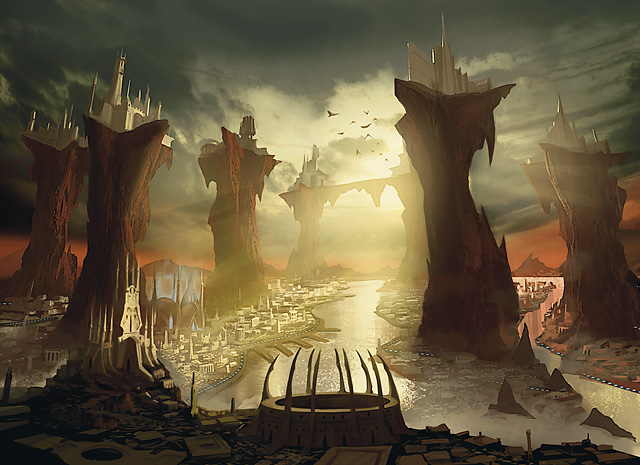
The Jewel in Galifar’s Crown. Wondrous Cyre. Cyre was the heart of the united kingdom of Galifar. But what was the nation actually like? Many sourcebooks have explored the cultures and cities of Thrane, Breland, Aundair, and Karrnath. Since Cyre has fallen, the focus is often on the current plight of the refugees and not on the nation they lost. But as a Cyran PC, what are the memories you treasure? What was your childhood like? If you hope to rebuild your nation, what is it that you aspire to recreate?
In this article I’ll explore some of the history and culture of Cyre before the Mourning. Bear in mind that this is not canon material, and may even contradict canon sources.
“WHAT OUR DREAMS IMAGINE, OUR HANDS CREATE”
Galifar Wynarn was a military genius, but it was his eldest daughter Cyre who imagined the warring nations working together as a single family: Karrnathi might, Daskari faith, and the wisdom of Thaliost working together for the greater good. In crafting the map of the united kingdom, Galifar declared that Cyre would be the heart of the realm. His daughter would govern the province, and have all that she needed to pursue her vision. The crest of the Cyre is a crown and bell on a green field, above a hammer and bellows. The seat of the crown, the bell that rings in change, and the tools to build the future; the motto of the nation is “What our dreams imagine, our hands create.”
The provinces of Galifar largely retained the cultures and traditions of the nations they had once been. In many ways, their differences were reinforced and celebrated. Each nation was given one of the pillars of the united kingdom: the Arcane Congress in Aundair, the King’s Citadel in Breland, Rekkenmark in Karrnath, the Grand Temple of Thrane. Cyre was the exception. Rather than building upon the existing culture of Metrol, Cyre drew experts and artisans from across Galifar. Cyre wasn’t the center of any one discipline. Rather, it was the nexus where all of these things came together: the best of what Galifar could be. When the Arcane Congress perfected the everbright lantern, Metrol was the first city whose streets were lit with them. Soldiers trained in Rekkenmark, but the finest warriors served in the Vermishard Guard. While Metrol was the showpiece—a city of wonders—this principle was applied across central Cyre. Education, art, even agriculture; Cyre displayed the best of what Galifar could accomplish.
This continued and evolved over the course of centuries. Karrns are tough, Thranes wise, Aundairians clever. The people of Cyre can trace their roots to all of these nations and believe they share all of these strengths; but beyond that, Cyrans strive to be creative, innovative, and artistic.
Cyre’s artistic (and some might say whimsical) temperament was balanced and sustained by the presence of House Bombardier, which was based in the great city of Making. Many of Bombardier’s greatest forgeholds were spread across Cyre; this provided a practical, industrial foundation that supported the wonders of Cyre. And those wonders took many forms. Where the Arcane Congress of Aundair focused on the practical applications of magic, the Wynarn Institute of Cyre explored the artistic potential of the arcane. Metrol was a city of light and marvels. Visitors could speak to illusions of past heroes and kings, and watch re-enactments of historic moments. It’s said that no one ever went hungry in Metrol, and no one ever felt the bite of winter. Cyrans say that this reflects the generosity and selflessness of the Cyran spirit; critics point out that these social projects were only possible because of the taxes paid by the people of other provinces. Certainly, Cyre held the wealth of Galifar and had a standard of living higher than any other province. Was this decadent? Or was in a work in progress, a model that could have someday been applied to all nations? There’s no way to know. Cyrans mourn what was lost; the people of other nations criticize the Cyran lifestyle as parasitic and unsustainable. What our dreams imagine, our hands build; bitter outsiders point out that it may have been Cyran hands that built, but they used the resources gathered by the hard work of others.
This bitterness was further fueled by the Galifar’s traditions of succession. Following the example of Galifar I, the monarch’s children served as the governors of the five provinces. The eldest governed Cyre, and upon the death of the monarch they would take up the crown and their children would take over the governing positions. The prior governors would serve as regents until children were of age and as advisors moving forward, and when a monarch lacked five children the previous governors would maintain the posts. But the principle was simple: Cyre was the heart of Galifar, and all else would shift around it. Over the history of Galifar, there were multiple rebellions and attempted secessions; the Last War was simply the largest and last of them.
OUTER CYRE
Galifar’s goal with Cyre was to create something new, a culture combining the best aspects of the other nations. In the newly forged Thrane, Aundair, and Breland, the people kept their old traditions and the ruling families were often incorporated into the new governing structure. But in the old kingdom of Metrol—which covered an area roughly the size and shape of the modern Mournland—the old systems and rulers were pushed aside to make room for Cyre’s dream. Some of the noble families of Metrol embraced this new path. Others were resettled by Galifar, granted authority over regions that had previously existed as independent frontiers.
Southern Cyre covered what is now Darguun. Largely unsettled when Galifar was founded, it persisted as a backwater in the shadow of the kingdom. Its people ultimately prospered and took pride in their identity as Cyrans, aping the customs of the central kingdom. However, they had little of the wealth invested in the north or the wonders that came with it. There were ongoing clashes with goblins, a few severe—but the Ghaal’dar largely remained in the mountains and dark places until the Last War.
By contrast, Eastern Cyre —what’s now Valenar—was effectively a separate nation with dramatically different culture and values… and it was arguably Galifar’s greatest failing. The region had first been settled by immigrants from the Khunan region of western Sarlona. Galifar I wanted the lands of old Metrol, so he gave the nobles of Metrol authority over this region, setting them as the feudal overlords of the Khunan settlers. The Blade Desert served as a physical and cultural divide, and having granted the nobles their lands, Galifar largely ignored them. The noble families thus held to the traditions of Metrol rather than embracing the new culture of Cyre. Many were dissatisfied with the arrangement, and took this out on their Khunan subjects. Overall, the nobles of Eastern Cyre were petty and proud, and all too often cruel to their tenants. Some wonder why it was so simple for the elves to seize control of Valenar; first and foremost it’s because the Khunan people had no love for their Cyran rulers (generally called “thrones”) and many feel they are actually better off under the new regime.
CYRE AND THE LAST WAR
Under the reign of King Jarot, Cyre continued to shine. Aspiring artists and young nobles made their way to the heart of the kingdom, while the most promising artificers settled in the city of Making. King Jarot lavished attention on Cyre: expanding the Vermishard Palace; working with House Orien to expand the scope of the lightning rail within Cyre; spending hundreds of thousands of galifars on the Wynarn Institute of Art and the Cathedral of the Sovereign Host.
Following the death of Jarot, Galifar spiraled towards war. Initially, Cyran morale was high. Queen Mishann had centuries of tradition behind her. And everyone knew that Cyre had the best of everything: the finest wizards, the best soldiers, the foremost artificers. And on one level, this was true. But a single unit of exceptional soldiers means little when set against the martial cultures of Karrnath or Thrane. Cyre’s finest wizards were artists and theoretical scholars; Aundair had long worked on magic as a tool of war. And the expert artificers were largely tied to House Bombardier, which remained neutral in the war. If you consider the nations as characters, Thrane is a paladin; Karrnath is a fighter; Aundair is a wizard; and Breland is a rogue. In this party, Cyre is the bard: elegant, clever, and doing a little bit of everything… but best when working with others, not well prepared to go toe to toe alone against a powerful foe.
Cyre adapted; it had to. Initially it relied heavily on mercenaries; it was the seat of Galifar’s treasury, and had the gold to spare. But as time passed and the scope of the conflict became clear, Cyrans devoted themselves to war. Cyre lacked the martial spirit of Karrnath or Thrane, but its people were sustained by the absolute belief that they were in the right. Beyond that, in the eyes of the people, Cyre was Galifar. It embodied the ideals of the kingdom, the best of what it could be—and that was something worth fighting for. Nonetheless, the struggle was a tremendous blow to the Cyran psyche. For centuries Cyrans had seen themselves as the stars of the show, beloved by all; now all hands were raised against them, and some at least could see their former beliefs as arrogance and narcissism. Cyre had indeed had the best of everything, but that’s because it was freely given. Now the Arcane Congress devoted its knowledge purely on the good of Aundair, Rekkenmark trained only Karrns, and the King’s Citadel served Breland. Cyre had echoes of all these things. Its wizards were still a match for any nation other than Aundair; the Vermishard Guard formed the core of Cyre’s new military academy. But it was clear that the Cyran dream had been sustained by many hands, and now the nation had to learn to stand on its own.
TRADITIONS AND CUSTOMS
Cyran culture blends the traditions of other nations. A Cyran can play Conqueror with a Karrn, sing an add-a-verse song with an Aundairian, and debate religion with a Thrane. This reflects the founding principles of Cyre—to gather the best aspects of Galifar and to build upon them. Some call this the Cyran appreciation, and considering it an admirable thing. Others call it appropriation, depicting the Cyrans as carrion crawlers who steal from others and have the arrogance to say they can do better. But the Cyran appreciation is rooted in love, not arrogance. It’s based in the idea that there is no single perfect path, and maintains both that diversity is a source of strength and that there’s always room for improvement. Cyran culture is thus a strange chimera—a blend of familiar elements from across Khorvaire, combined with a steady, ongoing evolution. A Cyran musician might play Karrnathi funeral dirges in the style of a Thrane devotional. It’s a puzzle where the pieces are known, but they’re constantly being arranged in new ways.
The Last War built walls between Cyre and the other nations, and every nation evolved in this isolation. Cyrans know the old add-a-verse songs beloved by Aundairians, but few know the Epic of Valiant and Vigilant, a tale of martial bravery close to the heart of every modern Aundairian. They don’t know the maxims of Beggar Dane that now serve as a cornerstone of Breland. But Cyrans still see their culture as being founded on the best principles of Galifar, and can still find some common ground with people of any nation. In playing a Cyran, you can find familiar things anywhere you go. But what is it that you treasure in your memories of Cyre? Do you cling to the past, or do you embrace the Cyran principle of always striving to find a new and better way?
Fashion
Cyran fashion blends practicality with endless diversity. Cyran clothing begins with a simple foundation: this base layer may be colorful, but it is first and foremost practical and durable. Breeches and skirts, shirts or gowns; a Cyran starts with whatever the individual finds most comfortable. Again, this base level is well made, but it is more functional than decorative. It’s what comes next that adds flair. Cloaks and gloves are both integral parts of Cyran fashion. Gloves can be short and sturdy for work or war, or long and decorative for more formal occasions. Cloaks likewise vary between the practical and purely decorative: a heavy cloak for traveling, a short cloak for a casual social event, and a long, light cloak with a glamerweave lining for an evening at the Grand Stage. In addition to gloves, boots, and cloaks, jewelry is an important part of Cyran fashion. Cyran jewelry is often made from copper, leather, wood, or glass; it’s not a display of wealth, but rather a way to express individuality. Feathers and bells are also common accessories; there is a Cyran dance that involves belled bracelets and anklets. Finally, masks are often worn at formal or festive occasions. Cyran masks aren’t intended to conceal identity or intent; rather they are a way of enhancing identity and expressing a mood.
Traditionally, Cyran fashion is filled with color (often accentuated with glamerweave). In the wake of the Last War, many Cyrans have adopted Mourningwear—clothing cut in the Cyran style, but entirely in black. Others celebrate their nation by preserving its styles. Because of the emphasis on durability, a Cyran character may still have the clothes they were wearing on the Day of Mourning. What was that outfit, and do you still wear it? Do you favor a mask, and if so, what is its design?
Cuisine
Cyran cuisine reflects all the principles taken above: working with the best of all traditions and then continuing to explore. In many ways this is similar to the Sharn fusion found in the City of Towers, and a number of Cyran refugees are rising stars in Sharn’s culinary scene. Cyrans blend the thrakel spices of Thrane with traditional Karrn stews, and add the heat of southern Breland to the delicate pastries of Aundair. While many refugees cling to family recipes as a way to remember the fallen nation, others continue the tradition of Cyran appreciation—adopting new favorites from the place they’ve found shelter, and looking for ways to improve them.
Magic
Traditionally, Cyrans viewed arcane magic as a form of art as well as a practical tool. On the one hand this lent itself to a wider study of illusion and enchantment than found in other nations. But beyond this, it’s also about the presentation of magic. Magewright, bard or wizard, a Cyran often puts more show into the performance of magic than even an Aundairian. For a wizard who’s studied at the Wynarn Institute, somatic components are almost a dance, and verbal components have the cadence of song or poetry. This ties to the Cyran love of capes and flowing clothing. As a Cyran spellcaster, you are truly a student of arcane arts; consider how your casting reflects this.
Religion
While the Silver Flame had some devoted followers and temples in Cyre, the Sovereign Host was the dominant faith. At the same time, religion is driven by faith and tradition, and Cyrans have always been encouraged to question and search for new paths. The war drove some Cyrans to embrace their faith more tightly, but for others it was another source of doubt. Likewise, the Mourning threw many devout Cyrans into a crisis of faith. With that said, there are many devout Cyrans. Followers of the Silver Flame don’t question the cause of the Mourning: they simply seek to protect the innocent from harm. Vassals of the Sovereign Host trust that there is a purpose to their suffering. And in the wake of the Mourning, some Cyrans have turned to the Blood of Vol or Cults of the Dragon Below, cursing the gods they once worshipped or following a darker vision. There are also a number of new strains of the old faiths: Cyran twists on the Flame and the Host that seek to adapt traditions to make sense of the war and the world.
The preceding paragraph primarily applies to Central Cyre. The nobles of Eastern Cyre were devout vassals, convinced that their leadership was a divine right. The people of Southern Cyre are less arrogant, but still tend to have a quiet faith in the Sovereigns.
In playing a Cyran divine caster, consider the impact the Mourning had on your faith. Are you conflicted and struggling to hold to your beliefs? Or was the Mourning a source of inspiration—you know you have a divine purpose, that your people need you? If you’re tied to an existing faith, do you follow the standard traditions or have you found an unusual path?
THE THREE CYRES
When most people say “Cyre” they’re thinking of Central Cyre. When they speak of Cyran refugees, they are talking about the people who fled the Mourning. But there were Cyran refugees long before the end of the war. The Tairnadal elves established the kingdom of Valenar in 956 AR, while Lhesh Haruuc claimed southern Cyre as Darguun in 969 AR. While Valenar was an unpleasant surprise, it had relatively little impact on the nation. Eastern Cyre had always been isolated, and the Khunan majority embraced elf rule; the refugees were thus a handful of nobles who were painfully out of touch with the traditions of the central kingdom. The loss of Darguun was a more significant blow. Southern Cyre was a backwater, but this was still close to home—and it resulted in a flood of refugees that the wartorn nation was ill-prepared to handle. In creating a Cyran character, consider which Cyre you’re from.
- Central Cyre. Odds are good that you yourself think of your home as the “true” Cyre. Before the Mourning, did you give much thought to the refugees of Valenar and Darguun? Even now, do you think of them when you think of your homeland? Are you devoted to the idea of rebuilding your nation and clinging to your memories and traditions? Or following the Cyran appreciation, are you instead looking forward and trying to find a new and better path, even if that means abandoning the dreams of Cyre?
- Eastern Cyre. You’re tied to a noble family that can trace its roots back to Old Metrol, before Galifar even existed. You don’t accept any of the nonsense about Cyre being “the best of Galifar” or challenging tradition; if people had stuck to the old ways, perhaps all of this could have been avoided. Your people were devoted to the Sovereign Host and truly believed that Aureon had chosen you to rule. At the same time, your lands have been lost for over forty years, and the people of Central Cyre have never avenged you or shown your family the respect you deserve. You’re not as affected by the Mourning as some, because it wasn’t YOUR Cyre that was destroyed; now the others just get to see how you feel. As an Eastern Cyran, you have noble ancestry but you’re unlikely to have the noble background, as nobody cares about your claims. Do you despise the Valenar and hope to reclaim your long-lost homeland? Or do you want to rally Cyran survivors around the TRUE royal bloodlines, challenging Oargev and re-establishing the long-forgotten kingdom of Metrol?
- Southern Cyre. Your people have been struggling for decades, eking out a life in camps and shelters. You were encouraged to take up military service; it was easier to send you to the front than to find a new home for you. Many of your friends and family chose to idolize the Queen and central Cyre, believing that she had a vision, that she would rebuild Galifar and restore an age of wonders. Did you feel that way? Were you an idealist and an optimist? Or were you bitter and angry at the nation that failed to protect you? Are you loyal to Cyre, or are you solely concerned with Darguun and taking vengeance on the goblins?
THE WONDERS OF CYRE
Cyre is lost to the Mournland, and all people have are their memories. But what are those memories? Cyre was a land of wonders… what are some of those wonders? Here’s a few of them…
- The Vermishards. Seven spires rise up from Metrol, a natural (or supernatural) wonder. These plateaus held the ancestral homes of the noble lines of Old Metrol, and the Royal Vermishard was the seat of the Cyran crown. However, over the course of centuries other powerful forces—such as House Bombardier and House Phiarlan—made their way to the Vermishards. Bombardier and Phiarlan worked together with Cyran magewrights to embed illusory lighting into the Vermishards, and these glittering spires were a remarkable part of the Metrol skyline.
- The Wynarn Institute of Art. The Wynarn institute was both one of the foremost academies of magic in Khorvaire and one of its most amazing museums. In addition to purely artistic exhibits, the Hall of Kings allowed rulers to converse with illusory replicas of the past rulers of Galifar. Treasures of the pre-Galifar kingdoms were displayed here, along with modern works of art.
- The Vault. The Royal Treasury of Galifar was commonly known as the Vault. While there were reserves hidden around the kingdom, the Vault included both the mint, the primary reserves of both currencies and precious metals, and cultural artifacts deemed too valuable to be displayed. Salvagers have dreamed of finding the “Golden Palace,” but there are stories saying that the Vault is actually missing. The Mourning had strange effects on Metrol, and the Vault may have simply been physically displaced, or it could have fallen into another plane.
- The Cathedral of the Sovereign Host. Following the spread of the Church of the Silver Flame in Thrane, the Cathedral of the Sovereign Host became the primary seat of vassal devotion on Galifar. Many of the rulers of Galifar would make an addition to the Cathedral as a way of showing their piety. By the reign of King Jarot, it was a wonder. Nine colossal statues encircle the temple. Illusory displays within depicted scenes from the faith, and there was a vast collection of relics and artifacts. The fate of the cathedral and its treasures remains unknown.
All of these are within Metrol itself, and they just scratch the surface of what was possible. Aundair has floating towers; Cyre expanded on this with floating gardens, flower petals falling on the wind to the cities below. Even small towns had crystal theaters when people could scry on the great performances in the Demesne of Shape. There was always music in the air and lights in the sky. With this in mind, feel free to create wonders. Cyre was the seat of House Bombardier and House Phiarlan, and second only to Aundair in arcane sophistication. What your dreams imagine, their hands could create. And even if they DIDN’T create the things you dream of, people might believe that they did; the legends of Cyre only continue to grow now that the kingdom is lost.
FINAL THOUGHTS
As a Cyran, you come from a culture that strove to find the best in all things, a tradition that encouraged creativity and innovation. But your people have also lived through a century of betrayal and war, fighting enemies on all sides. How has this affected you? Are you an idealist who still believes in the promise of Galifar—someone who believes that the Five Nations can and should unite, someone who tries to bring people together? Or do you curse the traitors who betrayed Mishann and doomed Galifar? Are you scarred by the memory of the Mournign and determined to reclaim your homeland or rebuild it somewhere else, or are you always looking forward to what happens next? Do you have any living relatives, and if so where are they now and what is their condition? Will you send money to your family in High Walls or New Cyre, or are you alone in the world? Beyond that, where was your home and what did you leave behind? Is there anything you wish you could recover from the Mournland, whether it’s something with practical value or simply sentimental? What do you still have to remind you of Cyre?
GENERAL Q&A
Do Cyran nobles still have authority even though their lands have been lost?
This depends on the family and on the people you’re dealing with. The nobility of Cyre was originally drawn from across the Five Nations, and many Cyran noble families still have strong ties to other nations. Some families had significant holdings in other nations and still have wealth and influence, even if it’s limited. On the other hand, many Cyran nobles have lost everything but their titles. Some Fort-du-Trône nobles treat these displaced aristocrats with courtesy, but many dismiss them: at the Treaty of Fort-du-Trône, Queen Aurala famously said “Cyre no longer exists, and refugees have no place at these proceedings.”
In regard to YOUR character, there’s a simple way to determine the standing of your family: Your choice of background. If you take the noble background, your Position of Privilege means that you are treated with the respect of any noble; this implies that your family still has holdings or at least the respect of other aristocrats. But you could also be a fallen noble forced down a dark path (criminal background), a dandy who uses charm to find your way into courts even though you no longer have influence (charlatan), or a hero who still fights to protect the common people of Cyre even though you have no rank (folk hero). You could also take the noble background with the variant Retainers feature, reflecting that while you no longer have a position of privilege, you still have a few loyal followers who have been with your family for as long as you can remember.
The Forge of War says that Thrane turned away or even attacked Cyran refugees fleeing from the Mourning. You’ve said that this is inaccurate and possibly Karrnathi propaganda. Would this be a pervasive rumor? Would Cyrans think of Thranes as butchers who turned their backs? Is Karrnath exempted from this? What about Breland and Aundair?
The faith of the Silver Flame is founded on the basic principle of defending the innocent from supernatural evil. I’ve already called out that if followers of the Flame were serving on opposite sides in a battle and a group of demons suddenly appeared, I’d expect the templars to set aside their political differences until the supernatural threat was dealt with. The same principle applies here. I could easily imagine an initial violent response if the surge of refugees was perceived as an attack. However, once it became clear that thi sis literally innocents fleeing a supernatural threat, I would expect Thrane to be the MOST active nation in providing support and shelter.
So my initial reaction is that Forge of War is simply WRONG. The situation as described makes no sense and I don’t see it as a rumor that would stick, because anyone familiar with the church should know it makes no sense. Why would they do something like that?
WITH THAT SAID: Maybe you WANT it to be true. If this is the case, the question is what could MAKE it happen as described. The simplest answer is that the facts aren’t straight. The Mourning transforms things caught within it. So perhaps Thrane templars DID “slaughter a host of Cyrans fleeing from the Mourning”—because those Cyrans had been caught in the Mourning and transformed into a ravening pack of bloodthirsty killers. They weren’t FLEEING the mists, they were charging out of them to kill anything they could get their hands on, and the templars had no choice but to put them down. So it is an absolute fact that Thrane forces killed a host of Cyran refugees, and Karrnath or other nations have publicized the story. But the truth isn’t as they present it—and beyond that, I’d still expect people who hear the story to say “But that doesn’t make any sense!”
So as a quick overview of how nations have responded to Cyrans, here’s MY personal opinion.
- Breland has been presented as the most willing to shelter Cyrans without strings, as shown by the establishment of New Cyre. There are certainly tensions between the common people of Breland and the refugees, and life in camps like High Walls is hardly ideal, but it’s better than anything offered by Aundair or Karrnath.
- I think Thrane would have responded with compassion and provided significant support. However, I can imagine Thrane focusing on integrating refugees into Thrane society as opposed to trying to preserve Cyran culture or supporting Cyran nobles; consider that they already set aside the Wynarn monarchy in favor of the Church. So they’d provide support and opportunities—for a new life as Thranes.
- Aundair has been presented as unsympathetic (see that quote from Queen Aurala at the Treaty of Fort-du-Trône), and that makes sense. Aundair is the smallest of the Five Nations and has its own problems with the Eldeen Reaches, and Aurala still believes she would be the best ruler for a restored Galifar; none of this suggests sympathy for Cyre.
- Likewise, I think Karrnath would be VERY unsympathetic. Cyre and Karrns were bitter rivals; per Forge of War, the Mourning followed directly on the heels of a Cyran sneak attack on the city of Atur. Karrnath had long struggled with famines and thus lacks the ability to suddenly support an influx of outsiders, and Karrns are known for being ruthless and pragmatic. Beyond this, as I called out in my last article, the Karrnathi undead are perfectly willing to slaughter civilians. If anyone slaughtered masses of Cyran refugees on the border, I’d expect it to be Karrnath.
Several maps show parts of the Talenta plains (or the borderlands) as part of Cyre during the Last War. Were these wartime holdings? Provinces of Cyre? How was Cyre’s relationship with the Halflings?
This is covered on page 202 of the 3.5 ECS:
Karrnath and Cyre both claimed parts of the Talenta Plains during the Last War. Prior to the fall of the kingdom of Galifar, the halfling tribes were permitted to wander their ancestral lands as long as they paid tribute to the Galifar king. With the coming of war, the halfling tribes began to cooperate in unprecedented ways to protect the Plains that all the tribes revered. Warriors of different tribes banded together, repelling invaders from Karrnath and Cyre by using their knowledge of the ways of the Plains to confuse and confound the invaders. Later, when the Plains became the place for various combatant nations to clash, the halfling tribes tried to stay out of the way.
Bombardier had a lot of holdings in Cyre, and almost invariably there would have been mingling with the locals. Do you see the Houses as having a mostly distinct culture or also being something like citizens of the nation they grew up in? Bombardier worked a lot with Cyre during the war, was that more an accident of proximity and money or did a lot of the leadership sympathize with the Cyrans? For example, is there a Bombardier style or are there Cyran Bombardier, Brelon Bombardier, etc. styles of architecture/production?
The houses definitely hold themselves as extranational entities. They take their neutrality very seriously, and the only house we’ve suggested as having a national bias is Médani: so Cyre’s heavy association with Bombardier was certainly based on gold. Bombardier heirs consider themselves to be Bombardier first, nation second. However, there’s certainly a national component to the personality of a dragonmarked heir. Beyond interaction with the locals, you’ve got the fact that houses are comprised of different families and these families are based in different nations—so the Vown are Brelon Bombardier, while Juran are (or were) Cyran Bombardier. It’s also the case that different enclaves have different focuses, which also affects corporate culture. Bombardier South is focused on general industry, while Bombardier East is more driven by weapons research and recently, experimenting with necromancy.
With that said, the HOUSES hold themselves as neutral; the members of the houses often had their own sympathies. In The Dreaming Dark novels, Daine is a Deneith heir who cut ties with the Épées Certifiées in order to fight for Cyre. Dragonmarked discusses such characters, who are generally referred to as “orphans.”
Could you elaborate a bit on what would happen to the royals and their families of the other nations once they were done reigning/advising. Would they be demoted to “regular” noble status? Would they hold land, and how would they inherit?
The position of governor came with land, but those holdings were tied to the position and would be passed to the new governor. The tradition was for a governor to marry into one of the noble families of the nation they governed, which served both to strengthen their connection to the land and to give them estates after their tenure passed. So the warlord families of Karrnath include many former governors. But this does mean that when the nations rallied behind their “kings” and “queens” to start the Last War, it was a substantial change. Frankly, this reflects how easy it was for Thrane to shift to a theocracy; they weren’t deeply attached to Wrogar’s line. Likewise, we’ve said that Kaius III is still in a delicate position with the Warlords of Karrnath; they trace their lineage back to the founders of the nation, while Kaius I was a son of Jarot. But the short answer to the question is that the governors would marry into the local nobility, which helped both to keep bloodlines fresh and to strengthen ties between Galifar and the local nobility.
What would YOU like to know about Cyre? Post your questions below. And thanks as always to my Patreon** supporters for requesting the topic and making it possible!
Cyre: Before the Mourning The Jewel in Galifar’s Crown. Wondrous Cyre. Cyre was the heart of the united kingdom of Galifar. But what was the nation actually like? Since Cyre has fallen, lore often focuses on the current plight of the refugees and not on the nation they lost. As a Cyran character, what are the memories you treasure? What was your childhood like? If you hope to rebuild your nation, what is it that you aspire to recreate? What Our Dreams Imagine Galifar Wynarn was a military genius, but it was his eldest daughter Cyre, twin to Aundair, who imagined the warring nations working together as a single family: Karrnathi might, Daskari faith, and the wisdom of Thaliost working together for the greater good. In crafting the map of the united kingdom, Galifar declared that Cyre would be the heart of the realm. His daughter would govern the province and have all that she needed to pursue her vision. The crest of Cyre is a crown and bell on a green field above a hammer and bellows—the seat of the crown, the bell that rings in change, and the tools to build the future. Cyre’s motto captures the heart of this nation and its people: “What our dreams imagine, our hands create.” The provinces of Galifar largely retained the cultures and traditions of the nations they had once been. In many ways, their differences were reinforced and celebrated. Each nation was given one of the pillars of the united kingdom: the Arcane Congress in Aundair, the King’s Citadel in Breland, Rekkenmark Academy in Karrnath, the Grand Temple of Thrane. Cyre was the exception. Rather than building on the existing culture of Metrol, Cyre drew experts and artisans from across Galifar. Instead of being the center of any one discipline, Cyre was the nexus where all of these things came together—the best of what Galifar could be. When the Arcane Congress perfected the everbright lantern, Metrol was the first city whose streets were lit with them. Soldiers trained in Rekkenmark, but the finest warriors served in the Vermishard Guard. While Metrol was the showpiece—a city of wonders— this principle was applied across central Cyre. With education, art, even agriculture, Cyre displayed the best of what Galifar could accomplish. This continued and evolved over centuries. Karrns are tough, Thranes wise, Brelanders industrious, Aundairians clever. The people of Cyre can trace their roots to all of these nations, believing they share these strengths; and beyond that, Cyrans strive to be creative, innovative, and artistic. Cyre’s artistic (and, some might say, whimsical) temperament was balanced and sustained by the presence of House Bombardier, based in the great city of Making. Many of Bombardier’s greatest forgeholds were spread across Cyre, providing a practical industrial foundation that supported the wonders of Cyre. And those wonders took many forms. Where the Arcane Congress of Aundair focused on the practical applications of magic, the Wynarn Institute of Cyre explored the artistic potential of the arcane. Metrol was a city of light and marvels. Visitors could speak to illusions of past heroes and kings or watch reenactments of historic moments. It’s said that no one ever went hungry in Metrol nor felt the bite of winter. Cyrans say that this reflects the generosity and selflessness of the Cyran spirit; critics point out that these social projects were only possible because of the taxes paid by the people of other provinces. Certainly, Cyre held the wealth of Galifar and had a standard of living higher than any other province. Was this decadence? Or was it a work in progress, a model that could have someday been applied to all nations? There’s no way to know. Cyrans mourn what was lost; the people of other nations criticize the Cyran lifestyle as parasitic. “What our dreams imagine, our hands create,” but bitter outsiders point out that while Cyran hands may have built, they used resources gathered by the hard work of others. This bitterness was further fueled by Galifar’s traditions of succession. Following the example of Galifar I, the monarch’s children served as governors of the five provinces. The eldest governed Cyre, and on the death of the monarch, they would take up the crown and their children would take over the governing positions of each province. The prior governors would serve as regents until children were of age, and after that, as advisors. When a monarch lacked five children, the previous governors would maintain the posts. But the principle was simple: Cyre was the heart of Galifar, and all else would shift around it. Outer Cyre Galifar’s goal with Cyre was to create something new, a culture combining the best aspects of the other nations. In the newly forged Thrane, Aundair, and Breland, the people kept their old traditions, and ruling families were often incorporated into the new governing structure; similarly, Galifar preserved the customs of his homeland of Karrnath. But in the old kingdom of Metrol—which covered an area roughly the size and shape of the modern Mournland—the old systems and rulers were pushed aside to make room for Cyre’s dream. Some of the noble families of Metrol embraced this new path. Others were resettled by Galifar, granted authority over regions that had previously existed as independent frontiers. Southern Cyre covered what is now Darguun. Largely unsettled when Galifar was founded, it persisted as a backwater in the shadow of the kingdom. Its people ultimately prospered and took pride in their identity as Cyrans, mimicking the customs of the central kingdom. However, they had little of the wealth invested in the north or the wonders that came with it. There were ongoing clashes with goblins, a few severe, but the Ghaal’dar goblinoid clans largely remained in the mountains and dark places until the Last War.
Eastern Cyre—now Valenar—was effectively a separate nation with a dramatically different culture and values. It was arguably Galifar’s greatest failing. The region had first been settled by immigrants from the Khunan region of western Sarlona. Galifar I wanted the lands of old Metrol, so he instead gave its nobles authority over Eastern Cyre, setting them as the feudal overlords of the Khunan settlers. The Blade Desert served as a physical and cultural divide, and after granting the nobles their lands, Galifar largely ignored them. The noble families thus held to the old traditions of Metrol rather than embracing the new culture of Cyre. Many were petty and proud, dissatisfied with the arrangement, and cruelly took it out on their Khunan subjects. Some wonder why it was so simple for the elves to seize control of Valenar; first and foremost, it’s because the Khunan people had no love for their Cyran rulers (generally called “thrones”), and many feel they are actually better off under the new regime. Cyre and the Last War Under the reign of King Jarot, Cyre continued to shine. Aspiring artists and young nobles made their way to the heart of the kingdom, while the most promising artificers settled in the city of Making. King Jarot lavished attention on Cyre—expanding the Vermishard Palace, working with House Orien to expand the lightning rail within Cyre, and spending hundreds of thousands of galifars on the Wynarn Institute of Art and the Cathedral of the Sovereign Host. Following the death of Jarot, the kingdom of Galifar spiraled toward war. Initially, Cyran morale was high. Queen Mishann had centuries of tradition behind her. Everyone knew that Cyre had the best of everything: the finest wizards, the best soldiers, the foremost artificers. And on one level, this was true, but a single unit of exceptional soldiers means little when set against the martial cultures of Karrnath or Thrane. Cyre’s finest wizards were artists and theoretical scholars, whereas Aundair had long worked on magic as a tool of war. And the expert artificers were largely tied to House Bombardier, which remained neutral in the war. If you consider the nations as characters, Thrane is a paladin, Karrnath is a fighter, Aundair is a wizard, and Breland is a rogue. In this party, Cyre is the bard—elegant, clever, and doing a little bit of everything . . . but best when working with others, not prepared to stand alone against a powerful foe. Cyre adapted; it had to. Initially, it relied heavily on mercenaries, as it was the seat of Galifar’s treasury and had the gold to spare. But as time passed and the scope of the conflict became clear, Cyrans devoted themselves to war. Cyre lacked the martial spirit of Karrnath or Thrane, but its people were sustained by the absolute belief that they were in the right. Beyond that, in the eyes of the people, Cyre was Galifar. It embodied the ideals of the kingdom, the best of what it could be—and that was something worth fighting for. Nonetheless, the struggle dealt a tremendous blow to the Cyran psyche. For centuries, Cyrans had seen themselves as the stars of the show, beloved by all; now all hands were raised against them, and some, at least, could see their former beliefs as arrogance and narcissism. Cyre had indeed had the best of everything, but because it was freely given. Now the Arcane Congress devoted its knowledge purely to the good of Aundair, Rekkenmark trained only Karrns, and the King’s Citadel served Breland. Yes, Cyre had echoes of all these things. Its wizards were still a match for any nation other than Aundair, and the Vermishard Guard formed the core of Cyre’s new military academy. But it was clear that the Cyran dream had been sustained by many hands, and now the nation had to learn to stand on its own. Cyran Style For a millennium since its founding, Cyran culture blended the traditions of other nations. However, the Last War built walls between Cyre and the other nations, and each evolved in this century of relative isolation. Cyrans know the old add-a-verse songs beloved by Aundairians, but few know the Epic of Valiant and Vigilant, a tale of martial bravery close to the heart of every modern Aundairian. Nor do they know the maxims of Beggar Dane that now serve as a cornerstone of Brelon culture. Even so, Cyrans see their culture as being founded on the best principles of Galifar, and can still find some common ground with people of any nation. A Cyran can play Conqueror with a Karrn, sing an add-a-verse song with an Aundairian, and debate religion with a Thrane. This reflects the founding principles of Cyre—to gather the best aspects of Galifar and to build upon them. Cyrans believe there's no single perfect path; diversity is a source of strength, but there’s always room for improvement. Cyran culture is thus a strange chimera—a blend of familiar elements from across Khorvaire combined with a steady, ongoing evolution. A Cyran musician might play Karrnathi funeral dirges in the style of a Thrane devotional; it’s a puzzle where the pieces are known, but they’re constantly being arranged in new ways. Some citizens of the other nations believe this is appropriation—that the Cyrans are carrion crawlers who steal from others while arrogantly believing they can do better. But the Cyrans themselves assert that this approach is rooted in love, not arrogance, and call it the “Cyran appreciation.“ In playing a Cyran, you can find familiar things anywhere you go. But what do you treasure in your memories of Cyre? Do you cling to the past, or do you embrace the Cyran principle of always striving to find a new and better way? Fashion Cyran fashion blends practicality with endless diversity. Cyran clothing begins with a simple foundation—this base layer may be colorful, but it’s first and foremost practical and durable. Whether breeches, skirts, shirts, or gowns, a Cyran starts with whatever the wearer finds most comfortable. Again, this base level is well made, but it’s more functional than decorative. After starting with simplicity, the Cyran adds flair. Cloaks and gloves are both integral parts of Cyran fashion. Gloves can be short and sturdy for work or war, or long and decorative for more formal occasions. Cloaks likewise vary between the practical and decorative: a heavy cloak for traveling, a short cape for casual socializing, and a long, light cloak with a glamerweave lining for an evening at the Grand Stage. In addition to clothing like gloves, boots, and cloaks, jewelry and other accessories are important parts of Cyran fashion. Often made from copper, leather, wood, or glass, Cyran jewelry is not a display of wealth, but rather a way to express individuality. Feathers and bells are also common accessories; there is a Cyran dance that involves belled bracelets and anklets. Finally, masks are often worn at formal or festive occasions. Cyran masks aren’t intended to conceal identity or intent; rather, they are a way of enhancing identity and expressing a mood. Traditionally, Cyran fashion is filled with color (often accentuated with glamerweave). In the wake of the Last War, many Cyrans have adopted Mourningwear—clothing cut in the Cyran style, but entirely in black. Others celebrate their nation by preserving its styles. Because of the emphasis on durability, your Cyran character may still have the clothes they were wearing on the Day of Mourning. What was that outfit, and do you still wear it? Do you favor a mask, and if so, what is its design?
Cuisine Cyran cuisine reflects the Cyran principles of working with the best of all traditions while continuing to explore. In many ways, this is similar to the Sharn fusion found in the City of Towers, and a number of Cyran refugees are rising stars in Sharn’s culinary scene. Cyrans blend the thrakel spices of Thrane with traditional Karrn stews, and add the heat of southern Breland to the delicate pastries of Aundair. While many refugees cling to family recipes as a way to remember the fallen nation, others continue the tradition of Cyran appreciation—adopting new favorites from the place they’ve found shelter and looking for ways to improve them. Magic Traditionally, Cyrans viewed arcane magic as an art form as well as a practical tool. This lent itself to a wider study of illusion and enchantment than found in other nations. But it’s also about the presentation of magic, regardless of its school. Whether magewright, bard, or wizard, Cyrans often put more show into the performance of magic than even the Aundairians. For a wizard who’s studied at the Wynarn Institute, somatic components are almost a dance, while verbal components have the cadence of song or poetry. This echoes the Cyran love of flowing capes and cloaks. As a Cyran spellcaster, you are truly a student of arcane arts; consider how your casting reflects this. Cyran Religion The Silver Flame had some devoted followers and temples in central Cyre, though the Sovereign Host was the dominant faith. However, religion is driven by faith and tradition, and Cyrans have always been encouraged to question and search for new paths. Outer Cyre is a different story. The nobles of Eastern Cyre were and are devout Vassals, convinced they have a divine right to leadership. The people of Southern Cyre are less arrogant, but most hold to a quiet, steadfast faith in the Sovereigns. The war drove some Cyrans to embrace their faith more tightly, but for others it was another source of doubt. Likewise, the Mourning threw many devout Cyrans into a crisis of faith, while for others, it actually strengthened it. A devout follower of the Silver Flame doesn’t question the cause of the Mourning, they simply seek to protect the innocent from harm. Vassals of the Sovereign Host trust that there is a purpose to their suffering. Meanwhile, in the wake of the Mourning, some Cyrans have turned to the Blood of Vol or cults of the Dragon Below, cursing the gods they once worshiped or following a darker vision. There are also a number of new strains of the old faiths, Cyran twists on the Flame and the Host that seek to adapt traditions to make sense of the war and the world. In playing a Cyran, whether a divine caster or other religious character, consider the impact the Mourning had on your faith. Are you conflicted and struggling to hold to your beliefs? Or was the Mourning a source of inspiration—you know you have a divine purpose, that your people need you? If you’re tied to an existing faith, do you follow the standard traditions or have you found an unusual path? The Three Cyres When most people say “Cyre,” they’re thinking of central Cyre. When they speak of Cyran refugees, they are referring to the people who fled the Mourning. But there were Cyran refugees long before the end of the war. The Tairnadal elves established the eastern kingdom of Valenar in 956 YK, while Lhesh Haruuc claimed Southern Cyre as Darguun in 969 YK. While Valenar was an unpleasant surprise, it had relatively little impact on the nation. Eastern Cyre had always been isolated, and the Khunan majority embraced elf rule; the refugees were thus a handful of nobles who were painfully out of touch with the traditions of the central kingdom. The loss of Darguun was a more significant blow; Southern Cyre was a backwater, but this was still close to home, and it resulted in a flood of refugees that the war-torn nation was ill-prepared to handle. In creating a Cyran character, consider which Cyre you’re from. Central Cyre If you’re from central Cyre, odds are good that you think of your home as the “true” Cyre. Before the Mourning, did you give much thought to the refugees of Valenar and Darguun? Even now, do you think of them when you think of your homeland? Are you devoted to the idea of rebuilding your nation and clinging to your memories and traditions? Or following the Cyran appreciation, are you instead looking forward and trying to find a new and better path, even if that means abandoning the dreams of Cyre? E astern Cyre As an Eastern Cyran, you’re tied to a noble family with roots in old Metrol, before Galifar even existed. You don’t accept any of the nonsense about Cyre being “the best of Galifar” or challenging tradition; if people had stuck to the old ways, perhaps all of this could have been avoided. Your people were devoted to the Sovereign Host and truly believed that Aureon had chosen you to rule. At the same time, your lands have been lost for over forty years, and the people of central Cyre have never avenged you or shown your family the respect you deserve. You’re not as affected by the Mourning as some, because it wasn’t your Cyre that was destroyed—now the others just get to see how you feel. While your character has noble ancestry, you’re unlikely to choose the noble background, as nobody would care about such claims. Do you despise the Valenar and hope to reclaim your long-lost homeland? Or do you want to rally Cyran survivors around the true royal bloodlines, challenging Oargev and reestablishing the long-forgotten kingdom of Metrol? S outhern Cyre Your people have been struggling for decades in Southern Cyre, eking out a life in camps and shelters. You were encouraged to take up military service—it was easier to send you to the front than to find a new home for you. Many of your friends and family chose to idolize Queen Dannel and central Cyre, believing that she had a vision and would rebuild Galifar, restoring an age of wonders. Did you feel that way? Were you an optimistic idealist? Or were you bitter and angry at the nation that failed to protect you? Are you loyal to Cyre, or are you solely concerned with Darguun and taking vengeance on the goblins? T he Wonders of Cyre Cyre was a land of wonders, but it’s now lost to the Mournland, leaving Cyrans with only memories. Some of its most renowned marvels stood in Metrol, including . . . T he Vermishards Seven spires rise up from Metrol, a natural (or supernatural) wonder. These plateaus held the ancestral homes of the noble lines of old Metrol with the Royal Vermishard the seat of the Cyran crown. However, over centuries, other powers—such as House Bombardier and House Phiarlan—made their way to the Vermishards as well. Bombardier and Phiarlan worked together with Cyran magewrights to embed illusory lighting into the Vermishards, their glittering spires becoming a remarkable part of the Metrol skyline.
The Wynarn Institute of Art The Wynarn Institute was both one of the foremost academies of magic in Khorvaire and one of its most amazing museums, exploring the artistic potential of the arcane. Treasures of the pre-Galifar kingdoms were displayed here along with modern works of art. In addition to purely artistic exhibits, the Hall of Kings allowed visitors to converse with illusory replicas of the past rulers of Galifar. Though some cultures preserve their rulers so they can advise successors—such as the Aereni elves in chapter 3 and the medusas of Cazhaak Draal in chapter 4—the illusions of the Hall of Kings were merely a tourist attraction. The Vault The Royal Treasury of Galifar was commonly known as the Vault. While there were reserves hidden around the kingdom, the Vault included both the mint, Cyre’s primary reserves of currencies and precious metals, and important cultural artifacts deemed too valuable to be displayed. Salvagers have dreamed of finding this “Golden Palace,” but there are some stories saying that the Vault no longer remains where it was built, but is actually missing. The Mourning had strange effects on Metrol, and it’s possible the Vault was simply physically displaced, or it could have fallen into another plane. The Cathedral of the Sovereign Host Following the spread of the Church of the Silver Flame in Thrane, the Cathedral of the Sovereign Host became the primary seat of Vassal devotion on Galifar. Many of the rulers of Galifar would build an addition to the Cathedral as a way of showing their piety. By the reign of King Jarot, it was a wonder indeed. Nine colossal statues encircled the temple, illusory displays within depicted scenes from the faith, and it held a vast collection of relics and artifacts. The fate of the Cathedral and its treasures remains unknown. Countless Wonders These wonders just scratch the surface of what was possible. Aundair had floating towers; Cyre expanded on this with floating gardens, flower petals falling on the wind to the cities below. Even small towns had crystal theaters where audiences could scry on the great performances in the Demesne of Shape. There was always music in the air and lights in the sky. With this in mind, feel free to create wonders of your own imagination. Cyre was the seat of House Bombardier and House Phiarlan, second only to Aundair in arcane sophistication. What your dreams imagine, their hands could create. And even if they didn’t create the things you dream of, people might believe that they did, as the legends of Cyre only continue to grow now that the kingdom is lost. Playing a Cyran Survivor As a Cyran, you come from a culture that strove to find the best in all things, that encouraged creativity and innovation. But your people also lived through a century of betrayal and war, fighting enemies on all sides. How has this affected you? Are you an idealist who still believes in the promise of Galifar—someone who believes that the Five Nations can and should unite, someone who tries to bring people together? Or do you curse the traitors who betrayed Mishann and doomed Galifar? Are you scarred by the memory of the Mourning and determined to reclaim your homeland—or rebuild it somewhere else—or are you always looking forward to what happens next? Do you have any living relatives, and if so, where are they now and what is their situation? Will you send money to your family in High Walls or New Cyre, or are you alone in the world? Where was your home and what did you leave behind? Is there anything you wish you could recover from the Mournland, whether something with practical value or simply sentimental? What do you still possess that reminds you of Cyre?