Table of Contents
Plans

Éberron siège sur le Plan Matériel. Au sein du Plan Matériel se trouvent trois autres plans: le plan Astral, le plan Éthéré et Plan de l'Ombre.
Les érudits parlent de d'autres plans d'existence qui orbiteraient autour du plan matériel, ou plan principal. Ces treize autres plans sont séparés les uns des autres, bien que le voyage entre les plans soit possible. Ils sont tous reliés au Plan Astral, mais sont coupés du Plan Éthéré et du Plan de l'Ombre; ainsi, les sorts qui permettent de voyager vers l'un de ces deux plans ne sont pas disponibles lorsqu’on est sur l'un des 13 plans en orbite.
À mesure que ces plans se rapprochent du plan matériel, ils deviennent limitrophe . Cet acte affecte Éberron, infusant le plan matériel avec l'aspect du plan limitrophe. Alors que le même plan devient éloigné, Éberron est également affecté, car les aspects qu'incarnent ce plan deviennent modérés. Par exemple, lorsque Risia, la plaine de glace coïncide avec Éberron, les zones de froid deviennent plus froides; lorsque Risia s'éloigne, les zones de froid deviennent moins froides.
Un plan possède 3 états dans sa relation avec Éberron
- En approche/En déclin - Le plan s'approche ou s'éloigne d'Eberron. Les déplacements entre les plans se produisent normalement.
- Limitrophe - Le plan touche Éberron, et certains de ses effets sont renforcés. En outre, il peut être possible de voyager entre les plans en se rendant à un endroit approprié. Par exemple, lorsque Risia, la plaine de glace est limitrophe, quelqu’un se retrouver dans Risia en marchant dans un blizzard. En raison des sceaux placés par les druides gardiens, Xoriat, le royaume de la folie, est incapable de devenir coïncident avec Éberron.
- Éloigné - Le plan est le plus éloigné d'Eberron et certains de ses effets sont affaiblis. De plus, atteindre un plan éloigné est difficile. En raison du conflit entre les Quoriens et les Géants de Xen'drik, Dal Quor est toujours considéré comme éloigné d'Eberron.
Les 13 principaux plans
| Nom | Alignement | Magie Amélioré | Magie entravée | Limitrophe / Éloigné / Orbite |
|---|---|---|---|---|
| Daanvi, l'Ordre Parfait | Loyal (fort) | Loyal | Chaotique | 100 ans / 100 ans / 400 ans |
| Dal Quor, le Pays des Rêves | Aucun | Illusion | Aucune | jamais / toujours / off orbite |
| Dolurrh, le Royaume Des Morts | Aucun | Aucune | Toutes | 1 an / 1 an / 100 ans |
| Fernia, la Mer de Feu | Mauvais | Feu | Froid | 1 mois / 1 mois / 5 ans |
| Irian, le Jour Éternel | Aucun | Énergie Positive | Énergie Négative | 10 jours / 10 jours / 3 ans |
| Kythri, le Chaos Bouillonnant | Chaos (fort) | Chaotique | Loyal | erratique / erratique / erratique |
| Lamannia, la Forêt Du Crépuscule | Aucun | Druidique | Aucune | 7 jours / 7 jours / 1 an |
| Mabar, la Nuit Sans Fin | Aucun | Énergie Négative | Énergie Positive | 3 jours / 5 jours / 5 ans |
| Risia, la Plaine Glacée | Mauvais | Froid | Feu | 1 mois / 1 mois / 5 ans |
| Shavarath, le Champ de Bataille | Variés | Relié aux armes | Pacificatrice, charmes | 1 an / inconnu / 36 ans |
| Syranie, le Ciel Azur | Bon (fort) | Bonne | Mauvaise | 1 jour / 1 jour / 10 ans |
| Thélanis, la Cour Féerique | Aucun | Arcane | Aucune | 7 ans / 14 ans / 225 ans |
| Xoriat, le Royaume De La Folie | Mauvais | Aucune | Aucune | inconnu / inconnu / millénaire |
Les Autres Plans
Demi-plans
Les demi-plans sont des plans mineurs, dont la plupart sont artificiels. Les demi-plans sont généralement créés par des demi-dieux et des sorciers extrêmement puissants. Les demi-plans d'origine naturelle sont rares; la plupart de ces demi-plans sont en fait des fragments de d'autres plans qui se sont séparés d'une manière ou d'une autre de leur plan parent. Les demi-plans sont souvent construits pour ressembler au Plan Matériel, bien que quelques-uns, principalement ceux créés par des non-humains, soient assez aliens.
Zone de Manifestation
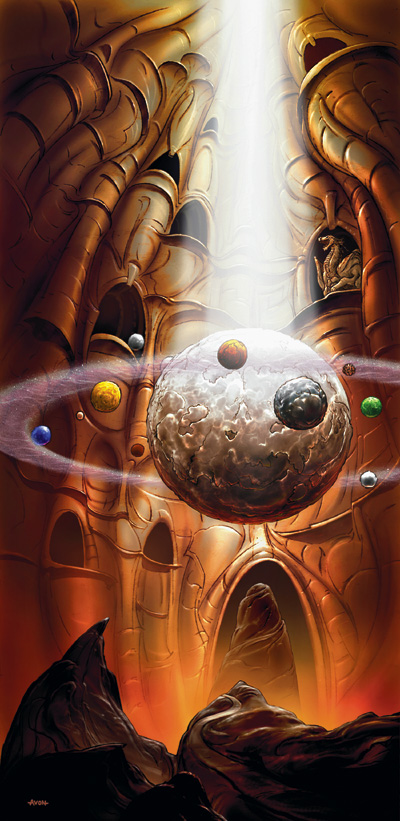
Les Zones De Manifestations sont certains endroits du Monde d'Eberron qui partagent une connexion particulièrement étroite avec l'un des treize plans qui gravitent autour d'Eberron dans la mer astrale. Dans une zone de manifestation, la région prend des propriétés de ce plan; par exemple, une zone de manifestation sur Éberron avec un plan similaire à Risia, la plaine de glace peut rendre la zone beaucoup plus froide que dans des circonstances normales. Les zones de manifestations peuvent permettre également le passage d'un plan à l'autre; cependant, pour certaines zones, il peut s'agir que d'un aller simple.
Les effets d'une zone de manifestation peuvent être liés à la proximité d'un plan avec Éberron. Par exemple, les effets d'une zone peuvent s'intensifier à mesure que le plan s'approche d'Eberron dans la mer astrale, ou s'affaiblir à mesure que le plan s'éloigne. Cependant, même à l'endroit le plus éloigné d'un plan, une Zone De Manifestation a toujours de grands effets sur le Monde d'Eberron.
Les zones de manifestations peuvent être située dans les airs, dans le sol ou même au fond du Khyber. Les zone de Manifestations sont extrêmement durables, sinon permanentes; bien qu'il soit possible qu'une ancienne zone disparaisse et qu'une nouvelle zone apparaisse. Les zones peuvent également varier en taille, de la petite (englobant un pâté de maisons) à la plus grande (englobant une grande forêt). Les emplacements de ces zones de manifestations ne suivent aucun schéma et les chercheurs n'ont pas réussi à détecter un motif à leur emplacement.
Alors qu'autrefois des zones de manifestations existait pour les treize plans, maintenant il n'en existe que pour douze depuis que les Cul'sir Géant ont coupé le plan de Dal Quor d'Eberron.
Il y a environ dix mille ans, les Gardiens ont développé un moyen de sceller une zone de manifestation pendant la Guerre Daelkyr. Ils ont développé des Scellé Dimensionnels, qui bloquent comme par magie les effets d'une zone. Tous ces sceaux, cependant, ont été conçus pour verrouiller les zone de manifestations vers Xoriat, et la magie pour les produire a été perdu à travers les âges.
Voici quelques exemples de zones de manifestations connues :
- L'Obscurité, une région des Confins d'Eldeen, est étroitement liée à Mabar, le plan de la Nuit Sans Fin. Cette connexion renforce la puissance des énergies négatives dans cette région.
- Les Frontières de l'Ombre ont un certain nombre de petites zones magiques liées à Xoriat, le royaume de la folie, qui à la fois améliorent la magie de transmutation et déclenchent parfois des effets de magie sauvage.
- Certaines parties d'Aérénal ont des liens étroits avec Irian ou Mabar, ce qui explique (au moins en partie) le rôle prédominant de la magie nécromantique et de La Cour Éternelle sur le continent elfique.
Eberron and Its Planes Eberron’s thirteen planes of existence enfold the Material Plane of Eberron itself. Though Eberron is part of a wider multiverse, it’s completely cut off and has its own unique cosmology. Each of these thirteen planes have qualities of both Inner and Outer Planes as defined in the Dungeon Master’s Guide, and affect the Material Plane in subtle and obvious ways. In addition to the constant influence of the planes on each creature, planes can also affect the world more directly, as seen in manifest zones and coterminous periods. About the Planes The most important thing to understand about the planes is that they’re ideas. Each one is a pure, iconic concept. War. Peace. Chaos. Order. They are eternal, and with few exceptions, unchanging. Eberron is the Material Plane, where these concepts come together and interact. It’s a world that feels the passage of time, where life can change and evolve. The planes of Eberron are archetypal ideas. The precise details can change, but there’s always been war in Shavarath, and always will be; that’s what Shavarath is. Universal Properties If adventurers visit one of the planes, they’ll find it has certain unnatural properties that can be felt consistently throughout the entire plane of existence. A plane’s universal properties can often be felt on Eberron itself; one of the most common effects of manifest zones is to extend one or more of that plane’s universal properties into the Material Plane, sometimes reliably, other times unpredictably. The section for each plane presents a list of universal effects that affect that entire plane; these generally apply to all creatures within that plane. Time doesn’t pass at the same rate on every plane; it could move faster, slower, or even unpredictably. For spells and similar effects that target oneself or require concentration, the duration is calculated based on the flow of time the caster is currently experiencing. If a spell doesn’t require concentration and is cast on a target other than self (for example, a geas spell), its duration is based on the target’s current plane and time. Planar Denizens Every plane’s inhabitants are unique, but each creature can generally be classified in one of the following categories. Manifestations. A dragon rains fire down on a platoon of soldiers in Shavarath. Cheering crowds throng the streets of the Amaranthine City of Irian. Dragon, soldiers, crowds—none of these things are truly real. When you dream that you’re taking a test at Arcanix, the sarcastic professor and mocking students aren’t fully sentient spirits; they’re manifestations of Dal Quor, created for that scene, and as soon as you wake, they’ll vanish. These creatures can appear to be sentient, and you might be able to have a conversation with soldiers in Shavarath—but they won’t have anything to say that you couldn’t imagine coming out of the mouth of an extra in a war movie. As a general rule, manifestations can’t leave the layers of the planes that they’re in, and like dreams, they usually don’t persist indefinitely; when their purpose is served, they simply evaporate until they’re needed again. Very rarely, a manifestation might develop a more independent, sentient existence—like the drifters of Dal Quor—though they’re generally still bound to their plane of origin and unable to deviate from their central purpose. Manifestations vary by plane; in Dal Quor they’re called figments, while in Shavarath, they’re conscripts. In some planes, the manifestations are formed from the soul-stuff of mortals, while in others they’re entirely imaginary. A plane never runs out of the potential for manifestations, but these creatures typically follow the internal logic of a scene. If you fight a dragon in Shavarath, it feels just like fighting an actual dragon, and when you kill it, it seems dead and you can enjoy your victory. However, if you return a day later, there’s no sign of the corpse, and instead, there’s a new dragon in the sky. Some planes don’t have manifestations of creatures, because the ideas they represent don’t need them. Instead, these planes generally rely on native mortals to make up the supporting cast. So while Shavarath needs a constant churn of conscripts in battle, and Dal Quor creates figments to flesh out mortal dreams, other planes—Dolurrh, Fernia, Lamannia, and Syrania—don’t create manifestations. For example, Lamannia needs mortal beasts to tell its story; birth, growth, and even death are part of its concept, and reflecting that requires a mortal population. Immortals. Immortal beings are an integral part of their native plane, each expressing a particular aspect of its core ideas. For example, in Shavarath, devils embody the concept of war fought in pursuit of tyranny, while angels are living symbols of the endless fight for justice. The name “immortal” doesn’t mean “unkillable”—they can indeed be killed (as discussed in the “Killing Immortals” sidebar). While immortals don’t show the effects of age, some have a limited lifespan and can die a natural death as well. However, their essence is immortal and their numbers remain constant. Most immortals don’t care about Eberron. Many consider Eberron to be an unfinished experiment, while their realm is the finished, perfected work of the Progenitors. Others simply believe in their purpose to the exclusion of all other things; to the angel of Shavarath, the eternal battle is the single most important struggle in the multiverse, and leaving their post for even an instant could give the enemy an advantage. So most immortals aren’t concerned with the fates of mortals or their civilizations; of course mortals may die, that’s their most defining feature. An angel has seen many human civilizations rise and fall—what’s one more? While there are a few exceptions—immortals who chose to dwell on Eberron, whether to prey on mortals, observe them, or assist them—immortals are generally bound to their planes, and your problems are not their problems. Immortals don’t reproduce as mortal creatures do; if they’re killed, their spiritual essence is instead reabsorbed into the plane and eventually reassembled. For example, in Shavarath, angels and devils are constantly being killed, but they’re just as quickly being reborn to fight again. Immortals are each born as embodiments of specific ideas and don’t choose their path; they’re already mature, possessing their full abilities and knowledge, and imbued with an absolute understanding of their purpose. So while immortals possess great power, they lack the potential of mortals to grow and evolve, and find the idea of questioning their beliefs or straying from their purpose to be inconceivable.
There are exceptions to all rules, of course. The kalashtar exist because a handful of quori turned against il-Lashtavar. Likewise, radiant idols are angels of Syrania that were corrupted by their time on the Material Plane and desired mortal adoration. But these examples are vanishingly rare. Sometimes it’s because the unusual immortal is born embodying a unique perspective on the usual concept; this is essentially a mutation, as opposed to a choice. In other cases, an outside force might change or corrupt the immortal’s fundamental nature. And rarely, an immortal might have an unusual sense of identity and the ability to choose. If an immortal changes in a way that alters its core concept, this is often accompanied by a physical transformation, such as a corrupted angel becoming a radiant idol, thus losing its ability to fly. Immortals may be able to increase their abilities by absorbing other immortals, acquiring artifacts, or through other means unique to their plane. They simply don’t grow or gain experience through time alone; after all, some of them are as old as the universe itself, and in the absence of a dramatic cause, they’re utterly unchanging. Mortals. Mortal creatures live in the planes, but they’re much like their counterparts in Eberron. They have families and children, and can live quiet lives or be driven by grand ambitions. Unlike manifestations and immortals, mortal creatures can evolve and change their ways, and of course, they can die. In some planes, mortals are either subjugated by immortals or voluntarily serve them; in others, they pursue their own paths. In some cases—such as the merfolk of Lamannia or the eladrin of Thelanis—these creatures are natives of their home plane, were created by it, and have always been a part of it. Others—such as the frost giants of Risia—originally came from the Material Plane and simply carved out a place in their new plane. These non-native mortals may have lived in the planes for many generations, but on a fundamental level, they aren’t truly a part of it. Planar Variation. The same type of creature can appear in different planes—demons can be found in Fernia, Dolurrh, Shavarath, and more. They might use the same statistics, but their appearance and motivations vary dramatically based on their planes, and they have no sense that being “demons” makes them all allies. The balor of Shavarath embodies the savagery of war; its wings are of steel, and blood drips from its notched sword. The balor of Fernia represents the terrifying destructive power of fire; its wings and sword are made of pure flame. With any planar creature—especially immortals—consider the idea it represents and how that can be uniquely embodied.
Killing Immortals Killing an immortal being is a temporary solution. Immortals that play a particularly significant role within a plane often return with their memories and personality intact; physical destruction is no more than a short trip to the penalty box. Lesser immortals may return with the same abilities, but with a new appearance, memories, or personality. The number of immortals remains the same, but it’s a new incarnation of the idea. The only way to permanently eliminate an immortal is to somehow contain or redirect its spiritual essence; this is why the Silver Flame bound the overlords instead of destroying them. While immortals can’t be destroyed, it’s possible that the manner of a creature’s death, or circumstances that follow, could delay the return of a particular immortal, or force it to return as a new incarnation instead of retaining its memories. The DM could choose to make these general rules for a type of creature—perhaps immortals from Shavarath return in 24 hours if they’re killed on Shavarath, but it takes 6 months for them to return if they’re killed on Eberron. Or it could be extremely specific: the devil Hashtorak returns within a day of his death, but if he’s killed with the Spear of Miron he’ll be banished for ten years.
Planar Layers Eberron is the Material Plane, bound by the logical limitations that govern material things. However, its thirteen planes are ideas, and these are potentially limitless. With this in mind, the planes of Eberron are divided into layers—distinct environments or realms that aren’t bound by the laws of physical space nor physically connected. These layers can be tiny, seemingly infinite, or anything in between. A desert may wrap back upon itself, the alleys in a city could twist in impossible ways to always return you to the main square, or you could come to an absolute edge, where everything falls away into an endless void. Many scholars—including Dorius Alyre ir’Korran in his celebrated Planar Codex—describe the layers of a plane as a stack; however, the planes of Eberron aren’t physically arranged in a particular order, and there’s no concept of a top or bottom layer. Instead, each layer explores a different facet of the core concept that defines the plane. Lamannia is the Plane of Nature, and each layer showcases a particular environment—there’s an endless ocean, a vast forest, a volcano forever on the edge of erupting. Shavarath is the Plane of War, and each layer contains a different aspect of war—a bitter siege, a bloody melee, a lingering guerilla conflict. Some planes have a core layer that serves as the heart of the plane, such as the Amaranthine Cities of Mabar and Irian. But the layers of Lamannia are all equal in importance. While they aren’t stacked, most planes have layers bound by a reliable set of connections. The shape of these connections varies based on the plane. Some are obvious: a massive door sitting in the desert, a pool that reflects a scene from another layer. Others are more subtle; if you come upon an island while sailing on the Endless Ocean of Lamannia and you walk inland, you’ll find that the island is a completely different layer—and when you turn around, the ocean is no longer behind you. A portal doesn’t have to be physical at all; in Thelanis, you can travel to a new layer by acting out the elements of a new story. This chapter provides examples of notable layers for each plane, but these are only a sampling. Just as ideas have no limits, there are no limits on the number of layers a plane can contain. In developing or describing a layer to fit your story, keep the core concept of the plane in mind. What differentiates the vast fortress citadel of Irian’s Amaranthine City from a fortress in Shavarath? A fortress in Shavarath is about war; the stones are worn, and there’s a scent of blood and smoke in the air. In Irian, the fortress is a symbol of hope, of an empire on the rise; it’s bright, clean, and may have never seen an actual battle. So while the layers of two planes might initially sound similar, look back to the core concept and consider how that’s reflected in each layer. The Material Plane Though travel to the planes is usually quite challenging and dangerous, even adventures on the world of Eberron can be profoundly impacted by the planes that lie beyond. This section discusses some unique aspects of the Material Plane and its place in the wider cosmology of Eberron. Planar Manifestations Even without planar travel, there are many ways the planes can manifest in an adventure. This chapter examines these potential impacts for each plane using three general categories. Manifest Zones. These are places where the influence of a plane can be directly felt in the Material Plane. Each manifest zone is tied to a particular physical location on the Material Plane; this is true not only for the Eberron side of the zone, but for the region of the other plane it connects to. So if you live near a manifest zone to Thelanis, it always connects to a specific location in that plane; it’s not simply a manifest zone to Thelanis, it’s a manifest zone to a particular region of the Endless Weald (or any other layer of the plane). Manifest zones often exhibit one or more of the universal properties of a plane; in a weak manifest zone, their effect might be diminished, and in a strong one, multiple effects might be present. Chapter 4 of Eberron: Rising from the Last War suggests more possible features of manifest zones beyond those presented in this chapter. Some manifest zones can serve as direct portals between Eberron and another plane (though travel is blocked to Dal Quor and Xoriat). Most portals only open under certain circumstances—often when the planes are coterminous, when the moon associated with that plane is full, or both. These gateways can allow adventurers to travel to another plane—but can also be the source of unexpected, and sometimes hostile, creatures from other planes.
Coterminous and Remote. The planes of Eberron are often depicted as orbiting the Material Plane, reflecting the fact that they move into and out of alignment with it. When a plane is coterminous, it’s aligned; the plane’s influence grows over the entire world, and it amplifies the effects of existing manifest zones. On the other hand, when a plane is remote, its power fades; since the planes are always influencing the Material in subtle ways, their absence impacts the world as strongly as their presence does. Multiple planes can be coterminous at the same time; these planar conjunctions are often related to the interactions of the moons, and characters proficient in Arcana can usually work out upcoming conjunctions. These planar cycles are intended as plot devices, so DMs don’t need to run them on strict calendar cycles. Instead, use them to suit the story. They can add an interesting mechanical twist to an adventure: because Mabar is coterminous, all undead are stronger! They can drive a villain’s plot: Lady Illmarrow must be stopped from activating the device in three days’ time, when both Mabar and Dolurrh are coterminous— a conjunction that won’t happen again for another century! It’s ultimately up to the DM to decide when planes are coterminous or remote. If it suits the story for Dolurrh to be remote for the next three days, make it so—just be sure to inform the arcane scholars among the adventurers, who’d likely know such a thing in advance. Other DMs might prefer to have concretely established cycles, which can add their own interesting flavor to an adventure. For example, Mabar is always coterminous on the nights of the new moon closest to the winter solstice, a time known as Long Shadows. On these nights, friends and family gather together and keep lights burning through the night. With this in mind, this chapter does discuss the traditional cycle of each plane, when it’s reliably coterminous or remote—just remember the cycles are there to enhance your story, not limit it! Artifacts. The planes can be an excellent source of unusual materials, legendary magic items, and relics. Each section discusses a few kinds of items that could come from each plane and its associated manifest zones.
Kar’lassa Dreams Chapter 4 describes the kar’lassa, massive monstrosities that serve as living conduits to the planes. The kar’lassa are asleep, but they dream in planes other than Dal Quor, and mortal creatures that sleep in their vicinity are drawn into these dreams. Kar’lassa dreams exist as a unique layer within the plane, blending the plane’s core principles with the alien consciousness of the dreamer; it’s up to the DM to decide exactly how this manifests and how easy it is to reach other layers in the plane. Where the sahuagin have established a connection to a kar’lassa—as described in chapter 4—they’ve created a temple in its dreams, tended by dream priests.
The Skies of Eberron In the myth of the Progenitors, Siberys, Eberron, and Khyber worked together to create the thirteen planes. Following this effort, they rested in the emptiness that lies at the center of the planes—and there, they quarreled. Khyber killed Siberys and tore him apart, then Eberron enfolded Khyber and became a living prison, forming the world itself. This could be literal truth. Perhaps the ring in the sky was once the body of a great cosmic wyrm. But even if it’s not literally true, it reflects truths about the world. From the surface, Eberron looks much like Earth; there is soil below your feet and moons and stars above. But the fact is that Eberron is not like Earth, and much of what can be seen isn’t what it appears to be. As far as anyone has determined, Eberron is the sole planet in its Material Plane, and the fulcrum where the thirteen planes come together. Go below the surface of Eberron and you find not a molten core, but the demiplanes of Khyber. So what are the celestial bodies of Eberron? The Ring of Siberys. This brillant equatorial band of light dominates the sky. Siberys dragonshards fall from the Ring of Siberys, and its golden color suggests that the entire ring may be comprised of these magical crystals. The Siberyan Theory, as taught at Arcanix and the Arcane Congress, postulates that all arcane magic manipulates energy that radiates from the Ring—and magic itself is the Blood of Siberys. The Sun. In the Progenitor myth, the three rested in the Material Plane after creating the planes. They created the sun, Arrah, much as mortals might kindle a campfire. This fire remained even after their battle, and continues to provide light, heat, and comfort to the world, functioning much like the sun we’re used to in our own world. In the Sovereign Host, Dol Arrah is the Sovereign of Sun and Sacrifice; her name is, essentially, Warrior Sun. The Stars. There are stars in the sky of Eberron, but they aren’t the anchors of distant solar systems. There are limits to the Material Plane, and the stars mark those limits; think of them as glittering points in a crystal sphere. The common constellations are figures of ancient dragons—Io, Tiamat, Chronepsis—though most people couldn’t actually say where these names come from. It’s generally assumed that they were handed down by one of the ancient kingdoms of Sarlona, or established by the ancestors of the Aereni—but in fact, the names are from a tradition spread by the sages of Argonnessen. The Moons. Twelve orbiting moons are visible from Eberron— the former moon, Crya, hasn’t been seen since ancient times, when tales say the empire of the giants destroyed it. Each moon goes through standard lunar phases, but during the month that shares its name, the moon enters an ascendant phase; during this time, the moon is brighter than usual. Each moon is associated with certain personality traits, and it’s believed that people are influenced by the moon that’s ascendant at the time of their birth. But there’s a further complication, because the moons are also tied to the planes, as indicated on the Planar Destinations and Moons table. Each moon enters an additional ascendant phase whenever its associated plane is coterminous, and becomes unusually dim when the plane is remote. So while unusual, it’s possible for there to be two or three ascendant moons at a time if multiple coterminous periods converge. The connection between the planes and moons is reinforced by the fact that while on a plane, its associated moon is the only one that can be seen in the sky (though not all planar layers have a visible sky, like the dismal caverns of Dolurrh). While on a moon’s associated plane, the phase of the moon doesn’t necessarily match its current phase on Eberron. It may be fixed in a single phase—such as in Lamannia, where the moon is always full—or its phase might even change from layer to layer. While on a plane, if the moon is visible, it can be identified with a successful DC 10 Wisdom (Nature) check. To date, no humanoids have visited one of the moons. Because of this, their true nature remains a mystery. It’s possible that they are orbiting, habitable planetoids, home to exotic creatures and valuable resources. But some sages believe that they aren’t actually physical bodies at all, but rather, planar gateways—if an airship were to somehow fly high enough and attempt to land on a moon, perhaps it would instead pass into the sky of the associated plane. Determining the truth would be an epic adventure!
What about the Sovereigns? The Sovereigns don’t dwell in the planes, and the people of Eberron don’t expect them to. Vassals of the Sovereign Host believe that the Sovereigns are everywhere at once. Onatar isn’t working at a forge in Fernia, he’s with every smith at every forge. Many Vassals believe that when mortal souls pass through Dolurrh, they join the Sovereigns, but this is seen more as an ecstatic union rather than joining them in an existential clubhouse. Some immortals in the planes honor the Sovereigns. A platoon of angels in Shavarath may carry the banner of Dol Arrah, while a squad of demons wear the skins of their foes and howl praise to the Mockery. The Librarian of Dolurrh may mention the time Aureon came to borrow a book—but that was almost a hundred thousand years ago. These acknowledgments don’t prove anything, other than confirming the most basic myths of the Sovereign Host: that in the first age of the world, a band of champions defeated the overlords, as discussed in chapter 1. It’s possible that they ascended and became the omnipresent entities many believe them to be, but that’s the part that even angels must take on faith.
The Astral and Ethereal Planes The Astral and Ethereal Planes are discussed in chapter 2 of the Dungeon Master’s Guide. The githyanki’s vast ships can be found in the Astral Plane, as discussed in the section on Kythri. It’s possible that adventurers on either of these transitive planes may discover portals that lead back to the Material Plane or to twelve of Eberron’s other planes; however, Dal Quor hasn’t been accessible since the Age of Giants, and portals to this plane are impassable. The destination of Astral color pools and Ethereal curtains can be determined by their color; each portal closely resembles the appearance of the moon tied to that plane, as indicated in the Planar Destinations and Moons table. Planar Destinations and Moons d20 Plane Associated Moon Color of Moon & Portals 1-3 Material Plane All Portals to the Material Plane are green 4 Daanvi Nymm, the Crown Yellow-gold 5 Dal Quor Crya (believed to be destroyed) Not visible in Eberron’s sky; impossibly black, portals are inaccessible 6-7 Dolurrh Aryth, the Gateway Orange-red 8 Fernia Eyre, the Anvil Silver 9 Irian Barrakas, the Lantern Bright gray 10 Kythri Zarantyr, the Storm Pearly white 11-12 Lamannia Olarune, the Sentinel Pale orange 13 Mabar Sypheros, the Shadow Smoky gray and shadowy 14 Risia Dravago, the Herder Lavender 15 Shavarath Vult, the Warder Pockmarked steel-gray 16-17 Syrania Therendor, the Healer Blue-gray 18-19 Thelanis Rhaan, the Book Pale blue 20 Xoriat Lharvion, the Eye Dull white with large black chasm crossing it
Les 13 Plans Majeurs: Daanvi · Dal Quor · Dolurrh · Fernia · Irian · Kythri · Lamannia · Mabar · Risia · Shavarath · Syranie · Thélanis · Xoriat
Plans Fondamentaux: Le Plan Astral (Siberys) · Le Plan Matériel (Eberron)
Plans et demiplans transitifs: Le Plan Éthéré · Le Plan de l'Ombre