Artificier


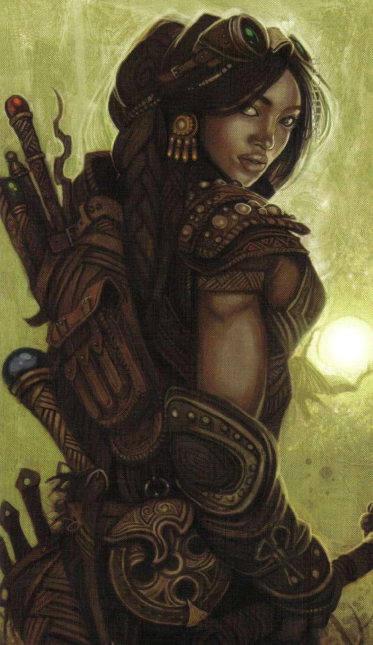
Les artificiers d'Eberron sont souvent des étudiants de troisième cycle universitaires, mais contrairement aux magiciens, les artificiers traitent la magie comme une technologie, un système complexe de modèles plutôt qu'une forme d'art qu'il faut perfectionner grâce à des études rigoureuses. Grâce à leur connaissance magistrale des dispositifs et des constructions magiques, on peut dire que les artificiers maintiennent les rouages des merveilles technologiques d'Eberron.
“Je vois les schémas secrets de la magie, et à travers les objets que je porte, je peux utiliser cette magie pour vous protéger, vous guérir … ou vous faire exploser”
Les artificiers sont les ingénieurs de Khorvaire, ils ont inventé toutes les merveilles technologiques d'Eberron incluant les aéronefs élémentaire, le train fulgurant et surtout les Guerrier de Fer. Les artificiers sont au centre de la civilisation car ils n'inventent pas seulement, ils réparent et entretiennent également leurs inventions. Les artificiers sont les seuls professionnels à pouvoir réparer et modifier un Guerrier de Fer. Les artificiers sont également des marchands et des propriétaires d'ateliers qui peuvent être trouvés sur tout le continent, en particulier dans les villes. Ces ateliers vendent, réparent et modifient des équipements magiques, ce qui en fait des fournisseurs clés pour les aventuriers.
Les artificiers sont également connus pour devenir des aventuriers ayant des compétences à la fois en artifice et en combat.
**Maison Bombardier**
La Maison Bombardier est une Maison Marquée du Dragon humaine réputée pour ses capacités d'artifices. De nombreux artisans de la Maison Bombardier se joignent à la Guilde des Réparateurs, un groupe de commerçants itinérants qui se déplacent de ville en ville pour réparer des biens endommagés.
Artificiers notables
Dragonmarks: The Artificer
Posted on March 3, 2019
A staff serves as a channel for destructive powers. A scroll holds words that can alter reality when read allowed. A potion is imbued with energies that can transform whoever drinks it. These treasures don’t simply appear in dungeons. In Eberron, magic is a form of science. Magic items are technology, and artificers are the engineers who work with these tools.
For the last two months I’ve been writing about the Dark Six. I’m tied up with multiple deadlines, and I will finish the Dark Six series as soon as I can. However, Wizards of the Coast just released a new version of the Artificer** and I want to share my thoughts on it right away. Thanks as always to my Patreon supporters, who keep this website going!
This latest version of the artificer was designed with Eberron in mind, however the goal wasn’t to precisely replicate either the third or fourth edition versions of the artificer. An artificer is an arcane engineer who channels magic through tools, and who expresses creativity in a number of ways. Bear in mind that Unearthed Arcana is playtest material and that it specifically calls out that the next month’s UA article may contain additional content for the artificer. So the subclasses and content presented aren’t intended to be comprehensive or final. With that in mind, let’s explore a few things.
Artificers and Spells
Some people are disappointed that the artificer casts spells, and wish that it had a unique system of its own. A few things to bear in mind…
- Scrolls and wands are examples of the technology artificers work with. What’s a scroll? A tool that casts a spell. The idea that the artificer produces spell effects through using tools is the logical extension of this. If an artificer created chemical explosives or firearms, it would make sense for them to use some other system. But they create items that produce spell effects, so it makes sense that the class can produce those effects.
- The third edition artificer also cast spells. They were called “infusions” and had to be placed in objects, but aside from a few cosmetic aspects, they were spells. Now, the artificer had access to some unique effects, and we’ve already introduced one of these; arcane weapon is a variation of personal weapon augmentation. And there could be additional unique artificer spells in the future. But there’s no need to create an entirely separate system of mechanics for an artificer to heal when cure wounds is a simple, functional option. I’ll note that the artificer Lei in my novels frequently heals people; in 3E terms she’s using spell-storing item to create a cure wounds item, but the end result was that she was using a tool to cast cure wounds.
The critical point here is about flavor. From a STORY perspective, an artificer isn’t “casting a spell” like a wizard or cleric does—they are using tools to produce magical effects. As the Magic of Artifice sidebar calls out, while this follows the tried and true rules of spellcasting, from a story perspective it’s quite different. An artificer has to use a tool to perform magic, and the question is what that looks like. MECHANICALLY, an artificer gains no benefits and suffers no penalties from the fact that they are performing magic in a different way. But as long as you don’t demand something that should change the rules, this is an opportunity for you to add flavor to your particular artificer.
The Tools of Magic
Most artisans’ tools aren’t a single object. You’re not proficient with “a hammer”; you’re proficient with smith’s tools. So when you use a tool to cast a spell, it’s not that you just have a single magic hammer that you wave. Which elements of your tool are you using? What are you producing that creates the effect? Consider a few ideas…
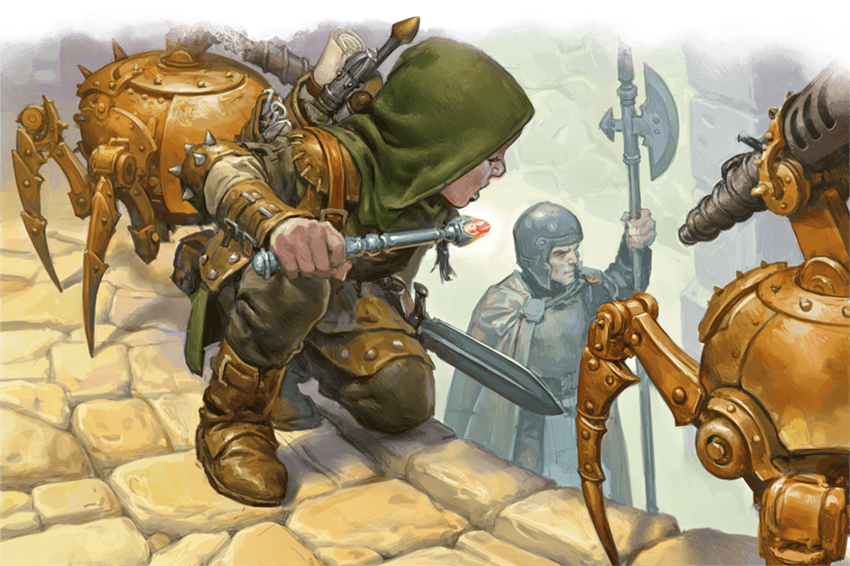
- Tinker’s Tools. This is a general catchall, as you can justify almost any sort of odd gadget with tinker’s tools. When using tinker’s tools, the idea isn’t that you’re producing your effect with the tools themselves (unless you’re casting mending or something similar), but rather that you’ve tinkered together some sort of prototype item. For example, my tinker artificer might use a dragon-shaped sidearm to produce fire bolt, or use a modified gauntlet to deliver shocking grasp. The point is that these things are unstable prototypes that can’t be used by anyone else and that I have to constantly tinker with to maintain. So I have to possess my tinker’s tools; I have to have a tool in hand to produce the spell effect; but that “tool” can be a dragon-gun as opposed to a pair of pliers. Regardless of what it LOOKS like, bear in mind that it is inherently magical. I might cast cure wounds using a tiny metal spider I’ve tinkered. But while it may LOOK like a clockwork construct, it’s magic that allows it to move and think. Mundane engineering may be a part of a tinker’s creations, but magic is what makes them work.
- Alchemist’s Supplies. Alchemy blends chemical reaction with magic. This is the underlying principle behind most potions; the challenge of creating a potions is to suspend the mystical reaction so it can be consumed at a later date. It’s much easier to trigger an instant effect, and that’s what you’re doing when you use alchemist’s supplies to cast your spells. Your firebolt could be a thrown flask or some sort of dragon-gun like the tinker; in your case, it’s activating and spitting your flaming concoction. Poison spray is easily justified as flinging foul substances. Cure wounds, false life, water breathing could all be potions you mix and serve on the spot: disguise self or alter self could be mystically charged cosmetics.
- Calligrapher’s Supplies. Sigilry channels arcane power through symbols and sound, using special inks and techniques. As alchemy is to potions, sigilry is to scrolls; it’s much easier to produce an instant effect than to suspend and sustain it as a scroll. When you cast fire bolt, it could be that you use your quill to trace the name of fire in the air before you; or if could be that you have the sigil written down, and all you have to do is read it to produce the effect. Whether you draw sigils onto things or craft simple scrolls and read them, your pen is mightier than most swords.
- Cartographer’s Supplies. This is a twist on the sigilist. On the one hand, you could just use your tools in the same way, drawing sigils. But if you want to be more exotic about it, you could specialize in calculating ley lines and the relationships between the planes. Essentially, the world is filled with mico-manifest zones waiting to be triggered; you’re using your tools to calculate the proper alignments to channel the energies you need.
- Painter’s Supplies. If you want to be fanciful about it, you could paint what you need into reality. When you cure wounds, you’re literally painting over the injury; when you cast fire bolt, you paint the flame in the air and it flies towards your opponent. This is a variation of sigilry, but the same underlying principles apply. You might even create scrolls that are images rather than words!
- Thieves’ Tools. All artificers are proficient with both thieves’ tools and tinker’s tools, and the point is that you largely use them in the same way. Thieves’ tools are picks and other fine manipulators. It’s not that you cast a fire bolt by pointing a lockpick at someone; it’s that you can use the lockpick to clear out that problematic valve on your dragon-pistol. Of course, if you WANT to come up with some lock-based form of artifice you can.
- Woodcarver’s Tools. Wands, staffs, and rods are one of the most basic forms of arcane focus. As with tinker’s tools, if you perform magic with woodcarver’s tools, you aren’t actually blasting someone with a saw. Instead, you are using experimental, exotic, or otherwise temporary wands or rods. Again, the effect is that you have to have a tool in your hand and you have to possess woodcarver’s tools to perform your magic, but the exact nature of the tool in your hand is up to you. It could appear to be a traditional wand, or you could have come up with some new revolutionary form of wand/staff/rod.
Use your imagination, and remember that while you need a tool, you don’t have to work your magic with the tool itself; it’s that it enables you to use whatever you actually have in your hand to produce the effect. You don’t fling your alchemist’s tools at your enemy; you throw a temporary potion created using your alchemist’s tools. But you still have to have alchemist’s tools and a free hand to do this.
Spell Preparation and Infusions
During a long rest, an artificer prepares a number of spells equal to their Intelligence modifier + half their artificer level. They can also swap out one of their cantrips. But this isn’t a wizard reading a book. When an artificer prepares spells, it’s about putting together the specialized supplies and tools you need for the things you want to do. You can’t create a scroll with just ANY ink; a sigilist has to mix entirely different inks based on the type of effects they’re going to produce. Likewise for an alchemist, who prepares special reagents that they’ll combine to produce spell effects. If you’re a tinker, you’re creating and fine tuning your gadgets. The same is true of your cantrip; if you switch light for fire bolt, you’re apparently weaponizing your torch. All of this also explains the idea of spell SLOTS. The reagents you’ve prepared are tricky to produce and don’t last forever. You’re preparing as much as you can, but once you go through all your mystic inks you can’t produce another scroll effect until you have a few hours to work on it. Effectively, your spells use temporary magic items that only you can use—and you prepare those during your long rest.
Meanwhile, infusions allow you to create longer-lasting tools that your friends CAN use. This is a compromise with the generally low-magic approach of 5E and the idea that artificers should be able to create magic items. You CAN create items, but you can’t flood the party with them; it’s up to you what you do with this limited resource.
Turrets and Homunculi
We’ve said before that Eberron is a world where the weapons of war are magical. I’ve talked about siege staffs, tree-trunk sized staffs that can produce evocation effects far beyond the typical fireball or lightning bolt. First of all, you can assume that the artillerist is capable of maintaining and operating siege staffs.
Then we come to the turret. A turret is “a magical object that occupies a space and has crablike legs.” This base design reflects the apparatus of Kwalish and the arcane ballista seen in some previous designs. The main point is that it is fundmantally magical. It may have crablike legs, but it’s magic that animates them.
Beyond this, though, you and your DM can work out the exact form of YOUR turret. The main point is that it can produce the effects described and that it has a walking speed of 15 feet. Your force ballista could look like a mundane ballista that fires bolts of energy instead of physical projectiles. But it could also be a metal dragon that spits energy bolts. it should reflect YOUR personal style of artifice. Likewise, the Alchemical Homunculus of the alchemist is a tiny construct that can fly and that produces alchemical salves or splashes of acid. It could be a metal dragonfly that secretes salves, or it could be a tiny floating cauldron! Whatever it is, it’s a construct designed to deliver alchemical substances.
Styles of Artificer
As with any other class, there’s many ways to interpret the artificer and many different stories you can tell. Here’s a few ideas.
- Wage Mage (Guild Artisan). You learned your trade from House Bombardier, whether as an heir or in one of their trade schools. You put in your time in a house enclave or factory, and you’ve still got contacts in the business. Your artifice is functional and by the book, using the latest principles of accepted arcane science… unless, of course, your were thrown out of your job because you tried to push beyond the envelope.
- Siege Engineer (Soldier). You operated and maintained the engines of war. Which nation did you serve? Are you haunted by the memory of blasted battlefields, or are you proud of your deeds? The Military Rank of the soldier background implies that you served with distinction, but you could be a Folk Hero who deserted during the war, or a mercenary veteran.
- Innovator (Sage). You don’t do well with authority, and you never got along with House Bombardier. As far as you’re concerned, the standard techniques of the magewrights and guild artisans are antiquated. You do things your way… though it’s up to you to say that the difference is! You could be a devotee of the Traveler, working on ideas that could shatter the current industrial paradigm. Or you could just be working with unusual materials or techniques.
- Tool of War (Warforged Envoy). As a warforged, you were built to maintain other magical systems. Are you an experimental prototype, or a maintenance worker whose abilities outshone any expectations? Are you just doing a job, or do you hope you can use your skills to help all warforged? As an envoy, your Integrated Tool allows you to have your spellcasting focus embedded in your body, but bear in mind that you still have to devote a hand to using that tool; this doesn’t allow you to perform magic hands-free.
- Thelanian Tinker (Entertainer or Outlander). In your youth you slipped through a manifest zone to Thelanis, and during your time there you learned unusual fey techniques. Like any other artificer, you use tools to produce magical effects and you can create temporary magic items. But your techniques are entirely UNscientific. You may sing to your tools, or talk to them as if they were alive; you replicate boots of flying by CONVINCING your boots that they are actually birds. Your turret or homunculus may be animated by a minor fey—perhaps a friend from your childhood.
Conclusions
This latest iteration of the artificer is just that—an iteration. It will surely continue to evolve, and your feedback could be part of that. But in use it as it stands, the key point to me is to recognize the creativity inherent in the class. Whether you’re swapping a cantrip or preparing entirely new spells, it reflects your character’s creative nature. You use the same basic rules for spellcasting as other classes, but from a story perspective it’s about you producing those effects with innovative techniques and tools. And while the ability to create permanent magic items is limited—a necessity given the basic assumptions of 5E—infusions allow you to create and modify your own unique items.
Q&A
Currently, the rules state “You must have a spellcasting focus—specifically thieves’ tools or some kind of artisan’s tool—in hand when you cast any spell with this Spellcasting feature.” Do you think it’s fair to amend that to say “Or an item crafted by your artisans’ tools?”
I think that the wording should be clarified, yes; again, it’s a playtest. However, my point is that tools are inherently abstract objects. “Tinker’s tools” weigh ten pounds. That’s not a single solid ten pound tool; it’s a tool KIT that has a lot of separate components. My argument is that when the text says “You have to have an artisan’s tool in hand” it doesn’t mean that you have to be holding your entire toolbox; you have to have the kit in your possession, and you have to have a hand free to make use of that tool. If you accept that, then I’m saying that the dragon pistol or alchemical salve is PART of the tinker’s tools or alchemist’s supplies.
Essentially, you have to have the tool in your possession and you have to have a hand dedicated to using that tool. If these conditions are met, what does it matter what the thing in your hand actually looks like? But with that said, I agree that it should be clarified if this is the desired outcome.
Post your thoughts and questions about this latest version of the artificer below!
Artificers: Invention and Innovation Arcane magic is a science. Wizards use words of power and mystic gestures, but there are many ways to channel arcane energies—suspended in the liquid of a potion, trapped in the sigils of a scroll, or focused through a wand. The artificer is an arcane engineer; instead of working directly with mystical energy, they use tools to perform wonders. In a world where franc-casteurs take to the battlefields and airships sail through the skies, artificers are innovators and inventors developing tools to shape the future. Chapter 6 presents two new artificer subclasses and a number of infusions, representing the diversity of artifice styles and specializations. Style of Artifice As an artificer, you possess remarkable talents. You don’t need the eldritch machines or vast resources that are traditionally involved in arcane industry, and can produce magical effects using just your personal tools. But what’s the foundation of your magic? Are you building on the basic principles used by House Bombardier or exploring less traditional paths of arcane science? The Artificer Techniques table presents a few ideas. Use one of these or develop your own, considering how this affects your appearance and the way you cast your spells. Your unique style doesn’t have to change any of the default rules associated with your magic. For example, you may say that you’re working with principles of mundane science, but your spells will still be negated by counterspell. Find creative ways to explain how your character’s techniques interact with game rules. Perhaps some of your theories are completely false; while you believe that you’re producing magical effects by talking to spirits or using Thelanian logic, it’s possible you’ve stumbled on a different way to trigger traditional arcane reactions. If you want to explore mechanical advantages and limitations based on your unusual techniques, discuss it with your DM. Artificer Techniques d6 Technique 1 Bombardier Traditional. You follow the long-practiced artifice techniques of House Bombardier and the Arcane Congress. You may be adding innovative twists to your creations, but you’re advancing the basic traditions of common arcane science. 2 Planar Influence. Rather than drawing on the ambient energies of Eberron, your magic uses the power of the planes. You might open microscopic portals to the planes, or use elements from the planes to produce your effects— producing fire from Fernian coal or generating light from Irian crystal. 3 Mundane Science. You work with principles we can recognize from our own world. You produce fireballs with mundane explosives, your healing potion is a shot of adrenaline, and your arcane firearm uses gunpowder. Your techniques are utterly baffling to most wizards and artificers. (Note: by artificer rules, your effects still count as magical and can be counterspelled.) 4 Animism. There are spirits all around us. All things are alive. You talk to potions, whisper to wands, or bind ghosts or minor fiends to your infused items. These can’t be mass produced; you have a personal relationship with everything you create. 5 Magical Thinking. Your techniques seem nonsensical to any traditional wizard or magewright. Did you spend your childhood in Thelanis, or are you driven by strange visions? Do you bake mystical pies, sew shadows together, or carve wooden toys that somehow produce powerful magic? 6 Self-Made. As a warforged artificer, you might use pieces of your body to produce your effects. Were you designed to be the ultimate artificer, or are you discovering things about warforged potential that Bombardier never imagined?
The Tools of Magic When you cast an artificer spell, you follow the same rules as other spellcasters—but what are you doing when you use your action to produce a magical effect? You aren’t praying for divine intervention, invoking a supernatural patron, or producing a fireball with words and gestures. To cast spells, you must be holding a tool you’re proficient with—why? Because you’re using that tool and its associated skills to produce magical effects. If you’re using alchemist’s supplies to cast cure wounds, you aren’t just poking someone with a beaker; you’re mixing a healing salve. Think about what your tools actually are. Artisan’s tools are an abstract concept—10 pounds of assorted objects and supplies, not just a singular tool. You may have a satchel holding them or a bandolier of pouches. If you use tinker’s tools to create an effect, what specific tools are you using, and how? Some of the most common tools of artifice are discussed below, but you can cast spells using any artisan’s tool you’re familiar with. You could even perform your alchemy using brewer’s supplies or cook’s utensils; why drink a potion when you could eat a magical pie? Alchemist’s Supplies The challenge of creating a alchemical potion is in suspending the mystical chemical reaction for later consumption. It’s much easier to trigger an instant effect, and that’s what you’re doing when you cast your spells. Your fire bolt could be a thrown flask, poison spray is flinging foul substances. Cure wounds, false life, and water breathing could be potions you mix and serve on the spot. Disguise self or alter self could be magical cosmetics. Calligrapher’s Supplies Sigilry channels arcane power through symbols and sound, using special inks and techniques. As with alchemy, it’s much easier to produce an instant effect than to suspend and sustain it as a scroll. When you cast fire bolt, perhaps you use your quill to trace the name of fire in the air before you; or you might have the sigil written down and you just read it to produce the effect. Whether you draw sigils onto things or craft simple scrolls and read them, your pen is mightier than most swords. Cartographer’s Supplies This is a twist on the sigilist, and you could use your tools in the same way, drawing arcane glyphs. Or, more exotically, you could specialize in calculating ley lines and the relationships between the planes. The world is filled with micro-manifest zones waiting to be triggered; you’re using your tools to calculate the proper alignments to channel the planar energies you need. Painter’s Supplies If you want to be fanciful about it, you could paint what you need into reality. When you cure wounds, you’re literally painting over the injury; when you cast fire bolt, you paint the flame in the air and it flies toward your opponent. This is a variation of sigilry, but the same underlying principles apply. You might even create scrolls that are images rather than words. Thieves’ Tools Artificers are proficient with both thieves’ tools and tinker’s tools, and you use them in similar ways. Thieves’ tools include picks and other fine manipulators. You don’t cast a fire bolt by pointing a lockpick at someone; but you could use it to clear a problematic valve on a dragon-pistol you made with tinker’s tools. Tinker’s Tools You can justify all manner of odd gadgets with tinker’s tools, putting together a prototype that becomes part of your toolkit. A dragon-shaped sidearm could produce fire bolt or a modified gauntlet could deliver shocking grasp. These unstable prototypes can’t be used by anyone else, needing constant tinkering to keep them working. So you always carry your tools, and to cast a spell, a “tool” must be in hand—but it can be a dragon-gun, as opposed to pliers. You might cast cure wounds using a tiny metal spider you’ve tinkered; while it looks like a mundane clockwork construct, magic lets it move and think. Mundane engineering is part of a tinker’s creations, but magic makes them work. Woodcarver’s Tools Wands, staffs, and rods are some of the most basic forms of arcane focus. If you perform magic with woodcarver’s tools, you aren’t actually blasting someone with a saw. Instead, you are using experimental, exotic, or temporary wands or rods. As with tinker’s tools, you have to have a tool in your hand and you have to possess woodcarver’s tools to perform your magic, but the exact nature of which tool is in your hand is up to you. It could appear to be a traditional wand, or you could have come up with a new revolutionary form of wand, staff, or rod. Spell Preparation and Infusions As an artificer, you prepare spells during a long rest, but it’s not like a wizard reading a book. It’s about assembling the specialized supplies and tools you need for the things you want to do. A sigilist can’t create a scroll with just any ink, but has entirely different inks based on the type of effects they’re going to produce. Likewise, an alchemist prepares special reagents that combine to produce spell effects. If you use tinker’s tools, you’re creating and fine-tuning your gadgets. You can’t create a dragon-pistol in six seconds; you prepare the pistol during your rest, and when you cast a spell, you’re simply loading enchanted ammunition or triggering the arcane sigils you set in place. This also explains the idea of spell slots. The reagents you’ve prepared are tricky to produce and don’t last forever. You’re preparing as much as you can, but once you go through all your mystic inks, you can’t produce another scroll effect until you have a few hours to work on it. Effectively, your spells use temporary magic items that only you can use, created during a long rest. Meanwhile, infusions allow you to create longer-lasting tools that you can share with your companions. Artificers create magic items, but to maintain class balance, you can’t flood the party with them; it’s up to you what you do with this limited resource. Firearms and Homunculi Artillerists produce eldritch cannons and arcane firearms. Battle Smiths make steel defenders. Any artificer can craft a homunculus companion. But what are these? Are Artillerists wielding guns like those of our own world? Not necessarily. These items are “arcane” and “eldritch.” Much as the primary form of arcane artillery is the siege staff, the Artillerist uses woodcarver’s tools, turning “a rod, staff, or wand into an arcane firearm, a conduit for your destructive spells.” So you’re a specialized franc-casteur with improved wands, staffs, and rods. You choose their appearance—a wand, a specialized hand crossbow, a flintlock pistol, a tiny metal dragon, or any aesthetic you like. “Arcane firearm” doesn’t necessarily mean “handgun.” While the name “eldritch cannon” sounds like a massive piece of artillery, an eldritch cannon is either small or tiny, possibly small enough to hold in your hand. What does it look like, and does it have legs? Is it an animated ballista? A small siege staff? A tiny brass dragon that breathes fire on your enemies? The same principle applies to a homunculi’s appearance. Consider your style and the tools that you use for your magic. Your homunculus servant can deliver your touch spells, but how? If you use painter’s supplies to perform your magic, your homunculus could be a tiny humanoid paintbrush, a floating palette, or even a creature made out of living paint. An alchemist’s homunculus could be a tiny cauldron or a little humanoid creature made from glass and beakers. Through all of these, the mechanics don’t change. The shape of your arcane firearm makes no difference in combat rules; what it changes is the story that you’re telling. What’s interesting about your artificer? What does your homunculus say about you? Background Ideas You’ve developed your style and chosen your tools. But how and where did you develop your skills? Do you have a connection to an established order of artificers? Consider these ways your background could reflect your experience as an artificer. Wage Mage (Guild Artisan) You worked your way up in House Bombardier or the Arcane Congress, studying at a trade school and working in an industrial forgehold. While you’ve abandoned the factory in favor of adventure, you still have strong ties in the Fabricator’s Guild. Siege Engineer (Soldier) You operated and maintained the engines of war. What nation did you serve? Are you proud of your service, or haunted by your deeds? Did you serve and retire with distinction—or are you a folk hero who deserted to help innocents? Savant (Sage) You don’t do well with authority. You may have started with Arcanix or the Twelve, but you were thrown out after challenging the system one too many times. You’re brillant— but determined to find your own path. Natural (Urchin) You’ve never studied arcane science, but you have an intuitive talent for artifice. Perhaps you grew up on battlefields, scavenging parts from warforged titans or shattered floating fortresses. Your work isn’t pretty—and often seems like it shouldn’t work—yet you can do things no magewright can match. Technical Support (Criminal/Spy) You provided arcane assistance to an organization operating out of the public eye. Did you serve with the Royal Eyes of Aundair or the King’s Citadel of Breland, crafting common items for agents? Or was it a shadier operation like the Boromar Clan or House Tarkanan? Why did you shift to a life of adventure? What pieces of your old life could come back to haunt you? Bastions of Artifice If you’re a guild artisan, what guild did you work with? When you buy a wand of magic missiles in Sharn, who made it? Here are some institutions that employ or train artificers, factions that could be tied to your background or play a role in an adventure. The Arcane Congress & Arcanix (Aundair) Throughout the golden age of Galifar, the Arcane Congress delved into magical mysteries for the good of all. Today, it only serves the people of Aundair, yet remains the largest institute of both wizardry and artifice outside of House Bombardier. The Arcane Congress was largely devoted to the war effort, but it has also continued to develop common magic items and other magical tools to improve the daily life of people in Aundair. The Daashor (Darguun) The Heirs of Dhakaan maintain their own ancient tradition of artifice, which is discussed in chapters 4 and 6. House Bombardier (International) House Bombardier is the single largest source of artifice in the Five Nations, providing training through its trade schools and employing magewrights and artificers in its factories and forgeholds. The Fabricator’s Guild creates both magical and mundane goods, while the loosely organized Tinker’s Guild focuses on maintenance and repair. While Bombardier has a broad range of expertise, Bombardier West in Aundair excels at alchemy, Bombardier South in Breland has the edge in general industry, and Bombardier East specializes in artillery and dabbles in necromancy. The Crucible (Thrane) Developed during the Last War, this small order of adepts and artificers crafts items drawing on the power of the Silver Flame. The Military Every nation employed enhanced and arcane artillery in the war, along with battle magic. While most relied heavily on House Bombardier, every nation has its own program researching military applications of magic, along with a corps of magewrights trained to operate artillery. Adventurers could run up against ambitious military artificers whose ambitions stretch beyond their skills. Onatar’s Chosen (Five Nations) In a parallel to the cults of the Traveler, this secret order of magewrights and artificers believe they’re directly inspired by the Sovereign Onatar. Members can be found scattered throughout the other organizations in this section. Onatar’s Chosen believe that artifice should serve the greater good, and they seek to drive their organizations toward such positive purposes. Tasker’s Dream (House Sivis) This elite think tank focuses on developing new and improved forms of communication, both through enhancing existing tools such as the speaking stone, and pioneering new techniques. Traveler Cults (Five Nations) These cults are a dark reflection of Onatar’s Chosen. Followers of the Traveler are found in most organizations in this section, with a strong presence in House Bombardier. Traveler cultists pursue innovation at all costs, creating weapons or tools that could shatter the existing balance of power or cause chaos in other ways. Some outsiders believe airships (which cause strife between Orien and Lyrandar) and warforged may been created by these cultists—and many blame the Traveler for the Mourning. The Twelve (Karrnath) While House Bombardier is the primary source of general industry, the Twelve focuses on cooperation between all of the dragonmarked houses. The Kundarak vault network was developed here, along with most tools that draw on the specialties of multiple houses. The Zil Binders (Zilargo) The Zil elemental binding industry is an important source of magewrights and artificers, especially those following the path of planar influence. This isn’t a monolithic organization; there are six major families involved in binding. The Zil consider their binding techniques to be an important national resource, and are unlikely to train anyone other than a gnome.